Troubleshooting
Kelvinator Air Conditioner Leaking Water Inside, Fixes That Last
A dark stain creeps down the plaster under the indoor head. The skirting board below it feels damp, and that is the everyday face of a Kelvinator air conditioner leaking water inside. Solutions begin at the drain rather than at the refrigerant.
What confuses owners is that nothing sounds broken. Cool air still arrives, the fan still turns, and yet water keeps finding your wall and your floor.
So this guide starts from the beginning. It explains where the water comes from and what it damages while you wait. Then it shows what you can safely check, and where a licensed technician takes over.
We service this brand as specialists, and we hold no manufacturer appointment.
On this page
- Where the water inside your room actually comes from
- How a Kelvinator indoor unit is meant to stay dry
- The words owners use for the same fault
- What water inside does to a home
- The causes, most common first
- Stopping the leak safely, step by step
- Common misunderstandings about a Kelvinator aircon leaking water inside
- When a licensed technician has to take over
- What a technician checks on a Kelvinator leaking water inside repair
- What drives the cost of putting it right
- Help across Australia when water appears indoors
- Questions owners ask when water shows up indoors
- Putting the leak behind you
Where the water inside your room actually comes from
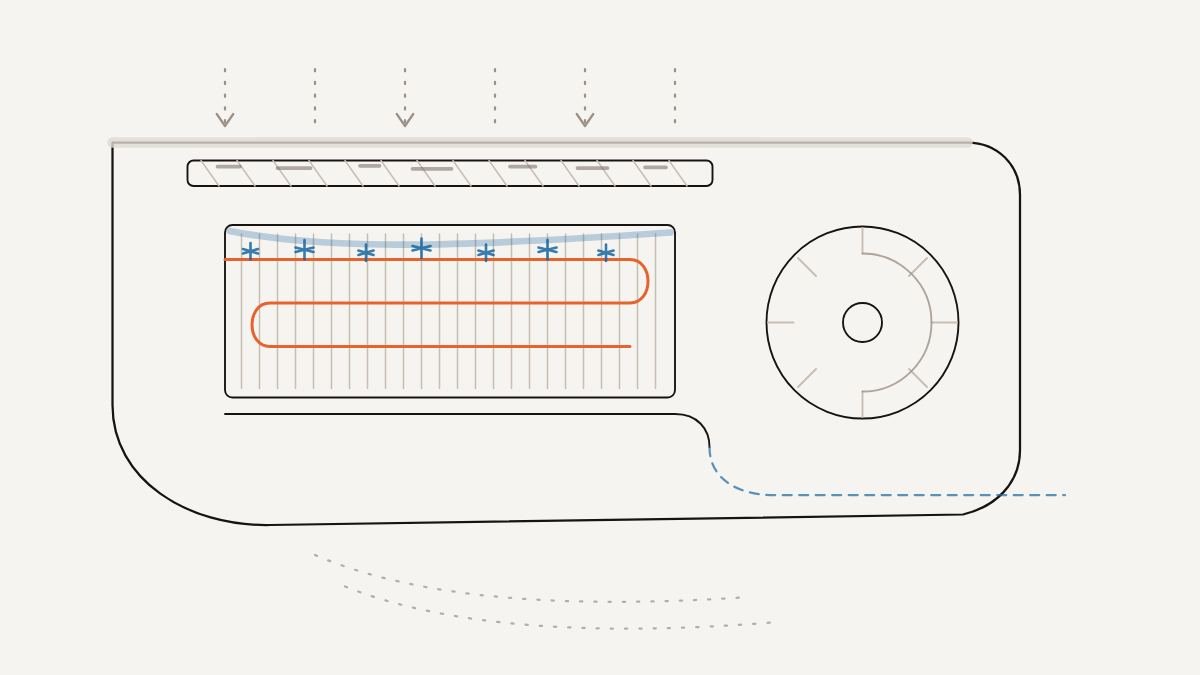
Cooling makes water. When warm room air crosses a cold indoor coil, moisture in that air turns back into liquid, exactly as it does on a cold glass.
That liquid has to go somewhere. So every wall head, window box and ducted unit carries a built in path that moves the water out of the building.
A leak indoors means that path has failed. Water still forms as usual, but instead of leaving the house it runs down the back of the case and onto your wall.
Condensate in plain English
Technicians call that water condensate. It is simply moisture pulled out of your indoor air, and on a sticky day one room head makes a surprising amount of it.
The drain pan under the coil
Under the coil sits a shallow tray, often called the drain pan. Water drips off the cold fins and gathers at one low corner of it.
The tray only ever holds a moment of water, so it stays deliberately shallow. Because of that, even a thin layer of sludge can push water over the front lip and into the room.
The drain line and where it ends
From the low corner of the tray, a flexible hose runs out through the wall. That hose is the drain line, and it usually finishes near the outdoor unit or above a garden bed.
Since one hose serves the whole path, a fault can show as water indoors or as puddles outdoors. Our guide to water leaking outside around the outdoor unit covers that second pattern.
How a Kelvinator indoor unit is meant to stay dry
On most wall mounted models nothing in the drain path uses electricity. Gravity does the entire job, quietly, for years at a time.
The path water takes on a normal day
Air enters the top of the indoor unit, passes the filters and meets the cold coil. Moisture condenses on the fins, then runs downward under its own weight.
Fall, the gentle slope that does the work
Fall is the trade word for slope. A drain line needs a continuous downhill run from the tray to its outlet, with no rising sections along the way.
If a section sags or lifts, water sits in the dip instead of moving on. Over months that standing water breeds slime, and the slime closes the pipe completely.
When a small pump joins in
Some installations cannot achieve natural fall, for example a head fitted low on an internal wall. A small condensate pump then lifts the water until gravity takes over.
A pump adds two more failure points, the motor itself and the float switch that starts it. So a system with a pump needs an electrical check as well as a drain check.
The words owners use for the same fault
People describe this problem in many ways. Every version lands on the same short list of causes.
Some report a Kelvinator air conditioner leaking water indoor unit fault. Others say the Kelvinator aircon leaking water indoor unit drips only late at night, once the room has cooled.
Plenty write it as Kelvinator split system water leaking from indoor unit, or as a Kelvinator air conditioner water leaking from indoor unit. All of those describe one condensate path.
The phrase Kelvinator aircon water leaking from indoor unit tells us where to look first, and that alone is enough to begin. Meanwhile a Kelvinator split system leaking water indoor unit report gets identical first checks.
Dripping compared with running water
A Kelvinator air conditioner dripping water inside behaves differently from a steady run down the wall. Drips point at moisture forming on the case, while a run points at a tray that has overflowed.
A Kelvinator aircon dripping water inside from the louvres often means dirty fins, because moisture blows off dust rather than draining away. Therefore a deep clean sometimes ends the problem.
A Kelvinator split system dripping water inside only in muggy weather may sit at the limit of its drain capacity. Even so, a sagging hose is more likely.
The same fault across different models
A Kelvinator reverse cycle leaking water inside acts exactly like a cooling only model while it cools. Heating mode sends the condensate outdoors instead, which is why the drip belongs to summer.
A Kelvinator inverter leaking water inside often runs long, gentle cycles, so its tray stays wet almost constantly. Meanwhile a Kelvinator window air conditioner leaking water inside usually means the case has lost its slight tilt.
A Kelvinator wall unit leaking water inside points straight at the tray or the hose behind the casing. In every model the water begins in the same place, on the coil.
What water inside does to a home
We treat this fault as urgent, and the puddle is not the reason. It is what the water does quietly, inside materials you cannot see.
Plaster, cornice and paint
Plasterboard drinks water and loses strength as it does so. A stain that looks cosmetic this week can become a soft, crumbling patch that needs cutting out.
Floors, carpet and skirting boards
Water reaches the floor junction next. Timber boards cup, laminate edges puff up, and underlay stays damp for weeks.
Skirting boards suffer worst, since they sit where the water lands. So pull rugs and furniture clear of that wall as soon as you spot a leak.
Power points and cables below the unit
Indoor heads often sit above a light switch, a power point or a wall mounted television. Water tracking down that wall can reach live terminals, and that is a genuine electrical hazard.
If water has reached an outlet or an appliance, switch that circuit off at the switchboard and keep everyone clear. Then call an electrician or our team before anyone uses the outlet again.
Mould, smell and indoor air
Damp wall cavities grow mould within days in warm weather. Once mould takes hold behind the sheeting, the smell returns every time the room warms up.
The unit then blows air across a wet tray and spreads spores. As a result a small drain fault becomes an air quality problem for the whole family.
Talk it through with a technician
Tell us the model and what the unit is doing, and we will bring the right parts to the first visit.
The causes, most common first
The list of causes is genuinely short. Working through it in order saves hours, whether you handle the simple checks or we do.
A blocked drain line
This leads the field by a wide margin. Dust, mould and insect nests build a plug inside the hose, water backs up into the tray, and the tray spills into the room.
A blocked line often leaks only under heavy load. So a Kelvinator split system leaking water inside on a scorching afternoon fits this pattern well.
Choked filters and an iced coil
Dirty filters starve the coil of airflow, and a starved coil drops below freezing. Ice then builds across the fins instead of water running off them.
When the unit stops, all that ice melts at once and swamps the tray. If you see frost on the fins, read our guide to a frozen coil that has iced up first.
Sludge sitting in the drain pan
Trays collect the fine dust that slips past a filter edge. Mixed with condensate, that dust becomes a soft sludge which blocks the outlet and holds water against the tray wall.
A hose that has lifted, kinked or sagged
Furniture, a cupboard or a curtain rail can press the hose upward behind the unit. Even a small rise creates a trap where water lingers and slime forms.
Pump or float switch failure
Where a pump lifts the condensate, a dead pump fills the tray within minutes. A float switch should cut the system before that point arrives.
When the float works properly, the unit stops rather than leaking. That can look like a system that will not turn on, so a dead unit and a wet wall often share one root cause.
Stopping the leak safely, step by step
There is a safe owner level sequence. It stops well short of the wiring and the refrigerant circuit, and each step rules out the one before it.
That sequence covers everything an owner can safely do on a Kelvinator leaking water inside. Troubleshooting past that point involves the tray beneath a live coil, the pump wiring or the sealed refrigerant circuit.
Owners understandably want one quick answer. In truth it depends on which part of the drain path gave up, so the checks above matter.
The lasting repair is a clear drain with proper fall and a clean tray. A towel on the floor only buys you time while the plaster keeps drinking.
Turn the system off at the remote, then switch it off at the wall isolator. Water and live parts must never meet.
Catch what is falling. Slide a shallow tray or a folded towel under the unit and pull furniture clear of the wall.
Dry the wall, the skirting and the floor properly, then wipe the surface. After that you can tell whether fresh water arrives later.
Open the front cover and lift out the filters. Look for a grey felt of dust, and check the fins behind them for frost or ice.
Wash the filters in cool water and dry them fully before refitting. Damp filters drip on their own and confuse the diagnosis.
Find the outdoor end of the drain hose. Watch it while the system runs, since a healthy line trickles steadily on a humid day.
If nothing at all leaves that hose, write it down. That single observation points a technician straight at a blockage.
Look along the hose for kinks, sagging loops or a lifted section, and gently free anything pressing against it.
Run the unit briefly and watch the wall. If water returns, shut the system down and book a visit rather than mopping again.
Common misunderstandings about a Kelvinator aircon leaking water inside
The water is almost never refrigerant
Refrigerant is a gas held under pressure, and it does not pool on your floor. When it escapes it hisses away into the air rather than running down the plaster.
So clear water beneath a Kelvinator ac leaking water inside is condensate in almost every case. That is reassuring, because drain faults cost far less to correct than a sealed system leak.
Dripping at a ceiling vent is a different problem
Ducted owners sometimes find beads forming at a ceiling outlet instead of at a wall head. That belongs to the water dripping from vents family, and it usually involves duct insulation rather than a tray.
The two faults can appear in one house at once. Even so, they need different tests, so say exactly where the water shows up when you call us.
Your filter clean did not break anything
Many people notice the first drips soon after a filter clean and assume they caused it. In truth the clean restored airflow and exposed a drain problem that already existed.
A quiet unit can still be leaking
Most drain faults raise no alarm whatsoever. Your wall head can run smoothly, cool the room beautifully and still send water down the plaster behind it.
Some displays do flag an indoor leak. Error codes such as D1 point at a float switch, and our separate guide walks through that code. Yet plenty of leaks never produce any code at all.
When a licensed technician has to take over
Australian law draws firm lines around this work, and those lines protect you. Once the job moves past filters and a visible hose, it belongs to a qualified person.
Anything behind the electrical cover
The indoor unit carries mains voltage at its terminal block, control board and fan motor. Water near those parts turns an already dangerous area into a serious risk.
So never open the electrical cover, and never dry a circuit board with a heat gun. Leave that side of the unit closed until a technician arrives.
Refrigerant and coil work
If ice keeps forming, the fault may sit in the refrigerant charge rather than the drain. Handling refrigerant requires a licence, proper gauges and recovery equipment.
A technician measures system pressures and pipe temperatures to judge the charge. Guesswork with a hardware store can of gas wrecks compressors and breaks the law.
Clearing and correcting the drain line
We clear a blocked line with regulated nitrogen, a wet vacuum or a purpose made drain pump. Household tricks such as blowing hard into the hose usually drive the plug further in.
Correcting fall is larger work again. It can mean lifting the indoor head off its bracket, adjusting the bracket and resetting the pipe run through the wall.
Pumps, float switches and sensors
A condensate pump is a wired appliance with a float and a small motor. Swapping one counts as electrical work, and matching it to the drainage logic matters.
Where a display shows a drainage fault, a technician tests the float switch rather than simply clearing the code. Otherwise the same message returns within days.
What a technician checks on a Kelvinator leaking water inside repair
A methodical visit follows the water backwards. It begins at the wet patch on your wall and finishes at whichever component stopped doing its job.
Sweating pipe work deserves its own mention. Where insulation has slipped, cold copper gathers condensation and drips inside the cavity, which imitates a drain fault almost perfectly.
- The wall, skirting and floor, to map how far the water has travelled and what it has soaked.
- Bracket level across the indoor head, measured with a spirit level.
- The tray, its outlet and the first stretch of hose, for sludge and biological growth.
- Flow at the outdoor end of the drain, with the system running under real load.
- Any condensate pump and float switch, where the installation includes them.
- Fault codes on the display, which narrow the search before tools come out.
What drives the cost of putting it right
Owners want one clean number for a leaking Kelvinator unit. Prices depend on what the technician finds behind the casing, so honest tradespeople will not quote before seeing the unit.
Several factors move the figure up or down. A simple line clear on an easy wall head sits at one end, while lifting a unit to reset pipe work sits at the other.
Our guide to pricing explains how we structure a visit and what a written quote includes. The figure always follows the diagnosis, never the reverse.
- Whether the blockage clears from the outdoor end or needs the indoor casing off.
- The height and position of the head, since ladders and tight cupboards slow everything down.
- Whether a pump, float switch or drain sensor needs replacing on the day.
- The coil condition, since a chemical clean may go with the drain clear.
- Whether the leak reached plaster or flooring that other trades must make good.
Help across Australia when water appears indoors
Humidity decides how often we meet an indoor leak like this. Australia is wide enough that the pattern shifts from the coast to the inland towns.
Subtropical air is harder on drains. We take plenty of calls about a Kelvinator air conditioner leaking water inside. Brisbane homes often have a line that coped all winter and gave up in one humid week.
Older housing stock and rendered walls shape the picture further south. Much of that work involves water appearing inside the room. Sydney owners often describe a hose that has sagged behind a wall it cannot escape.
Cooler weather grants no immunity from an indoor leak. Melbourne apartment residents often report a long shared drain line serving several units in one riser.
Finding a technician nearby is a sensible first move. Look for a licence, clear written quoting and a workmanship guarantee written in plain language.
Ask about licences before anyone starts work on a Kelvinator leaking water inside. Technicians should give you a number without hesitating, and the quote should say whether clearing the line and cleaning the tray are both included.
Questions owners ask when water shows up indoors
Why is water running down the wall under the indoor head?
In most homes the drain line has blocked, so condensate backs up and spills out of the tray. Dirty filters, an iced coil, a sagging hose or a failed pump explain nearly all of the rest.
Therefore start with the filters and the outdoor drain outlet before assuming the worst.
Why is my Kelvinator aircon leaking water inside only on humid days?
Humid air produces far more condensate, so a partly blocked line copes in mild weather and fails in sticky weather. The blockage existed already, and the humidity simply revealed it.
Treat it as an early warning, because once the line clogs fully the leak arrives every time the unit runs.
What should I do the moment water appears?
Switch the unit off at the wall, catch the water and move furniture away from the wall. Then dry the surfaces so you can see whether more water arrives.
After that, check the filters and watch for flow at the outdoor drain outlet.
How to fix an indoor Kelvinator leak after power outages?
Start by drying everything, since the timing is usually a coincidence rather than a cause. A pump equipped system is the exception, because the tray fills while the power stays off.
Some units also restart in a different mode and run longer than before. As a result an existing blockage finally shows itself, and the line needs clearing.
Why is my unit leaking indoors after cleaning filters?
Almost never because of anything you did. A clean filter restores airflow, the coil produces more condensate, and a marginal drain line finally gives way.
Refitting damp filters can cause a short lived drip as well. So dry them completely, refit them and watch the wall for an hour before you worry.
What to do when the leak appears in summer?
Treat it as a drain job rather than a heat problem, because summer simply multiplies the water the coil makes. A drain that managed a trickle in spring now handles a steady stream.
Meanwhile the season loads the coil with dust and pollen. Because both happen together, summer brings most of the indoor leaks we attend.
What does a drainage code on the display tell me?
Some models show a drainage related code, such as D1 on certain displays, when a float switch senses a high water level. That code narrows the search to the tray, the pump or the line.
Clearing the code without clearing the cause achieves nothing, so treat it as a pointer and pass it on when you book.
How much does an indoor leak repair cost?
The figure depends on access, on the cause and on whether parts such as a pump need replacing. A straightforward drain clear sits at the light end of the scale.
We quote after the diagnosis, so the number reflects the real job. In addition, we flag when wall or floor repairs need a separate trade.
Putting the leak behind you
Water on the wall under an indoor head is a drainage message, not a mystery. The coil makes condensate, something stops it leaving, and your plaster pays the price.
Act early and the fix stays small. Leave it running and the same fault reaches skirting, flooring and wiring.
When you are ready, you can book a service visit and tell us where the water appears. Our technicians work on Kelvinator systems every week, and a drain fault caught early rarely becomes an expensive one.
Browse the site
Book a technician
Speak to a qualified technician who works on Kelvinator systems
Call 1300 495 033 and tell us the model and the fault, or book online and we will come back to you.