Services
Kelvinator Air Conditioner Repairs, Repair or Replace
Your Kelvinator has stopped doing its job, and you now face a choice. Do you pay for Kelvinator air conditioner repairs, or put that money toward a replacement unit?
That choice feels harder than it should. Owners rarely know which faults are quick to put right, and which ones signal a system near the end of its working life.
So this page lays out a decision ladder. Work down it in order, and by the end you will know which rung your own unit sits on.
Because the ladder follows the same logic our technicians use, you can also follow the reasoning behind any advice you receive. That makes the final call yours rather than ours.
We are specialists in Kelvinator air conditioners and we work independently of the brand.
On this page
- What the word repair actually covers
- The decision path for Kelvinator air conditioner repairs
- Branch one, faults you can rule out without a technician
- Branch two, a single component repair
- Branch three, refrigerant and sealed system faults
- Branch four, control boards and electronics
- Branch five, when replacement makes more sense
- Step four in detail, what happens at a diagnosis visit
- What to have ready before the technician arrives
- What drives the cost of a repair
- How to judge cheap work against genuinely good value
- What a good outcome looks like
- Where we cover Kelvinator air conditioner repairs, Sydney to Darwin
- Finding a local technician near you
- Questions owners ask before booking
- Bringing the decision together
What the word repair actually covers
A repair puts a failed part back into working order. Servicing keeps a healthy system healthy, so the two jobs sit at different points in the life of a unit.
This work goes by many different names. Some owners call it Kelvinator aircon repairs, others call it Kelvinator ac repair, and a few ask for a Kelvinator air conditioner repairman by name.
All of those searches land on the same work. Whether you call it Kelvinator air conditioning repairs or something shorter, a technician still has to find the fault first.
Plenty of owners simply ask us to fix Kelvinator air conditioner faults without naming a part. That is fine, because the diagnosis names the part for them.
We work on these systems as a specialist business. Kelvinator makes the appliance, while our team diagnoses, mends and maintains it for the owner.
A technician can repair Kelvinator air conditioner models of most ages, although parts supply narrows with time. So age matters more than the badge once a system passes its first decade.
There are a handful of terms worth knowing before you read further.
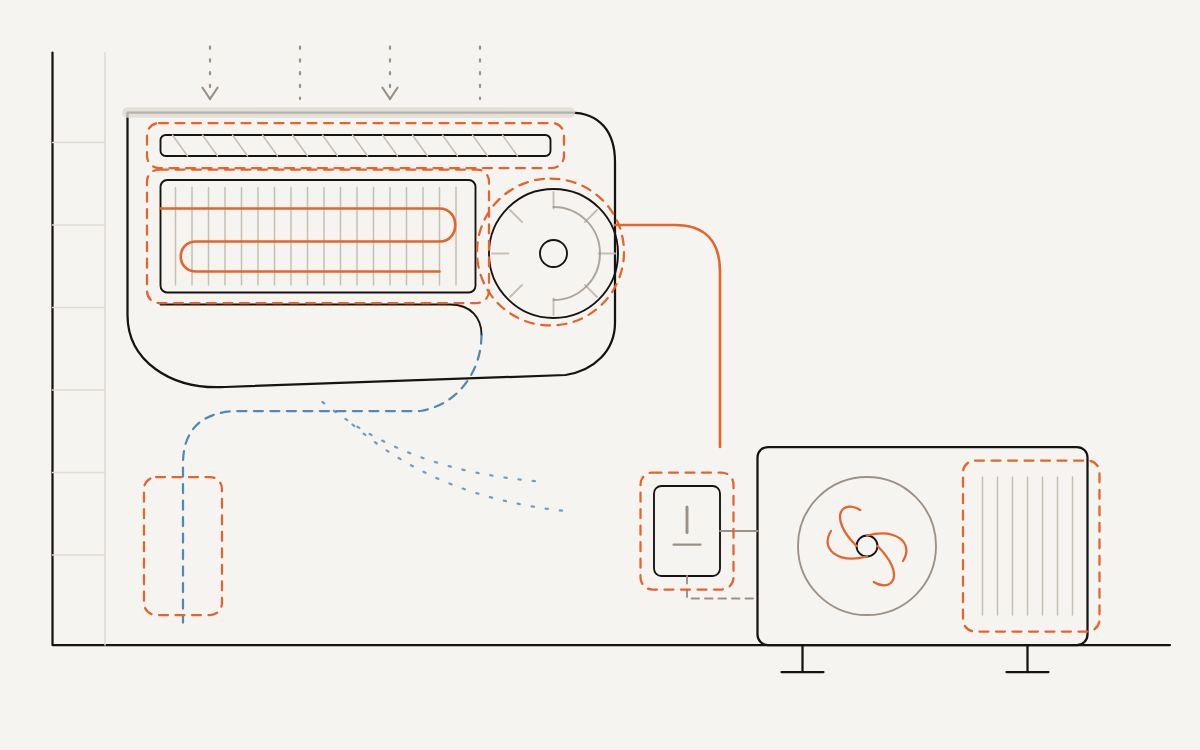
- Split system. An indoor head on the wall, joined by pipes to an outdoor compressor unit.
- Reverse cycle. A system that both cools and heats, because it can run the refrigerant cycle in either direction.
- Refrigerant. The gas that carries heat out of your room, sealed inside copper pipework.
- Capacitor. A small electrical part that gives motors the push they need to start turning.
- Control board. The electronics that read the sensors and then tell the rest of the system what to do.
- Ducted system. One central unit that feeds several rooms through vents in the ceiling or floor.
The decision path for Kelvinator air conditioner repairs
Work through the following steps in order. Each one either solves the problem outright or hands you a sharper question for the step that follows.
Most owners reach a clear answer by step four. However, older systems with several tired components push the question into step five, where the sums start to matter.
Each rung below gets its own section. Read the one that matches your symptom, since the branches rarely overlap.
Keep a short written record as you go. A note of the date, the symptom and the weather helps more than any memory does a fortnight later.
Check the simple things first. Confirm power at the switchboard, fresh batteries in the remote and a filter that is not choked with dust.
Note the symptom precisely. Write down whether the unit runs without cooling, trips the power, leaks water or shows an error code.
Decide whether the fault is safe for you to touch. Anything behind a cover, near a terminal or inside the outdoor cabinet belongs to a technician.
Book a diagnosis. A licensed technician tests the system, finds the failed part and then explains what the work involves.
Weigh the mend against the age and condition of the unit. Then choose between a single fix, a staged plan or a full replacement.
Branch one, faults you can rule out without a technician
Plenty of callouts end with a filter, a remote setting or a tripped safety switch. So spend a few minutes here before you book anything at all.
Slide out the front filters and rinse them under a tap. Let them dry fully, because a damp filter breeds mould and blocks airflow just as badly as a dusty one.
Then check the mode and the set temperature. A unit sitting in fan mode moves air without cooling it, and that single setting explains a surprising number of complaints.
Look outside as well. Leaves, garden waste and a stray pot plant pressed against the outdoor unit all starve it of the airflow it needs.
Check the drain outlet if you see water indoors. A blocked drain line often shows itself as drips down the wall below the indoor head.
Give the remote a fair test before you blame the unit. Fresh batteries and a clear line of sight rule out a fault that costs nothing to put right.
Reset a tripped safety switch once, and once only. If it trips again straight away, leave it off and call someone, because that pattern means a genuine electrical fault.
If those checks bring back normal running, you have saved yourself a callout. Regular servicing and maintenance keeps most of these small problems from coming back.
Branch two, a single component repair
This branch covers the most common paid work we do. A fan motor, a capacitor, a thermistor or a contactor fails, while the rest of the system remains sound.
Symptoms here tend to be specific rather than vague. The outdoor fan sits still while the compressor hums, or the indoor unit starts and stops in a short cycle.
Sometimes a bearing gives you warning. A grinding noise from the indoor head often means the fan barrel needs attention before it seizes completely.
Because our vans carry the common parts, our team can often finish this kind of work in a single visit. That is where a good Kelvinator repair service earns its keep.
Noise and behaviour together narrow the search. A unit that trips the breaker the moment the compressor starts points at a very different part than one that simply runs warm.
Sometimes the sensible move is to mend rather than replace. These systems hold their value well when the sealed circuit stays sound and only a small part has failed.
Ask the technician to show you the old part. A swollen capacitor or a seized bearing tells its own story, and seeing it makes the invoice easier to trust.
Branch three, refrigerant and sealed system faults
Refrigerant does not get used up over time. If the charge runs low, a leak exists somewhere in the pipework, the coil or a brazed joint.
So topping up without finding the leak wastes your money. A technician traces the leak first, mends the joint or coil, then recharges the system and checks the pressures.
These jobs take longer than a simple component swap. They also demand handling licences, which is one strong reason to insist on a properly licensed trade.
Where the leak sits inside the indoor coil, the sums change. Replacing a coil on an ageing unit sometimes costs more than the remaining life of that system justifies.
Leak detection uses several methods. A technician may use an electronic sniffer, a soap solution or a dye, depending on where the loss seems to sit.
After a leak repair, expect a period of testing. The technician holds pressure in the pipework, watches for a drop and only then puts the charge back by weight.
A compressor failure sits at the far end of this branch. Since the compressor is the single most expensive component, its failure often tips an older unit toward replacement.
Talk it through with a technician
Tell us the model and what the unit is doing, and we will bring the right parts to the first visit.
Branch four, control boards and electronics
Modern Kelvinator systems rely on a control board in each unit. When that board fails, the symptoms look random, and the unit may flash an error code instead of running.
Boards rarely fail for no reason. Power surges, water ingress and sustained heat all shorten their life, so a technician looks for the cause before fitting a new one.
Sensors sit in the same family of faults. A thermistor reading the wrong temperature can make a healthy system behave as though something serious has gone wrong.
Error codes give useful clues, though they rarely name the culprit outright. A code tells the technician which circuit complained, and the testing then follows from there.
Write the code down exactly as the display shows it. One character changes the meaning entirely, and a wrong note sends the diagnosis down the wrong path.
Surge protection helps more than most owners expect. Because a single storm can take out a board, a protected circuit quietly earns its keep over the years.
Parts availability decides this branch. While boards remain available for most current models, an older system can leave you waiting or looking at a replacement instead.
Branch five, when replacement makes more sense
Some units reach a point where further spending stops adding up. A very old system, a failed compressor and a corroded outdoor cabinet together point in one direction.
Consider the pattern rather than the single fault. Three separate callouts across two seasons tell you far more than any one part failure ever will.
Efficiency belongs in the calculation too. An ageing unit works harder for the same result, so the running cost climbs quietly while you keep paying for parts.
Think about how the room actually gets used now. A unit chosen for a smaller household may simply be too small for the way you live today.
Noise counts as well. A system that once ran quietly and now dominates the room has usually lost bearings, mounts or fan balance somewhere along the way.
Timing matters too. Replacing a struggling system before peak summer gives you a calmer choice than replacing it after a total failure in January heat.
If replacement wins the argument, plan it properly. Our guides on removal and replacement and on a fresh installation explain how the changeover runs.
Step four in detail, what happens at a diagnosis visit
The diagnosis is the hinge of the whole ladder. Without it you are guessing, and guesses lead to parts that were never faulty in the first place.
A technician starts with your description. Then the checks move from the outside in, covering power supply, airflow, electrical readings and refrigerant pressures.
Good diagnosis takes patience with intermittent faults. A unit that only misbehaves after an hour of running needs an hour of running before anyone can judge it.
Access shapes the visit as well. Clearing furniture, pets and stored boxes away from both units lets the technician work safely and finish sooner.
Ask questions while the covers are off. That is the one moment when you can see the parts, hear the readings and understand what the technician means.
At the end you get an explanation in plain language. You should hear what failed, why it failed and what your realistic options are from here.
What to have ready before the technician arrives
A little preparation shortens the visit and sharpens the answer. None of it takes more than ten minutes on the morning of the appointment.
Gather the details below and leave them somewhere obvious. Then the technician can spend the time on the fault rather than on questions.
Old paperwork helps as well. A previous invoice tells the technician which parts already went in, so nobody chases a fault that someone else has fixed.
- The model number from the sticker on the indoor head or the outdoor cabinet.
- The approximate age of the system, or the year the previous owner had it fitted.
- Any error code, along with the moment in the cycle when it appears.
- A note of recent work, including filter cleans, power outages and storms.
- Clear access to both units, with furniture, bins and garden growth moved aside.
- Somewhere safe for pets to wait while doors and windows stay open.
What drives the cost of a repair
We never name a figure before seeing the unit, because one symptom can have several causes. Still, you can predict roughly where your own job will sit.
Several practical factors shape the final bill. Each one shifts the amount of work involved rather than the value of any single part.
Access, parts and timing together set what you pay for Kelvinator air conditioner repairs. Prices move with all three, so two similar faults can land in quite different places.
Our pricing guide explains how we structure a job. It sets out the variables honestly, rather than pretending every fault costs the same.
Always ask for the scope in writing before you approve Kelvinator air conditioner repairs. Quotes should name the fault, the part, the labour and any return visit.
Ask whether the diagnosis fee forms part of the final bill. Practices differ between businesses, and one short question saves an awkward conversation later.
- The failed part. A capacitor is a small item, while a compressor sits at the heart of the system.
- Access. A ground floor split system takes less time than a rooftop unit or a ducted fan in a tight roof space.
- Diagnosis time. Intermittent faults take longer to pin down than a unit that fails every single time.
- Parts supply. Common components ride on the van, while rarer boards come on order from a supplier.
- Timing. An urgent same day callout costs more than a booking arranged a few days ahead.
- System type. Ducted and multi head systems carry more components than a single wall mounted head.
How to judge cheap work against genuinely good value
A bargain price sometimes costs more over the long run. A quick top up of refrigerant without a leak search buys a few weeks, then leaves you back where you started.
The better outcomes share a few simple traits. The technician explains the fault in plain terms, shows you the failed part and stands behind the work afterwards.
Look for a workmanship guarantee in writing. That guarantee comes from us, and it sits separate from the Kelvinator warranty, which the manufacturer handles.
Customer feedback helps, so long as you read it properly. Look for comments about diagnosis, tidiness and follow up rather than star counts alone.
Licences matter just as much as reputation. Ask which ones the technician holds for refrigerant and electrical work, and a good one will answer without hesitation.
Be wary of anyone who names a fault before looking at the unit. Confident guessing over the phone tends to end with parts you did not need.
What a good outcome looks like
A finished job should leave you in no doubt. The unit reaches the set temperature, the airflow feels strong and the outdoor fan runs without rattles or screeches.
You should also finish the visit better informed than you started. A technician who explains why the part failed helps you avoid the same fault next season.
Paperwork completes the picture. You want a record of the fault, the part fitted and any advice about the remaining life of your system.
Finally, a good outcome includes a plan. Whether that means yearly servicing or saving toward a replacement, you should leave the visit knowing what comes next.
Test the system yourself before the technician leaves. Run it in both cooling and heating, then let it settle for a while and check the airflow again.
Keep the paperwork somewhere sensible. A short history makes the next diagnosis faster, and it also helps when you eventually sell the home.
Quiet running matters as much as cold air. If the unit cools well but now hums louder than before, say so while the technician is still on site.
Where we cover Kelvinator air conditioner repairs, Sydney to Darwin
Our team works right across the mainland and beyond. The process stays the same everywhere, although local conditions shape the faults we see most.
Weather writes the fault list in each region. So the notes below tell you what your own climate tends to do to a system.
In Victoria the phones wake up with the first real hot spell. That week brings a rush of professional Kelvinator air conditioner repairs. Melbourne households ring as soon as a tired unit gives up.
Humid air changes the mix of qualified Kelvinator air conditioner repairs. Brisbane callouts lean toward blocked drains, mould and water where nobody wants it.
Fine dust travels a long way in the west. It works into the fins and drives another group of mobile Kelvinator air conditioner repairs. Perth homes often need a coil wash as well as a part.
Ducted systems in older housing fill much of our diary for licensed Kelvinator air conditioner repairs. Adelaide owners ask about roof space access more than anyone else.
Salt air ages an outdoor cabinet quickly. That alone brings forward plenty of Kelvinator air conditioner repairs. Gold Coast homes near the water lead that particular list.
Owners quite reasonably want the best Kelvinator air conditioner repairs. Canberra households ask us that question every autumn, since reverse cycle heating carries them through winter.
Coastal weather explains another cluster of Kelvinator air conditioner repairs. Newcastle owners watch outdoor coils age faster than inland homes ever do.
Nobody wants to pay twice for cheap Kelvinator air conditioner repairs. Hobart owners often ask how to tell a bargain from a false economy.
Constant cooling load shapes the far northern share of Kelvinator air conditioner repairs. Darwin systems run almost year round, so wear arrives sooner than it does further south.
Finding a local technician near you
A list of local Kelvinator air conditioner repairers is easy to find on a phone, and it is usually very long. A nearby technician reaches you sooner and returns more easily.
We run a mobile trade, which simply means the workshop travels to you. Since almost all air conditioning work happens on site, that is the normal way this trade operates.
Distance still shapes what we can promise. A technician already working in your suburb can often add a call, whereas a remote property needs planning around the travel.
Ask any business where its technicians actually live. If the answer is a city three hours away, a return visit for a warranty part becomes a slow business.
Questions owners ask before booking
How do I arrange a visit?
Send us the model number, the symptom and any error code showing on the display. Then you can book Kelvinator air conditioner repairs. Same day slots depend on demand and travel, so call early rather than late.
Can I arrange Kelvinator air conditioner repairs online?
Yes, and the enquiry form asks for your details and the symptom. It gathers the same information a phone call would. A technician then confirms the appointment with you directly.
What counts as an emergency?
Some faults will not wait for Kelvinator air conditioner repairs. Emergency work covers sparks, smoke, burning smells and water running into a ceiling. A fault that is merely uncomfortable usually costs less on a normal booking.
Is it safe to fix a fault myself?
Cleaning filters, clearing the outdoor unit and resetting a tripped breaker are all safe tasks. Anything beyond that involves live electrical parts or refrigerant under pressure, so leave it alone. A qualified technician carries the tools and the licences for the rest.
How long does the work usually take?
A straightforward component swap often finishes in the same visit as the diagnosis. Leak work and board replacements run longer, because testing and recharging both add time. We give you a likely duration once the diagnosis finishes.
What should a written quote include?
It should name the fault, the part, the labour involved and any return visit. Ask whether it covers the diagnosis itself, since practices vary between businesses. A clear scope prevents awkward surprises later on.
Do you guarantee the work?
Yes, our workmanship carries our own guarantee, and we put the terms in writing. That sits separate from any manufacturer cover on the appliance itself. Keep both records together, because the two answer different questions.
How do I decide between fixing and replacing?
Weigh the age of the system, the cost of the part and the history of previous faults. One failure on a young unit rarely justifies a new system. Three failures on an old one usually do.
Bringing the decision together
The ladder gives you a route through a stressful choice. Check the simple things, get a proper diagnosis, then weigh the work against the age of the unit.
Most faults sit in the middle branches, where one part restores full performance. Only a minority of systems truly earn a replacement, and the pattern of failures usually makes that obvious.
So if you want Kelvinator air conditioner repairs today, get in touch early and describe the symptom clearly. We will tell you what we think before you commit to anything.
Whatever branch you land on, write the symptom down while it is fresh. Clear notes shorten the diagnosis, and a shorter diagnosis keeps the whole job simpler.
If the unit still runs, use the time well. Read our servicing guide, because prevention costs far less effort than a breakdown in the middle of summer.
Browse the site
Book a technician
Speak to a qualified technician who works on Kelvinator systems
Call 1300 495 033 and tell us the model and the fault, or book online and we will come back to you.