Services
Emergency Kelvinator Air Conditioner Repairs
Tips can wait until the room is bearable again. The unit has cut out mid cycle, the fan is doing nothing useful and the temperature keeps climbing.
So this is the moment for emergency Kelvinator air conditioner repairs. Same day attendance exists for exactly that, because waiting until next week is not an option.
Before you call anyone, a few minutes of calm checking changes the outcome. It tells you whether this is a five minute fix or a real fault, and it tells the technician what to load into the van.
What follows is a full breakdown checklist, written so you can work through it in order. Nothing here asks you to open a sealed panel or touch wiring.
On this page
- Why a checklist beats guesswork when the unit stops
- What counts as a genuine air conditioning emergency
- The ten step checklist to work through first
- Working through the power and reset steps safely
- What the indoor unit is telling you
- What to look for at the outdoor unit
- Which checklist items need a licensed technician
- How an emergency callout runs from the first phone call
- How urgent calls get sorted when several land at once
- Preparing the home before the technician arrives
- If you rent or live in a strata building
- Parts, availability and the two visit repair
- What usually fails when a system stops without warning
- What a technician actually tests on arrival
- What drives the cost of urgent work
- Record keeping and the follow up that prevents a repeat
- Where we carry out emergency Kelvinator air conditioner repairs
- Choosing a technician you can trust at short notice
- Frequently asked questions about urgent breakdowns
- Book an urgent Kelvinator repair today
Why a checklist beats guesswork when the unit stops
Panic makes people do two unhelpful things. They either flick the same button twenty times, or they book a callout for something a reset would have cleared in a minute.
A checklist stops both. It also gives you a clear description of the fault. That matters when a technician is triaging several urgent air conditioner repair jobs at once.
Because emergency work runs on limited daily slots, the calls with clear symptoms usually get scheduled first. If you can say the outdoor fan spins but the compressor never starts, that beats saying it broke.
There is a second benefit. Working the list often reveals a blocked filter or a tripped safety switch. So you avoid an urgent aircon repair fee for a problem you could clear yourself.
What counts as a genuine air conditioning emergency
Not every fault needs a technician today. Some do, and telling the two apart protects both your budget and your safety.
Treat it as urgent when there is smoke, a burning smell, a repeated breaker trip or loud grinding outside. Water pouring through a ceiling belongs on that list too. In those cases, switch off at the isolator and call for urgent help straight away.
Treat it as urgent when a vulnerable person depends on the cooling. Infants, elderly residents and anyone with a heart or respiratory condition should not sit through a hot night without a working system.
Everything else can usually wait for a booked visit. Weak airflow, a noisy fan bearing or a slow drip into the tray still needs attention. However, a same day aircon service the following morning is often the sensible call.
The ten step checklist to work through first
Work through these ten items in order and stop at the first one that reveals the fault. Each step is safe for an owner to do without tools beyond a torch and a step stool.
Confirm the power supply. Check the wall switch, the isolator near the outdoor unit and the switchboard for a breaker that has flicked off.
Reset the system properly. Turn it off at the isolator, wait several minutes, then restore power and try again from the remote.
Check the remote batteries. A dying remote sends weak signals, so the unit responds late or ignores commands entirely.
Read any error code. Note the exact characters flashing on the indoor display or the blinking pattern of the status lights.
Check the mode and setpoint. A system left in fan mode or set above room temperature will run without cooling anything.
Inspect the filters. Slide out the indoor filters and hold them to the light, because a clogged filter starves airflow and triggers shutdowns.
Look at the indoor coil. Frost or a sheet of ice across the fins points to airflow loss or low refrigerant charge.
Check the drain and tray. Water dripping from the indoor unit usually means the condensate line has blocked and backed up.
Clear the outdoor unit. Remove leaves, bark, boxes and garden growth from within half a metre of the coil and fan.
Listen and record. Note whether the outdoor fan turns, whether the compressor hums, and how long the unit runs before it stops.
Working through the power and reset steps safely
Most sudden stoppages trace back to power rather than to a failed part. So the first three items on the list clear a surprising share of calls before anyone books a technician.
Find the isolator switch first. It usually sits on the wall beside the outdoor unit inside a small weatherproof box, and it cuts power to the whole system.
If the breaker at the switchboard trips again the moment you reset it, stop there. A repeat trip signals a short or an earth fault, and that needs a licensed emergency aircon technician rather than another attempt.
When the reset works and the unit runs normally, you have probably had a momentary supply issue. Still, keep an eye on it for a day, because a fault that clears once often returns.
What the indoor unit is telling you
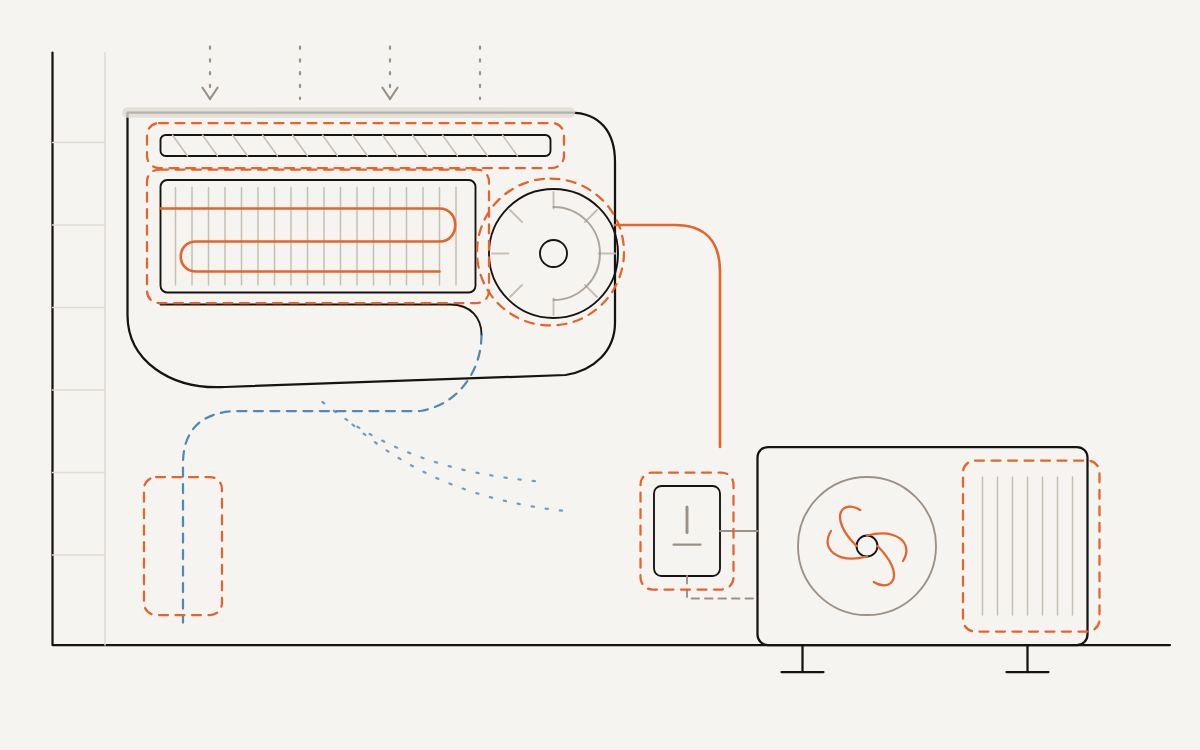
The indoor head carries most of the diagnostic clues. Error codes, ice, smells and drips all point in different directions, and each narrows the job before a van leaves the depot.
Write the error code down exactly as it appears. Codes differ between models and generations, so a photograph of the display gives our technician far more than a rough description over the phone.
Ice on the coil means airflow has dropped or refrigerant has leaked away. Turn the system to fan only for an hour to thaw it, then check the filters again before you run cooling.
A musty smell on startup usually points to biological growth on the coil and drain tray rather than a mechanical fault. That calls for a deep clean and sanitisation instead of an urgent breakdown callout.
Talk it through with a technician
Tell us the model and what the unit is doing, and we will bring the right parts to the first visit.
What to look for at the outdoor unit
Head outside next, ideally with a torch. The outdoor unit does the heavy lifting, so it shows heat, noise and airflow problems more plainly than the indoor head does.
Watch the fan for a full minute. If it never turns while the compressor tries to start, the unit will trip on high pressure and shut down within a few minutes.
Grinding, screeching or a rhythmic knock means you should switch off and wait for a technician. Running a machine that sounds like that turns a bearing repair into a compressor replacement.
Feel the air leaving the top of the outdoor unit as well. Warm discharge in cooling mode suggests the system still works, whereas ambient air suggests the compressor never ran.
Check the coil fins for dents, flattening and matted lint. A blocked outdoor coil cannot reject heat, so the unit cuts out on pressure long before it cools the room.
Oily residue on the pipework or the base pan often marks a refrigerant leak, since compressor oil travels with the gas. Sorting that involves leak testing and a proper regas of the system, not a simple top up.
Which checklist items need a licensed technician
Four of the ten items can end in a handover. Knowing which ones saves you from a risk that is never worth taking.
Our team handles that side of the work as professional emergency Kelvinator air conditioner repairs. Emergency callouts of that kind go to qualified refrigeration technicians, never to a general handyman.
We are a business that specialises in Kelvinator systems, and we are not the manufacturer. So we work on any brand of split system, ducted plant or window unit you happen to own.
That distinction matters for warranty questions. The Kelvinator warranty sits with the manufacturer, while our own workmanship guarantee covers the repair we perform on the day.
Any repeated breaker trip, burning smell or visible scorching at the isolator or terminals.
Refrigerant work of any kind, because handling gas legally requires a licence and recovery equipment.
Repairs behind a fixed electrical cover, including capacitors, contactors, control boards and sensors.
Faults that return within a day of a reset, since intermittent behaviour hides a deeper cause.
How an emergency callout runs from the first phone call
Knowing the shape of the visit removes a lot of stress. A Kelvinator breakdown service call follows the same sequence whether it comes first thing in the morning or late in the afternoon.
Nothing happens without your say so. If the repair turns out larger than expected, we stop and talk it through. That beats pressing on and surprising you at the end.
Mobile callouts help most on a hot day, because a stocked van finishes many faults in a single visit. Even so, some parts have to come from a supplier.
- You describe the symptoms, the model and anything the checklist revealed.
- We confirm a window and tell you what the attendance involves before anyone drives out.
- The technician tests electrically, measures pressures and temperatures, and isolates the fault.
- You get a plain explanation of the cause, the options and a written quote for the work.
- With your approval, the repair proceeds and the system is tested under load before the technician leaves.
How urgent calls get sorted when several land at once
On a hot day the phone rarely rings once. So calls get ranked, and knowing how that works helps you land a slot rather than a callback.
Safety comes first every time. Burning smells, scorching, water near electrics and repeated breaker trips move straight to the front of the queue.
Health need comes next. If an infant, an elderly resident or somebody with a heart or lung condition is in the house, say so when you call.
After that it comes down to clarity and location. A caller who can describe the fault precisely gets booked faster, simply because we know what the job needs.
Distance still matters, though it matters less than people expect. A clear fault an hour away often beats a vague one nearby, since guesswork costs the whole evening.
Preparing the home before the technician arrives
A little preparation shortens the visit and lowers the labour time. So use the wait productively rather than watching the clock.
Clear a path to both units first. Move furniture away from the indoor head, unlock side gates, and shift bins or pots crowding the outdoor unit.
Secure pets in another room. Technicians work with live circuits and open panels, and an excited dog underfoot slows everything down.
Find the paperwork if you have it. The model number, the serial number and any previous invoice let the technician check part compatibility before opening the machine.
Finally, make a note of when the fault started and what you were running at the time. Intermittent faults often tie to a specific mode, a specific room or a specific time of day.
If you rent or live in a strata building
Who pays and who books changes when the unit is not yours. So spend two minutes on that before you call anyone out at a late night rate.
Renters should contact the agent or the owner first, unless the fault is dangerous. Most tenancy arrangements treat a failed cooling system as urgent when a resident is at real risk.
Keep a written record of when you reported it. A short message with the time, the symptom and any error code protects everyone if the bill is later disputed.
Strata buildings add another layer, because the outdoor unit often sits on common property. Then the building manager may need to grant roof or plant room access before a technician can even reach the machine.
Ask about that access when you book. A wasted trip to a locked plant room still costs money, and it delays the fix by another day.
Parts, availability and the two visit repair
Vans carry the components that fail most often. Capacitors, contactors, fan motors, sensors, control relays and common refrigerants all travel with the technician.
Model specific boards and inverter modules are different. Those are ordered against your serial number, and an older system can take longer because stock moves slowly for discontinued lines.
When that happens, the technician aims to leave you with something workable. Sometimes that means restoring heating or fan only operation, and sometimes it means safely isolating the unit until the part lands.
For a system that has failed repeatedly and now needs an expensive board, we will say so honestly. At that point removal and replacement can make better sense than another round of repairs.
What usually fails when a system stops without warning
Sudden stoppages tend to come from a short list of parts. Knowing that list will not fix anything, yet it makes the explanation you get afterwards far easier to follow.
Start with the capacitor, because it is the most common single failure. It stores the kick that starts the compressor and the fan, and it weakens quietly over several seasons.
A weak capacitor shows itself as a hum without rotation. So the outdoor fan sits still while the compressor strains, then the unit trips on pressure a minute later.
Contactors sit next on the list. They are the heavy switch that feeds the outdoor unit, and their contacts pit and burn until the circuit no longer closes cleanly.
Sensors fail differently again. A thermistor drifting out of range does not stop the machine outright, although it does make the controller act on numbers that are simply wrong.
Fan motors give more warning than most parts. Bearings grumble, then screech, and the motor finally stalls on the hot afternoon that asks the most of it.
Control boards are the expensive end. Power surges, insect nests and long term heat all damage them, and a board fault often looks like several unrelated symptoms at once.
Refrigerant loss sits slightly apart from the rest. Because gas only leaves through a leak, a system low on charge has a hole somewhere that a top up will never close.
What a technician actually tests on arrival
Diagnosis follows a set order, and watching it happen is reassuring rather than mysterious. Each test rules out a group of faults before the next one starts.
Supply voltage comes first. If the incoming power is wrong, every reading after it means nothing, so nothing else gets measured until that checks out.
Then comes the control side. The technician confirms that the indoor board is calling for cooling and that the signal actually reaches the outdoor unit.
Current draw follows. A clamp meter on the compressor line separates a unit that never tried to start from one that tried and failed under load.
After that the gauges go on. Suction and discharge readings, taken with the ambient temperature noted alongside, show whether charge and airflow sit anywhere near correct.
Temperature split rounds out the picture. The difference between the air entering the indoor coil and the air leaving it shows how much work the system is really doing.
Only then does anyone reach for a part. Because that order matters, a technician who starts by swapping components is guessing rather than diagnosing.
What drives the cost of urgent work
What an urgent callout comes to has no single answer, because no two breakdowns are the same. What we can do is explain the factors that move the figure up or down.
Timing is the first factor. An urgent same day attendance carries a different rate to a visit booked a few days ahead. That reflects the disruption to a full day rather than the difficulty of the fault.
The second factor is the part itself. A capacitor is inexpensive, while an inverter board or a compressor sits at the other end of the scale entirely.
Access matters too. A ducted plant deck in a tight roof space takes longer than a wall mounted head at shoulder height, and labour follows time. Our pricing information explains how we structure quotes in more detail.
Diagnosis time counts as well. A fault that shows itself in ten minutes costs less to find than one that only appears after an hour of running.
Ask what the work will come to before the technician starts, and ask for it in writing. A trustworthy operator will give you that without hesitation.
Ask about the callout fee separately as well. Some operators fold the attendance into the repair, while others charge it whether or not you go ahead.
Watch for three warning signs while you compare. Vague verbal figures, pressure to decide immediately, and refusal to itemise parts and labour all suggest you should keep looking.
Record keeping and the follow up that prevents a repeat
An emergency repair is only half the job. The other half is making sure the same fault does not drag you back into the same night in a month.
Keep a simple file for the system. Store the model and serial number, the invoice, the parts fitted, the error codes seen and the date of every visit.
That record pays for itself later. When a technician can see the same sensor failed twice, the diagnosis moves from guesswork to pattern. Then the fix targets the cause rather than the symptom.
Book a service afterwards as well. A system that limps through summer on a patch usually shows warning signs months earlier, and an annual check catches most of them cheaply.
Photograph the outdoor unit clearance and the filter condition each season. Two photos a year make it obvious when growth, debris or dust has crept back to a level that starves the machine.
Where we carry out emergency Kelvinator air conditioner repairs
Perth to Hobart, coverage matters when the clock is running. Our technicians work Australia wide through a network of local refrigeration tradespeople, rather than out of one central depot.
New South Wales keeps us busiest for urgent callouts. Sydney work runs from the inner suburbs out to the western growth corridors.
The coast north of there follows its own calendar of urgent repairs. Newcastle and the Hunter get busy on the first humid weekend of the season, then quieten again once the nights cool.
Victoria brings a second peak in emergency work. Melbourne callers ring during heat waves, then ring again when reverse cycle heating fails in the depths of winter.
Queensland runs differently again, and humidity drives most of the breakdowns we attend there. Brisbane faults tend to start at the drain rather than at the compressor.
Further south the same damp weather feeds urgent breakdowns. Gold Coast homes sit close to the water, so salt corrosion and blocked condensate lines arrive together.
Dust does the damage further west, where it mats coils and blocks filters. Perth jobs often begin with a clean rather than a part, which makes for a cheaper night all round.
Long dry heat waves drive the southern share of this work. Adelaide systems run for days without a break, and that steady load finds any weak capacitor or tired fan motor.
Cold weather changes the shape of the emergency work. Canberra breakdowns lean toward heating faults, since a failed reverse cycle unit on a frosty night counts as urgent.
Tasmania tilts further that way again. Winter carries almost all of our urgent callouts. Hobart calls cluster in the cooler half of the year, when a heating fault leaves a house genuinely cold.
The Top End is the opposite case, because the load never really lets up. Constant humidity there keeps drains, trays and indoor coils under pressure right through the year.
Wherever you sit, you want local emergency Kelvinator air conditioner repairs. Darwin, Hobart and everywhere between should turn up somebody who can reach you quickly, although remote regions often run to the following morning.
If you want a licensed emergency technician nearby and nobody close by is available, widen the area. Then ask about travel time and travel charges before you commit to a booking.
Choosing a technician you can trust at short notice
Urgency makes people skip the checks they would normally make. Yet the middle of a breakdown is exactly when a bad choice costs the most.
Start with the licence. Refrigeration work involving gas requires a current one, so that should be a baseline rather than a selling point.
Ask about experience with the brand as well, since you want qualified people on an urgent job. Reviews and word of mouth both point toward technicians who know the fault codes on these systems.
Ask who actually attends, too. Some operators subcontract the overnight work, and the person who answers the phone may never see your unit.
Read the reviews for detail rather than for star counts. Useful ones describe the fault, the communication and whether the repair held. A wall of one line praise tells you very little.
Be wary of chasing the cheapest emergency callout. Prices alone make a poor filter, because a gas top up without a leak test lets the charge escape again and you pay twice.
Then there is the word that shows up in almost every search. Looking for the best emergency service for your Kelvinator? Quotes in writing, honest options and a real diagnosis are what most people are describing.
Ask how they test, what they carry and what happens if the part is unavailable. Three plain answers tell you more than any amount of marketing.
Frequently asked questions about urgent breakdowns
What counts as an urgent air conditioner repair?
Smoke, burning smells, repeated breaker trips, water entering a ceiling and grinding noises all count. So does any failure that leaves a vulnerable person without cooling on a hot night. Weak airflow or a minor drip can usually wait for a booked appointment the next morning.
Do you offer same day Kelvinator repairs?
Yes, subject to technician availability in your area on the day. Same day Kelvinator repairs work best when you call early and can describe the symptoms clearly. If the schedule is full, we will tell you honestly rather than leaving you waiting.
Can I get an after hours aircon repair on a weekend?
We work Monday to Saturday, 9 am to 6 pm, so we do not attend on a Sunday or late in the evening. A fault that appears outside those hours becomes the first call of the next working day, and phoning early gives you the best chance of a slot. If anything smelled burning or sat near water, switch the system off at the isolator while you wait.
Is 24 hour air conditioner repair available everywhere?
Not from us. We keep trading hours of 9 am to 6 pm, Monday to Saturday, rather than advertise a night service we could not staff properly. If another operator offers genuine 24 hour air conditioner repair, ask what the overnight window actually covers and what the loading is before you agree to it.
How much does an emergency callout cost?
The figure depends on timing, the part, the access and the diagnosis time involved. Because of that we quote on the job rather than publishing a number that would mislead you. Ask for the quote in writing before the work starts.
Can I book an emergency visit online?
Yes, the enquiry form takes requests at any hour of the day or night. Once we open, a phone call still moves faster for a true emergency, since we can triage the fault while you are on the line. Use the form for next day and scheduled work.
What should I do while I wait for the emergency aircon technician?
Switch the system off at the isolator if you smelled burning or saw water near electrics. Otherwise close blinds, run ceiling fans and move to the coolest room in the home. Keep the error code and your checklist notes handy for the technician.
Why did the unit stop on the hottest day of the year?
Heat exposes weakness that a mild day hides. A tired capacitor, a dirty outdoor coil or a marginal fan motor will all cope in spring, then give up when the load doubles. So a failure on the hottest afternoon is usually an old problem finally running out of margin.
Should I keep switching the system on to test it?
Not once it has tripped twice in a row. Repeated restarts push a struggling compressor through its heaviest load again and again, and that turns a small fault into a large one. Leave it off at the isolator instead, then wait for the technician.
What simple upkeep prevents an emergency callout?
Clean or replace filters every few months and keep the outdoor unit clear of growth and debris. Run the system briefly before each season starts, so faults surface on a mild day rather than on the hottest one. An annual service catches most of the rest.
Book an urgent Kelvinator repair today
A breakdown feels chaotic, but the response does not have to be. Run the ten item checklist, note what you find, and you will either clear the fault yourself or hand a technician a head start.
When the fault sits beyond the safe checks, call us as soon as we open. Urgent air conditioner repair bookings and next morning attendance both start with the same conversation about symptoms.
Our qualified technicians service and repair Kelvinator systems across the country, with a stocked van and a written quote before the spanners come out. Nothing proceeds until you approve it.
If your unit is limping rather than dead, book a service visit instead and get ahead of the failure. Either way, we would rather help you plan the fix than watch you sweat through another night.
Browse the site
Book a technician
Speak to a qualified technician who works on Kelvinator systems
Call 1300 495 033 and tell us the model and the fault, or book online and we will come back to you.