Services
Commercial Air Conditioning Service Explained in Plain English
You run a business, not a plant room. So when the cassettes above the counter stop cooling, a technician report can read like another language. A commercial air conditioning service should never need a translator.
Owners tell us the same thing every week. They know the shop feels warm and the staff keep mentioning it. Past that point, the detail turns foggy.
This page unpacks the subject slowly and without jargon. We define the terms, explain how the equipment works and show where a qualified technician has to step in.
By the end you will know what the work covers, what sits outside it, and how to arrange a visit without guessing.
On this page
- What a Planned Workplace Visit Actually Covers
- How the Equipment Works Before Anyone Touches It
- Common Misunderstandings Worth Clearing Up
- Matching the Service to Your Type of Site
- How a Visit Runs From First Call to Final Report
- When You Need Expert Help Rather Than a Quick Look
- What Shapes the Final Figure on Your Invoice
- Where Our Technicians Work Across the Country
- Questions Business Owners Ask Us Most
- Drawing the Detail Together
What a Planned Workplace Visit Actually Covers
A planned visit sends a technician to your workplace system on an agreed date. During that visit the technician inspects, cleans, tests and adjusts the equipment. If a component has already failed, repair work follows as a separate decision.
The visit produces a written record of condition. That record matters later, because it shows how the system behaved before a fault appeared. Without it, every breakdown starts from zero.
Service, Repair and Maintenance Are Three Different Words
Service means the scheduled health check on equipment that still runs. Repair means fixing something that has stopped or degraded. Maintenance means the ongoing programme that keeps both under control.
Commercial aircon repairs sit at the reactive end of that scale. A commercial air conditioning maintenance contract sits at the planned end. Most businesses need a sensible mix of the two.
Mixing the words up causes real confusion when you compare suppliers. One firm quotes a full clean while another quotes a quick visual check. Both call it a service, so you have to read the detail.
What the Letters HVAC Stand For
HVAC stands for heating, ventilation and air conditioning. A commercial hvac service therefore looks after more than cooling. It also covers heating output, fresh air supply and the ducting that moves air around a tenancy.
In a small office the whole system might be two wall mounted heads. In a larger tenancy it might be a rooftop package unit feeding twenty ceiling outlets. The same label covers both.
Why Workplace Equipment Differs From a Home Unit
A home system serves one family and rests for most of the day. A workplace system runs long hours and carries the heat of people, lighting, ovens, fridges and computers. That extra load wears parts faster.
Access differs too. Roof plant, ceiling voids and locked risers all shape how long a visit takes. Because of that, a business air conditioning service usually involves more planning than a home call.
How the Equipment Works Before Anyone Touches It
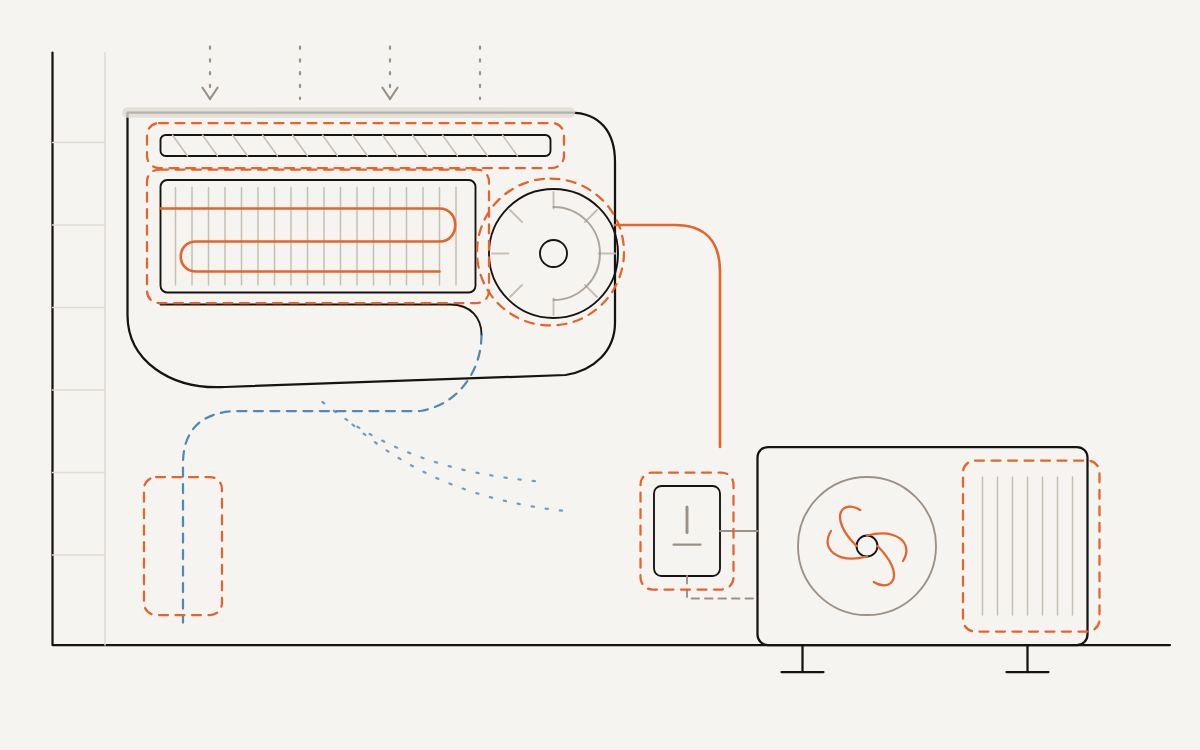
Understanding the basics makes every later conversation easier. You do not need engineering training, only a simple mental picture. The picture below holds true for almost every system in a commercial building.
The Refrigeration Loop in Simple Terms
Refrigerant travels in a sealed loop between an indoor coil and an outdoor coil. Indoors it absorbs heat from the air passing over the coil. Outdoors it releases that heat and starts again.
A compressor drives the whole loop. Think of it as the heart of the system, pushing refrigerant around at the right pressure. When the compressor struggles, everything downstream suffers.
Reverse cycle equipment simply runs that loop backwards in winter. So the outdoor coil collects heat and the indoor coil delivers it. The same machine therefore heats and cools.
Air Movement, Filters and Controls
Fans push treated air through grilles into the room. Filters sit in front of those coils and catch dust before it settles on the fins. Dirty filters choke airflow and force the compressor to work harder.
Controls decide when all of that happens. A thermostat reads room temperature, while a timer or building management system sets the operating hours. Many complaints about comfort trace back to control settings rather than broken hardware.
Ducted systems add another layer with zone dampers. Those dampers open and close to send air where staff actually sit. Our guide to ducted servicing explains that side in more depth.
Common Misunderstandings Worth Clearing Up
Half the confusion around commercial work comes from a few stubborn myths. Each one costs businesses money in a quiet way. Here they are, corrected.
A Cheap Visit Is Not the Same as Good Value
Chasing the cheapest quote feels responsible at the time. However, a cheap commercial air conditioning service costs you more over a year. It often skips coil cleaning, electrical testing and refrigerant checks.
You then pay for those omissions through higher running costs. Dirty coils force the compressor to work harder every hour it runs. So the saving on the invoice quietly disappears into the power bill.
Value comes from what the technician actually completes on site. Ask for the task list before the visit rather than after it. A short list usually means a short visit.
New Equipment Still Needs Attention
Owners assume a recent installation can coast for years. In practice, dust, grease and vibration start work from the first week of operation. Warranty conditions from the manufacturer also assume regular servicing.
Skipping early servicing can therefore weaken a warranty claim later. The Kelvinator warranty sits with the manufacturer, separate from any workmanship guarantee we offer. Keeping service records protects your position either way.
Cooling Problems Are Not Always Gas Problems
Many callers open with a request for more gas. Yet refrigerant sits in a sealed loop and does not simply run out. If the charge has dropped, a leak exists somewhere and needs finding.
Poor cooling far more commonly comes from blocked filters, dirty coils or failing fans. So a good technician measures before adding anything. Topping up a leaking system just delays the same call.
One Thermostat Does Not Please One Hundred People
Open plan tenancies create comfort arguments that no single setting can settle. Sunlight, partitions and desk positions all change how a room feels. Zoning and airflow balancing solve this better than constant thermostat changes.
Because of that, we often start with airflow readings rather than parts. The fix may be a damper adjustment or a diffuser swap. Both cost far less than replacing working equipment.
Talk it through with a technician
Tell us the model and what the unit is doing, and we will bring the right parts to the first visit.
Matching the Service to Your Type of Site
The label stays constant, yet the work varies enormously by building. A cafe kitchen and a quiet law firm stress equipment in different ways. Here is how the common cases differ.
Offices and Professional Suites
An office air conditioning service usually focuses on comfort, noise and even distribution. Meeting rooms heat up quickly because people and screens crowd a small space. Technicians therefore check airflow room by room, not just at the plant.
Filter condition matters more in offices than owners expect. Paper dust, carpet fibres and toner all end up in the return air. Clean filters keep staff comfortable and keep power use sensible.
Shops, Cafes and Hospitality Venues
Retail doors open constantly, so conditioned air escapes all day. Shop air conditioning repairs often trace back to equipment that simply never stops running. Grease and steam add another burden in food venues.
Coil cleaning matters most in these sites. Grease films act like a blanket over the fins and block heat transfer. Our page on cleaning and sanitisation covers the process and the hygiene benefits.
Strata Buildings and Shared Tenancies
Strata air conditioning maintenance brings a governance layer as well as a technical one. Committees need clear reporting, and lot owners need to know who pays for what. Common property plant and individual lot units follow different rules.
We keep the paperwork simple for building managers. Each visit produces a record per asset, so budgets and defect lists stay tidy. That clarity prevents arguments at the annual meeting.
Workshops, Warehouses and Split System Sites
Many smaller businesses run several wall units rather than one central plant. A commercial split system service handles each head and its matching outdoor unit. Roller doors, welding fumes and forklift dust all shorten filter life.
Because these units sit in harsh air, cleaning intervals shorten. A site that once coped with yearly attention may need two visits. Our technicians set the interval from what they find, not from a template.
Medical Rooms, Childcare Centres and Server Cupboards
Some rooms carry a duty of care that a shop floor does not. Consulting rooms, childcare sleep rooms and small server cupboards all need steady temperatures. So they sit higher up the priority list whenever a fault appears.
Filtration and noise matter more in those spaces as well. A quiet fan setting keeps a consulting room usable, while clean filters keep the air pleasant. We therefore set the checks to suit the room rather than the label on the door.
How a Visit Runs From First Call to Final Report
Knowing the sequence removes most of the anxiety around booking. The steps below describe a standard planned visit. Emergency work compresses the same sequence into a faster response.
Before the day arrives, gather anything that speeds the visit up. Keys, alarm codes, induction paperwork and a site contact number all save time. If a unit sits above stock or furniture, clear that space first.
Nothing on that list requires you to stand and watch. Most owners simply hand over keys and read the report afterwards. Still, we welcome questions on site if you want them answered live.
- You describe the site, the number of units and the symptoms. We ask about access, trading hours and any safety inductions the building requires.
- We agree a time window that suits your trade. Many businesses prefer the quietest part of the trading day so customers never notice the work.
- The technician arrives, signs in and isolates power safely before opening any panel.
- Filters come out first for cleaning or replacement, because airflow affects every later reading.
- The technician cleans indoor and outdoor coils, then clears condensate drains and trays.
- Electrical testing follows, covering contactors, capacitors, terminals and insulation resistance.
- Refrigerant pressures and temperatures go on the record, which reveals leaks and blockages early.
- Controls and thermostats get a functional test through both heating and cooling modes.
- The technician reports findings, flags anything at risk and recommends the next interval.
When You Need Expert Help Rather Than a Quick Look
Some checks belong to your own staff, and some clearly do not. Drawing that line keeps everyone safe and keeps warranties intact. The tests below explain where the line sits.
What Your Team Can Safely Do
- Wipe accessible return air grilles and keep them clear of stock or signage.
- Rinse washable filters in the smaller wall units, then dry them fully before refitting.
- Keep the area around outdoor units free of pallets, bins and vegetation.
- Note the exact time of day when comfort complaints appear, since patterns speed up diagnosis.
- Check that timers and setpoints still match your current trading hours.
- Keep a simple log of faults, dates and any noises staff notice while trading.
- Clear leaves, boxes and cobwebs from around the condenser fans after a windy week.
What Only a Licensed Technician Should Touch
Anything involving refrigerant requires a licence under Australian law. That covers gas recovery, leak repair, charging and system decommissioning. A licensed technician keeps you compliant as well as comfortable.
Electrical work sits in the same category. Contactors, capacitors and control boards hold dangerous charge even after isolation. So a trained technician handles those components as routine, while untrained hands should not.
Roof access and confined ceiling spaces add height and fall risk. Our technicians carry the training and equipment for both. Sending a staff member up a ladder instead creates liability you do not want.
Signals That Warrant an Urgent Call
Burning smells, tripping breakers and water pouring from a ceiling all justify an immediate call. Likewise, ice on pipework or a compressor that hums without starting needs prompt attention. Running the system through those symptoms usually multiplies the damage.
Trust your nose and your ears ahead of any manual. Unusual smells, grinding noises and sudden vibration all point at something mechanical. Turning the equipment off early often limits the repair bill.
Loss of cooling in a server room or a cold storage area also counts as urgent. Stock and data both suffer quickly once temperatures climb. In those cases we treat the job as an emergency and respond accordingly.
What Shapes the Final Figure on Your Invoice
We never publish a figure, because a fair number depends on your building. Instead, here are the factors that move the final figure up or down. Understanding them helps you compare suppliers honestly.
Those same factors drive the price differences between quotes. A cheaper number usually means a shorter scope rather than a bargain. Read the inclusions line by line before choosing.
Ask every supplier to price the same list of tasks, because scope moves the number more than travel does. A visit that includes coil cleaning always takes longer than a quick look. That difference then shows up in every figure you receive.
Our pricing page explains how we structure the work and what changes the final figure. If you want a commercial air conditioning service quote for your site, send us the unit count and the address type. That detail alone removes most of the guesswork.
- The number of indoor units and outdoor units on site, since each one takes time.
- Equipment type, because a rooftop package unit differs greatly from a wall mounted head.
- Access difficulty, including roof anchors, scissor lifts, ceiling hatches and locked plant rooms.
- Timing, as an urgent same day visit costs more than one booked ahead.
- Condition on arrival, since heavily fouled coils take longer to bring back.
- Frequency, because a maintenance agreement spreads work across the year more efficiently.
Helpful Tips for Comparing Suppliers Fairly
Ask every provider for the same scope in writing. Otherwise you compare a deep clean against a visual inspection and reach the wrong conclusion. A few practical checks keep the comparison honest.
Check licence details, insurance and reporting format as well as price. A serious contender will supply all three without hesitation. Vague answers early usually predict vague reporting later.
Where Our Technicians Work Across the Country
Owners want a commercial air conditioning service close by, then wonder how to judge the options. Proximity helps, yet climate knowledge matters just as much. We work right across the country and brief each crew on local conditions.
Coastal salt, inland dust and tropical humidity all attack equipment differently. Because of that, our intervals and cleaning methods change by region. The right routine always reflects the weather outside the building.
Regional towns sit inside our coverage as well, not just the capitals. Travel time changes the scheduling rather than the standard of work. So a country pub receives the same checklist as a city tower.
A well stocked van carries common parts on board, so many faults close on the first visit. Where a part has to come in, we tell you straight away. Guessing helps nobody.
- We handle a licensed commercial air conditioning service Sydney wide, from harbourside offices to warehouses out west.
- A mobile commercial air conditioning service Melbourne cafes depend on has to swing between heating and cooling in one day.
- Humidity drives the professional commercial air conditioning service Brisbane venues ask for, far more than raw temperature does.
- Dust and salt shape the qualified commercial air conditioning service Perth industrial sites request each year.
- The local commercial air conditioning service Adelaide venues book usually lands ahead of the busy event season.
- Late trading defines the best commercial air conditioning service Gold Coast hospitality operators can arrange.
- Cold mornings mean the commercial air conditioning service Canberra offices order must prove heating performance too.
- Logistics firms book commercial air conditioning service Newcastle side, because large open sheds hold heat under steel roofs.
- Reverse cycle heating dominates the commercial air conditioning service Hobart tenants ask about.
- Constant humidity means the commercial air conditioning service Darwin sites need barely pauses all year.
Questions Business Owners Ask Us Most
What does a planned visit include?
A standard visit covers filter cleaning, coil cleaning, drain clearing, electrical testing and refrigerant checks. The technician also tests controls in both heating and cooling modes. You then receive a written condition report with recommendations.
Repairs sit outside that scope and follow your approval. We separate the two so you always know what you agreed to.
How often should a business arrange a visit?
Once a year suits a light duty office with clean surrounding air. Kitchens, workshops, gyms and coastal sites usually need two visits or more. Manufacturer documentation for your model gives a useful baseline.
Our technicians set the final interval from what they find on site. Heavy fouling always means a shorter gap between visits.
What affects commercial air conditioning service price the most?
Unit count and access difficulty move the number more than anything else. Equipment type matters next, followed by the hours you want us on site. Condition on arrival then decides how long the clean takes.
We explain each factor before work starts. That way the invoice never surprises anyone.
Can you provide a commercial air conditioning service same day?
We keep capacity for urgent faults, so a same day booking is often possible. Availability depends on your location, the crew nearby and the parts involved. Calling early in the morning improves your chances.
If you need somebody today, call as early as you can. Should the day fill up, we say so honestly and hold the next slot for you.
How should I judge commercial air conditioning service reviews?
Look for reviews that describe the actual site and the actual fault. Detailed accounts carry far more weight than short praise. Patterns matter more than any single comment.
Watch how a business responds to criticism as well. A measured reply usually signals a team that fixes problems properly.
Is a commercial air conditioning maintenance contract worth arranging?
For most multi unit sites, yes, because planned work costs less than emergency work. A contract also fixes your intervals so nobody forgets a season. Reporting stays consistent, which helps budgeting and compliance.
Our maintenance plans set out how the coverage works. Single unit shops sometimes do better with simple annual booking instead.
Can I arrange the whole visit online?
Yes, and most clients now prefer it. An online request lets you list units, access notes and preferred hours in one go. We confirm the window by return message.
Use our book a service page to start. Phone contact still works if your situation needs a conversation.
What counts as a commercial air conditioning service emergency?
Anything that threatens safety, stock, data or your ability to trade counts. Burning smells, repeated breaker trips, water damage and total loss of cooling all qualify. Server rooms and cold storage always take priority.
Turn the system off at the isolator if you smell burning. Then call us and describe exactly what happened.
Drawing the Detail Together
The work is simply a planned and documented health check on the equipment your business relies on. It cleans the parts that collect dirt, tests the parts that carry current and records the readings that predict failure. Repairs then follow as informed choices rather than panic decisions.
Knowing the vocabulary puts you in control of every quote you receive. You can now tell service from repair, spot a thin scope and judge whether the interval suits your site. That knowledge alone saves money over a few seasons.
If you want a qualified technician for your office, shop, warehouse or strata building, our team is ready to help. Tell us how many units you run and when your doors open. We will suggest a sensible interval and a time that keeps your trading day intact.
Multi site operators can arrange visits for every location in one call. We then stagger the crews so no branch loses a trading day. One report format covers the lot, which keeps head office happy.
Need a hand reading a report from another provider? Send it through and we will translate the findings into plain language. You are under no obligation to use us afterwards.
Keep every report in one folder, whether paper or digital. Patterns then appear across seasons, so budgeting for replacement becomes far easier. Building managers find that history useful when a lot owner starts asking questions.
Prefer to read a little more first? Browse the related guides above, or send us a note whenever you are ready. There is no pressure, and questions cost nothing.
Browse the site
Book a technician
Speak to a qualified technician who works on Kelvinator systems
Call 1300 495 033 and tell us the model and the fault, or book online and we will come back to you.