Troubleshooting
Kelvinator Air Conditioner Weak Airflow, A Beginner Guide
The vent still breathes, yet you barely feel it two steps away. That gap between a fan you can hear and air you cannot feel is what owners mean by Kelvinator air conditioner weak airflow.
Beginners find this confusing because nothing looks broken. The unit lights up, the fan turns and the remote answers every button press.
In practice, weak airflow behaves like a plumbing problem for air rather than an electrical fault. Something along the path has narrowed, so less air reaches the room each minute.
So this guide starts with the words and the parts, then moves to the checks. Because most cases trace back to filters and coils, that chain gets the most attention here.
On this page
- What weak airflow actually means
- How air moves through a Kelvinator split system
- Why filters and coils cause most Kelvinator air conditioner weak airflow cases
- Common misunderstandings about Kelvinator aircon weak airflow
- Living with the system day to day
- What happens if weak airflow goes unchecked
- How to fix weak airflow step by step
- What a technician adds to Kelvinator weak airflow troubleshooting
- When a licensed technician becomes essential
- Error codes, apps and weak airflow
- What weak airflow repair involves and what shapes the cost
- Weak airflow in summer and other seasonal patterns
- Where we work across Australia
- Frequently asked questions
- The Picture as a Whole
What weak airflow actually means
Weak airflow describes volume, not temperature. The air leaving the vents may feel properly cold, although too little of it arrives to change how a room feels.
Technicians talk about air volume, which simply means the amount of air the indoor fan moves each minute. When that volume falls, comfort falls with it, even while the cooling circuit works normally.
Volume and temperature are two separate faults
A unit that pushes plenty of air that never turns cold has a different problem. That symptom belongs with our separate guide to a system that does not cool.
Kelvinator weak airflow runs the other way around. The cooling still works, yet delivery falls short, so the room drifts warm between cycles.
The words owners use for the same symptom
Some owners describe a Kelvinator air conditioner not blowing hard, while others say a Kelvinator aircon is barely blowing. Both phrases point at the same measurement.
We hear about a Kelvinator aircon not blowing hard in a bedroom. Others describe a Kelvinator split system not blowing hard, or a Kelvinator air conditioner barely blowing in a small office.
You may also see a Kelvinator split system airflow reduced since the last clean, or a Kelvinator ac weak airflow on the lowest fan speed only. The wording shifts, although the diagnosis path does not.
Which systems show the symptom
Wall mounted heads show it most, because their filters sit right in the room air. However, every design follows the same rules, from a small bedroom head to a large ducted layout.
Owners report Kelvinator window air conditioner weak airflow, Kelvinator wall air conditioner weak airflow and Kelvinator split system weak airflow in similar numbers. Kelvinator reverse cycle weak airflow turns up in winter too, since one fan serves both modes.
Variable speed models add a wrinkle. Because a Kelvinator inverter weak airflow complaint often starts with the fan deliberately running slow, settings deserve a check before hardware.
How air moves through a Kelvinator split system
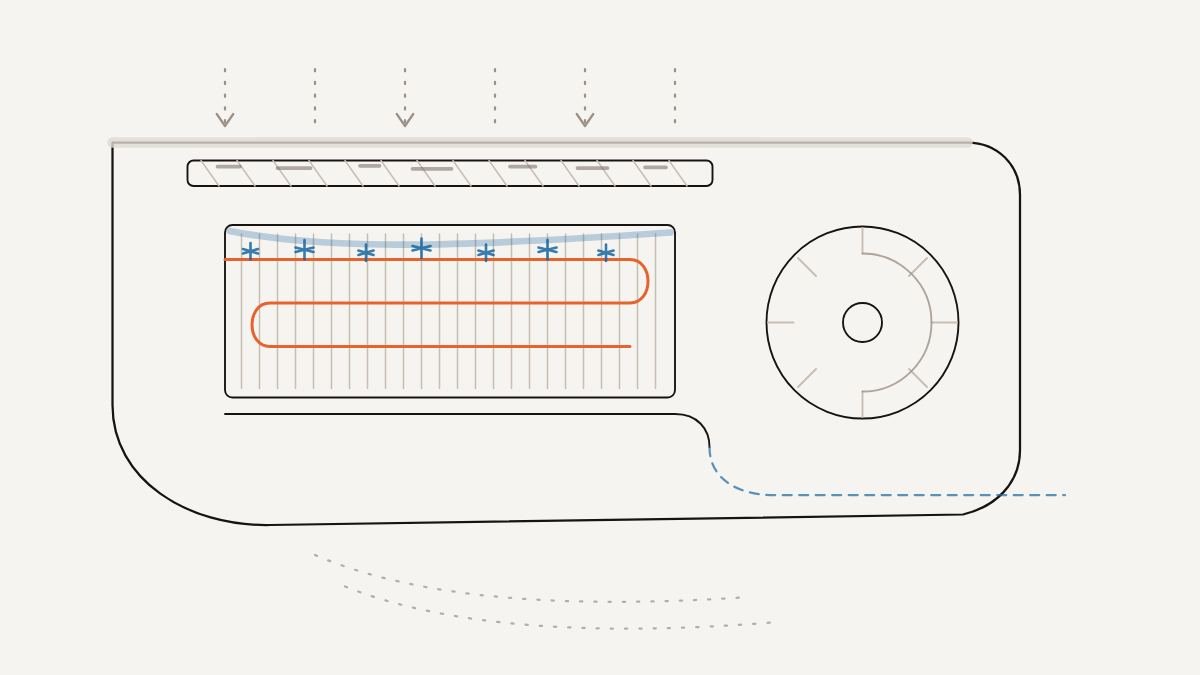
Air travels a loop. The indoor unit draws room air in through the top grille, passes it across a cold coil and pushes it back out through the lower vent.
Every part of that loop can restrict the flow. So a beginner gets further by picturing the path than by memorising part names.
The return grille and the filters
The front panel lifts open to reveal two flat mesh filters. These catch dust, hair and lint before that debris reaches the delicate parts behind them.
Filters work by trapping, so they close up as they collect. Once the mesh loads with fine grey felt, the fan strains and Kelvinator air conditioner low airflow follows.
The indoor coil
Behind the filters sits a coil of thin aluminium fins wrapped around copper pipe. Cold refrigerant runs through the pipe while room air squeezes between the fins.
Those fin gaps measure barely more than the thickness of a few sheets of paper. Therefore even a light fur of dust across the face cuts the opening dramatically.
The blower wheel
A long barrel shaped fan sits below the coil. Dozens of small curved blades run along it, and each one scoops a little air forward.
Because those blades stay small, a film of dust changes their shape. The wheel then turns at full speed while it throws far less air into the room.
The louvres and the room itself
Finally the air passes the moving louvre and enters the room. Curtains, a tall wardrobe or an open doorway can break the throw pattern well before the far wall.
Why filters and coils cause most Kelvinator air conditioner weak airflow cases
Dust does not arrive all at once. It builds in stages, and each stage hands the problem along to the next part in the path.
Understanding that chain explains the most common Kelvinator air conditioner weak airflow causes without any tools at all. Then the right repair becomes obvious rather than a guess.
Stage one, the filters load up
Fine dust bonds to the mesh and slowly closes the holes. Airflow drops gently, so most owners never notice the day it changed.
Pets, carpet, candles and nearby building work all speed this up. As a result two identical units in one street can need very different cleaning intervals.
Stage two, dust reaches the coil
A loaded filter also sags and lets air sneak around its edges. That bypass air carries dust straight onto the coil face, where it sticks to the damp fins.
Coil dust matters far more than filter dust. Because the fin gaps stay tiny, a thin grey mat there can halve the air a unit delivers.
Stage three, the blower wheel glazes over
Some dust travels past the coil and lands on the blower blades. Moisture from the cooling process turns it into a sticky film that hardens over several seasons.
At that point the wheel no longer grips the air properly. Owners then describe a Kelvinator aircon low airflow that returns within weeks of every filter clean.
Stage four, the coil begins to ice
Low airflow leaves the coil colder than the design intends. Moisture then freezes on the fins, which blocks the gaps further and starves the fan even more.
That loop has its own guide on this site, since frozen coils bring extra symptoms such as dripping and sudden shutdowns. Still, weak airflow usually arrives first as the warning.
Common misunderstandings about Kelvinator aircon weak airflow
Beginners often chase the wrong part first. So it helps to clear away a handful of ideas that send people down blind alleys.
A filter that looks clean can still block the air
Held flat on a bench, a loaded filter can look almost new. Hold it up to a window instead, and the light shows how little of the mesh remains open.
Rinsing alone leaves the finest layer in place. Therefore a soft brush and a gentle stream of water from the clean side both matter.
Weak airflow after cleaning the filter
Plenty of owners still report weak airflow after cleaning filter mesh twice in one week. That result frustrates people, although it actually confirms the chain above.
Because the filter never held the only blockage, the coil or the wheel now carries the restriction. So the next step moves deeper into the head rather than back to the sink.
Fan speed settings and quiet modes
Auto fan mode lowers the speed once the room nears the target temperature. Sleep and quiet settings do the same on purpose, and both feel like a fault.
Check the remote before you open anything. If high fan speed restores a strong stream, the hardware sits fine and the setting told the whole story.
Weak airflow differs from a fan that will not spin
A completely stationary indoor fan points at a motor, a capacitor or a control board. We treat that as a separate fault, and it carries its own guide on this site.
Weak airflow means the wheel still turns. So the tests differ, and the repairs differ along with them.
Weak airflow after a power outage
Some owners notice weak airflow after power outage events on the very same afternoon. Nothing has usually broken during the blackout.
Instead the unit returned to a default setting, often a low fan speed or a timed program. Our guide to a timer that will not behave as expected covers that side in more detail.
Living with the system day to day
Once the parts make sense, everyday habits matter more than gadgets. A few small choices keep the air volume where it should sit.
Choosing a fan speed
Run a higher fan speed on very hot days. Because more air across the coil carries more heat away, the room settles sooner and the compressor works less.
Lower speeds suit gentle overnight cooling. However, if low speed feels like nothing at all, the unit is telling you something about its filters.
Giving the unit room to breathe
Keep the top of the indoor head clear by at least a hand span. Tall furniture, shelving and hanging clothes all steal air before it reaches the filters.
Aim the louvres along the ceiling rather than straight down. Air that hugs the ceiling travels further, then falls gently and mixes across the whole room.
What healthy airflow feels like
Stand two metres from the indoor unit with the fan on high. You should feel a clear stream on your face and hear a steady rush rather than a rattle.
Repeat that test each season and remember the result. As a result you notice a Kelvinator split system low airflow trend early, long before the room becomes uncomfortable.
Talk it through with a technician
Tell us the model and what the unit is doing, and we will bring the right parts to the first visit.
What happens if weak airflow goes unchecked
A restriction rarely stays a comfort problem. Instead it spreads into running costs, moisture and eventually component wear.
Longer run times
Less air means less heat carried away from each room. So the system runs longer for the same result, and your energy use climbs quietly.
Inverter models hide this well at first. Because they simply hold a higher output for longer, the extra effort never announces itself as a fault.
Damp smells and moisture
A starved coil runs colder and wetter than it should. Moisture then lingers on dusty fins, which encourages the musty smell many owners notice first.
Water can also track past the drain tray when ice melts unevenly. That leads to drips inside the room, a symptom covered by our guide to indoor water leaks.
Extra strain on the outdoor unit
The outdoor section responds to what happens indoors. When the indoor coil struggles, pressures shift and the compressor works under conditions it was not designed around.
Repeated icing and defrosting add to that strain. Therefore an early Kelvinator weak airflow repair usually costs less than the failures that follow neglect.
How to fix weak airflow step by step
Work through these steps in order and stop as soon as the stream improves. Every step here stays safe with the unit switched off at the wall.
This routine solves a large share of cases. When it does not, the restriction usually sits on the coil or the wheel, beyond hand cleaning.
Turn the unit off, then switch off the power point or the isolator. Wait a moment before you open the indoor head.
Lift the front panel until it holds itself open. Slide each filter up slightly, then draw it out and down.
Hold each filter up to the light. If you cannot see clearly through the mesh, it needs a proper wash rather than a shake.
Rinse from the clean side under a gentle tap. Brush stubborn felt away with a soft brush, then leave both filters to dry fully in the shade.
Look at the silver coil behind the filter opening. Fins should appear bright and evenly spaced, while grey matting or bent fins tell a different story.
Shine a torch down at the barrel fan below the coil. Furry blades explain a Kelvinator aircon airflow reduced complaint better than anything else.
Vacuum the intake and the outlet with a soft brush head. Avoid pushing any tool between the fins.
Refit the dry filters, close the panel and restore power. Set cooling to a low temperature with the fan on high for ten minutes.
Stand back and repeat your two metre test. Note whether the stream improved a little, a lot or not at all.
Write down what you found and what changed. That note turns a vague complaint into a useful brief for a technician.
What a technician adds to Kelvinator weak airflow troubleshooting
Professional Kelvinator weak airflow troubleshooting starts with measurement rather than opinion. Instruments show whether the fan turns at its commanded speed and how much air actually leaves the outlet.
Then the technician compares intake and outlet temperatures. Because a starved coil produces an unusually wide temperature split, that reading points quickly toward restriction.
Deep coil and blower cleaning
A proper coil clean uses a purpose made cleaner and controlled rinsing, with the electronics protected. Technicians dismantle enough of the head to reach the fins from both faces.
Blower wheels usually come out for cleaning. Because every blade needs individual attention, this task takes time and a steady hand.
Fan motor and control checks
Modern indoor motors report their speed back to the control board. So a technician can see whether the board asked for low speed or the motor failed to deliver it.
Worn bearings show up as noise and drag. In that case a motor replacement restores the air volume that cleaning alone cannot recover.
Ductwork and installation faults
Ducted layouts add restrictions of their own, such as crushed flexible duct or a collapsed connection. A Kelvinator air conditioner airflow reduced across every room often points there.
Wall and window units suffer from blocked outdoor faces instead. Meanwhile a struggling outdoor section can mimic the symptom, which our guide to an outdoor fan that starts and stops explains further.
When a licensed technician becomes essential
Owner maintenance stops at the filters and the visible surfaces. Everything past that point involves electricity, refrigerant or dismantling, so the rules change.
Electrical work
Never open the electrical cover on the indoor or the outdoor unit. Capacitors hold a charge after the power goes off, and that charge can injure you badly.
Australian law reserves fixed wiring work for licensed electrical workers. Therefore a Kelvinator weak airflow technician handles motor, board and capacitor tasks, not the owner.
Refrigerant work
Refrigerant pipes stay sealed for good reason. Licensed handling applies across Australia, and opening the circuit without that licence breaks the law and risks the manufacturer warranty.
Weak airflow rarely comes from refrigerant alone. Still, a starved coil and a low charge produce similar icing, so a technician measures before touching anything.
Water, chemicals and electronics together
Coil cleaning puts liquid close to live components. Because a soaked control board turns a small job into a large one, that work suits someone who does it daily.
Error codes, apps and weak airflow
Air volume has no dedicated fault code on most systems. So any airflow error code you come across is usually a related one instead.
App users sometimes blame the connection when the fan seems lazy. However, that is a different fault, and our guide to a system that will not connect to WiFi covers it properly.
What weak airflow repair involves and what shapes the cost
The fix ranges from a thorough clean through to a component replacement. Because those jobs differ so much in labour, no single figure describes them all.
Several factors move the cost of an airflow repair up or down. Our page explaining how our pricing works sets out the same factors in more depth.
So the honest answer depends on the diagnosis. A technician who inspects first can explain the options before any work starts.
- How far the technician must dismantle the indoor head to reach the coil and the wheel.
- Whether the unit sits at a comfortable height or needs ladders and access equipment.
- Whether parts such as a fan motor or a control board join the job.
- How many indoor heads or outlets the system serves.
- Whether the visit is urgent or booked ahead.
Weak airflow in summer and other seasonal patterns
Heat exposes a restriction that winter hides. Kelvinator air conditioner weak airflow in summer therefore appears in our calls far more than in the cooler months.
The reason sits in demand rather than damage. Because the system runs longer and harder, a shortfall in air volume finally becomes obvious inside the room.
Where we work across Australia
Our technicians service and repair Kelvinator systems as a specialist business, with no manufacturer affiliation. We handle these airflow faults Australia wide through our network of qualified people.
Homes across the Sydney basin send us plenty of calls. A Sydney visit for this fault usually begins with the filters, then moves to the coil if the stream stays soft.
Melbourne owners tend to notice it later in the season. A Melbourne booking for this fault often follows the first run of hot days after a long winter.
Frequently asked questions
Why is my Kelvinator air conditioner airflow weak?
Most often the air path has narrowed somewhere between the intake grille and the outlet. Loaded filters, a matted coil and a dusty blower wheel account for the bulk of cases.
Settings explain many of the rest, especially auto and quiet fan modes. So check the remote first, then clean the filters before you assume a hardware fault.
Why is my Kelvinator aircon airflow weak only in heating mode?
The same fan serves both modes, so a true restriction shows up in cooling as well. If only heating feels weak, the system may sit in a defrost pause or a warm up delay.
What to do when airflow drops suddenly?
Sudden changes point at settings, a blockage or something physical falling into place. Check the fan speed, then look for a toy, a curtain or an insect screen against the intake.
Next remove and inspect both filters. If everything looks clear and the stream stays weak, the fault sits deeper and needs a technician.
Is there a quick fix at home?
Washing the filters properly counts as the quickest genuine fix. Many units regain most of their stream within one drying cycle.
What is the best solution for an older unit?
Older systems usually need the full clean rather than the quick one. A technician cleans the coil and the blower wheel, then measures the result against expectations.
If the wheel or motor has worn out, a replacement part often restores normal volume. When repeated faults stack up, replacement of the whole unit deserves a fair comparison.
Can a Kelvinator split system barely blowing still cool a room?
It can, although slowly and unevenly. The air leaving the vent may feel very cold, because so little of it passes over a very cold coil.
How often should I clean the filters to prevent low airflow?
Monthly cleaning suits heavy use, pets or dusty streets. Every second month works for lighter use in a quiet home.
Keep a Kelvinator aircon low airflow check in the same routine. Feel the stream after each clean, and note any drop that returns quickly.
Does weak airflow mean I need a new air conditioner?
Rarely. Cleaning and small parts resolve most cases, and even a motor replacement costs far less than a new system.
The Picture as a Whole
Weak airflow describes a path problem. Air enters through filters, crosses a coil and leaves on a blower wheel, so any of those three can throttle the stream.
Start with what you can safely reach. Wash the filters properly, clear the space around the unit, check the fan speed and then measure the result.
If the stream stays soft, the restriction sits deeper and needs tools rather than patience. Because coil and blower work involves water, chemicals and electronics, a licensed technician should take it from there.
So when you are ready, book a service visit with our team and describe what you tried. Then we arrive prepared, and you get your air volume back sooner.
Browse the site
Book a technician
Speak to a qualified technician who works on Kelvinator systems
Call 1300 495 033 and tell us the model and the fault, or book online and we will come back to you.