Error codes
Kelvinator F5 Error Code and What It Says About Your System
The Kelvinator F5 error code rarely lands on a system that is fresh out of the box. Instead it turns up on a unit that has already worked its way through a long run of summers.
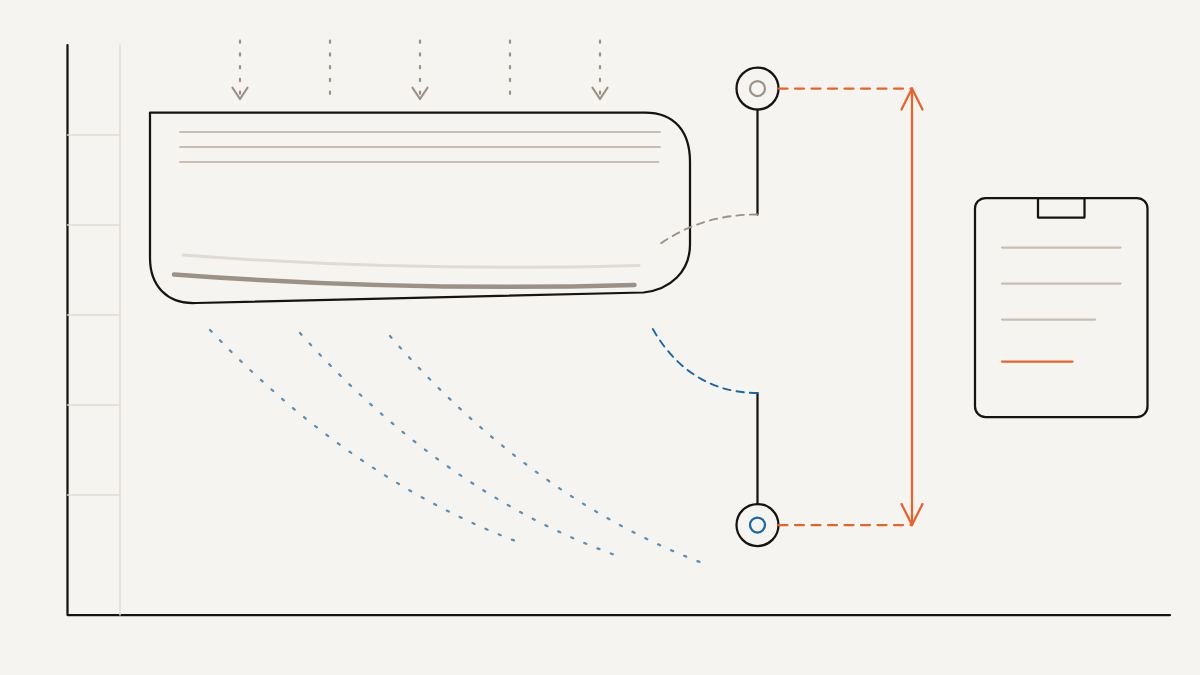
F5 points to a sensor fault. Something in the chain of small temperature probes has stopped reporting a value that the control board will accept.
Because of that, timing matters enormously with this code. Heat, humidity, a sudden cold snap and the minutes after a power interruption all expose a tired probe.
So this page follows the code across the life of a unit. You will see why F5 clusters in older systems, what you can check yourself and where a licensed technician has to take over.
We are technicians who specialise in these systems rather than the manufacturer of them.
On this page
- The Kelvinator F5 Code Meaning in Plain English
- Why the Exact Sensor Varies Between Model Families
- Why the Age of the Unit Changes the Picture
- The Early Years of a Kelvinator System
- The Middle Years and the First Quiet Warnings
- The Later Years When F5 Turns Up in Earnest
- What Changes Inside the System as a Sensor Ages
- Heat, Cold and the Conditions That Expose the Fault
- Storms, Outages and the Code That Latches
- What the Display Actually Shows You
- How This Code Sits Against Its Neighbours
- Which Model Ranges Show This Code
- What a Sensor Fault Does to Comfort and Running Cost
- What an Owner Can Safely Check
- How to Reset a Kelvinator Air Conditioner F5 Error
- When the Kelvinator F5 Error Keeps Coming Back
- Jobs Only a Technician Can Do
- How Our Technicians Approach F5 Troubleshooting
- How Maintenance Changes the Odds
- Getting the Longest Life From an Ageing System
- What Shapes the Cost of a Kelvinator F5 Error Repair
- A Preparation Checklist Before the Season Turns
- Regions Within Our Reach
- Frequently Asked Questions About the F5 Code
- What to Take Away From an F5 Code
The Kelvinator F5 Code Meaning in Plain English
Kelvinator error code F5 flags a sensor fault. A sensor here is a small temperature probe that feeds readings back to the control board several times a minute.
Those readings drive every decision the board makes. Therefore a probe that drifts outside its expected range leaves the board guessing, and it halts the cycle rather than run blind.
The Kelvinator F5 error meaning is narrow in one sense and broad in another. It names the class of fault, yet it does not name the exact probe involved.
That distinction shapes everything else on this page. In short, F5 tells you where to start looking, not what to buy.
Why the Exact Sensor Varies Between Model Families
Here is the honest part. The Kelvinator F5 fault code does not point at one fixed component across every model family in the range of units on Australian walls.
Different generations of control board assign the same two characters to different probes. On one series F5 may cover an indoor coil probe, while another series uses it for pipework or an outdoor reading.
So the label on the unit and the manual for that exact model are what confirm it. A technician reads the model number first, then works from the fault chart that belongs to that board.
Any guide that promises one universal answer for F5 is guessing. Because of that, we treat the two characters as a starting point rather than a finished diagnosis.
Why the Age of the Unit Changes the Picture
A sensor fault is not a random event. Probes drift slowly, and the drift only becomes visible once it crosses the tolerance the board allows.
That crossing point tends to arrive after a long stretch of thermal cycling. As a result, the same fault code carries very different weight on a young unit than on an old one.
On a young system, a Kelvinator fault code F5 usually means something specific went wrong. In an older system it usually means the slow arithmetic of age has finally caught up.
The Early Years of a Kelvinator System
In the first stretch of life, probes sit comfortably inside tolerance. Readings stay tight, the board trusts them and F5 almost never appears at all.
When it does appear early, look for a physical cause. A plug knocked loose during installation or a probe pushed out of its holder will both trigger the same code.
So an early F5 is worth chasing hard. Because the part itself has barely aged, the fault normally sits in the connection, the mounting or the routing of the wire.
Owners of newer units sometimes assume they have bought a lemon. In practice a young unit showing this code is usually telling you about an installation detail instead.
The Middle Years and the First Quiet Warnings
Somewhere in the middle of the life of a unit, small oddities begin. The system may overshoot the set temperature slightly, or the compressor may cycle more often than it used to.
Those are not faults yet. However they are the first hint that a probe has started to read warm or cool by a small margin.
Most owners never notice this stage. Instead they notice the running cost creeping upward and the room feeling slightly off, and they blame the weather.
Yet this is the cheapest moment to act. A technician comparing readings against expected behaviour can flag a lazy probe long before it locks the system out.
Talk it through with a technician
Tell us the model and what the unit is doing, and we will bring the right parts to the first visit.
The Later Years When F5 Turns Up in Earnest
Later in life the drift stops being subtle. The board sees a value it cannot reconcile, and a Kelvinator air conditioner error code F5 appears on the display.
At this stage the code often arrives in clusters. It clears on a reset, runs for a day or a week, then returns on the next genuinely hot afternoon.
That pattern is the classic signature of an ageing probe. Because the drift is marginal rather than total, the fault behaves intermittently instead of failing outright.
What Changes Inside the System as a Sensor Ages
A temperature probe lives in a hard place. It sits against metal that swings from very cold to very warm several times an hour, season after season.
Over time the sealing around the tip hardens and the wire near the body grows brittle. Moisture then finds its way into places it never used to reach.
Vibration adds to the problem. Because the outdoor unit shakes every time the compressor starts, a connector that once gripped firmly can loosen by a fraction.
Dust and salt air accelerate all of it. Coastal installations in particular collect a film that works its way into terminals and clips.
Heat, Cold and the Conditions That Expose the Fault
Extremes bring the problem forward. On a hot afternoon the coil runs at the top of its normal range, so a probe reading slightly high pushes past the limit.
Cold mornings do the same thing from the other direction. When a reverse cycle system starts heating from cold, pipe temperatures swing quickly and widely.
A Kelvinator reverse cycle F5 error in the middle of winter therefore has the same root as one in February. Only the direction of the swing has changed.
Humidity plays its own part. Damp air raises condensation around the indoor coil, and moisture near a tired probe makes an already unstable reading worse.
Storms, Outages and the Code That Latches
Power events matter here. A Kelvinator F5 error after power outage happens often, and it does not always mean the probe failed at that exact moment.
When the supply drops and then returns, the board runs its start up checks from cold. A probe that was already marginal now fails that check outright.
So the outage exposed the fault rather than created it. Even so, a surge can damage a board input directly, which is why repeated outages deserve attention.
Keep a note of storms and blackouts. If the code follows them reliably, that history helps a technician separate a supply issue from a worn component.
What the Display Actually Shows You
Presentation varies between products. A Kelvinator air conditioner showing F5 on a wall controller gives you the clearest read, since the characters sit on a small screen.
Other units flash the code through an indicator light instead. A Kelvinator air conditioner displaying F5 code through blinking lights needs the manual to decode the rhythm.
Write down what you see either way. Because some systems clear the display on the next power cycle, a photograph or a written note protects the evidence.
How This Code Sits Against Its Neighbours
F5 does not sit alone on the chart. Nearby codes cover related but separate conditions, and telling them apart saves a great deal of guesswork.
If your display alternates between codes, note every one of them. For example the F4 fault code and the F6 fault code each carry their own meaning and their own checks.
A system throwing several codes in one session tells a different story than one throwing F5 alone. In that situation our F8 code guide is worth reading as well.
Which Model Ranges Show This Code
Owners naturally ask about their own series first. A Kelvinator KSV F5 error, a Kelvinator KSD F5 error code and a Kelvinator HWJ series F5 error all describe the same class of problem.
Product type changes the presentation more than the cause. A Kelvinator window air conditioner F5 error appears on a small panel, while a Kelvinator wall air conditioner F5 code may only blink.
Kelvinator split system error code F5 reports are the most common we see. Still, a Kelvinator split system F5 error on a wall mounted head follows the same logic as one on a ducted return.
Variable speed models behave no differently in principle. A Kelvinator inverter F5 error code simply reaches the same conclusion through a board that modulates rather than switches.
Ducted heads and portable units round out the picture. Whatever the format, a Kelvinator aircon error code F5 describes the same broken trust between a probe and a board.
What a Sensor Fault Does to Comfort and Running Cost
Long before the code appears, a drifting probe costs you money. The board acts on a reading that is slightly wrong, so it runs longer or shorter than the room actually needs.
Comfort suffers in small ways first. Rooms overshoot, then undershoot, and the system hunts around the set point instead of settling.
Once the code locks the system out, the loss becomes obvious. A Kelvinator F5 error not cooling the room still lets the indoor fan move air, which fools some owners into thinking it works.
What an Owner Can Safely Check
Plenty of useful checking needs no tools at all. Start with the things that sit well away from the electrical side of the system.
That written record matters more than most owners expect. Because a Kelvinator aircon F5 error is often intermittent, a documented pattern helps far more than a single sighting.
- Note the exact code and whether it appears in cooling, heating or both.
- Pull the return air filters and clean them if they carry dust or lint.
- Look over the outdoor unit for leaves, cobwebs or anything blocking airflow.
- Confirm that furniture, curtains or shelving do not sit against the indoor unit.
- Time how long the system runs before the code returns and write it down.
- Check whether other appliances lost power recently, which points at the supply.
How to Reset a Kelvinator Air Conditioner F5 Error
A reset clears the stored code so you can watch whether it comes back. It repairs nothing at all, and that distinction is the entire point of doing it.
If the code stays away for weeks, a one off glitch looks likely. However a Kelvinator F5 error reset that holds for only minutes points squarely at a real component fault.
- Turn the system off at the remote or the wall controller.
- Switch off the isolator or the circuit breaker that feeds the unit.
- Wait several minutes so the board fully loses its stored state.
- Restore power and leave the system idle for a minute or two.
- Start it in the mode where the code appeared and watch it closely.
- Record how long it runs before F5 returns, if it returns at all.
When the Kelvinator F5 Error Keeps Coming Back
A Kelvinator F5 error keeps coming back for a reason. Repeating the reset changes nothing, and every restart cycle asks a little more of the compressor.
Watch for the interval shortening. When the gap between resets falls from days to hours, the drift has moved further out of range.
Meanwhile the system performs poorly in between. Rooms feel stuffy rather than cold, and a Kelvinator ac error F5 that recurs weekly rarely improves on its own.
Therefore a lasting Kelvinator F5 error fix comes from diagnosis rather than repetition. Once someone identifies the faulty probe or input, the code stops returning for good.
Jobs Only a Technician Can Do
The line here is simple. Anything behind a panel, anything involving wiring and anything requiring a meter belongs to a licensed technician.
There are legal reasons alongside the practical ones. Australian law restricts electrical work, and refrigerant handling requires a separate licence again.
Beyond the law, sensor testing needs the correct reference data for that specific board. Guessing at a replacement part often creates a second fault beside the first.
So the safe boundary sits at the covers. Cleaning, observing and resetting are yours, while testing and replacing belong to someone qualified.
How Our Technicians Approach F5 Troubleshooting
Kelvinator F5 error troubleshooting starts at the model plate rather than the display. Our technicians identify the series, then work from the chart that belongs to that generation of board.
From there the sequence runs from simple toward complex. They check connections and mounting first, then the probe itself, then the board input that reads it.
Where a probe has drifted, replacing it restores normal control quickly. If instead the board input has failed, the conversation shifts toward the board and the value of the repair.
Nothing gets replaced on a hunch. Because a Kelvinator ac F5 error code covers several possible probes, guessing simply moves the cost around without solving anything.
How Maintenance Changes the Odds
Maintenance does not stop a probe from ageing. Still, it removes most of the conditions that push a marginal reading over the edge.
Clean coils and clean filters keep temperatures inside the normal band. As a result the board sees gentler swings, and a drifting probe stays within tolerance for far longer.
A yearly service also catches the quiet middle stage. Because a technician compares live readings against expected behaviour, they often spot a lazy probe before it triggers anything.
Connections get attention during the same visit. The technician confirms that plugs seat firmly and that clips still hold wiring clear of vibrating metal.
Getting the Longest Life From an Ageing System
Older units repay gentle treatment. Setting a sensible temperature rather than an extreme one keeps the whole system inside its comfortable operating band.
Shading the outdoor unit helps as well. When the condenser breathes cooler air, coil temperatures stay lower and the probes see smaller extremes.
Run the system regularly rather than in bursts. Because long idle spells let moisture settle into connectors, a short monthly run in the off season does real good.
What Shapes the Cost of a Kelvinator F5 Error Repair
Kelvinator F5 error repair cost depends entirely on what the diagnosis finds. A loose connector and a failed control board sit at opposite ends of that scale.
Access affects the figure too. A wall mounted head at ground level takes less time than a ducted unit tucked into a tight roof space.
Part availability matters on much older systems. For a fuller picture of how we structure our charges, read our guide to service pricing.
A Kelvinator F5 error repair on a very old unit also raises a fair question. When several components have aged together, replacement sometimes makes more sense than another repair.
A Preparation Checklist Before the Season Turns
A little preparation before the first heatwave saves a lot of discomfort. Work through this list at the start of spring, then again before the cold arrives.
Testing early gives you room to act. Because parts and appointments both take time, a fault found in spring is far easier to handle than one found mid summer.
Run the system in both cooling and heating for a full cycle each.
Listen for the compressor starting and stopping more often than usual.
Clean the filters and clear the ground around the outdoor unit.
Note any code that flashes, even briefly, and keep that note somewhere safe.
Book a service if the unit has run a full year without one.
Check that the isolator and breaker are easy to reach if you ever need them.
Regions Within Our Reach
We service and repair Kelvinator systems across the greater metropolitan area and the suburbs that surround it. Houses, apartments and small commercial sites all sit inside that reach.
A Kelvinator F5 error Sydney households report during a heatwave gets the same method as any other call. Our qualified technicians diagnose first, then quote before any work begins.
Anyone dealing with a Kelvinator air conditioner F5 error Australia wide can still use the guidance above. However the repair itself needs a licensed technician standing in front of your actual unit.
If you want a Kelvinator service specialist nearby, look for full licensing and clear written quoting. Those two things matter more than any badge on a van.
Frequently Asked Questions About the F5 Code
What does F5 mean on Kelvinator air conditioner displays?
It means a sensor fault. One of the temperature probes has reported a value the control board will not accept, so the board stops the cycle. The exact probe depends on the model family, which the label and manual for your unit confirm.
What is F5 error on Kelvinator systems in plain terms?
Think of it as the board losing confidence in one of its thermometers. Rather than run on a reading it cannot trust, the system shuts down and shows the code. That protects the compressor from operating in the wrong conditions.
How to fix F5 error on Kelvinator air conditioner units at home?
You can clean the filters, clear the outdoor unit and perform a full power reset. Beyond that, testing a probe or a board input needs a licensed technician. So home fixing means ruling out the simple causes rather than repairing the fault.
How to fix Kelvinator F5 code when it appears just once?
Treat a single appearance as a possible glitch, especially after a blackout. Reset the system, then run it normally and watch for a week. If nothing returns, the board most likely caught a momentary reading during start up.
How to clear F5 error Kelvinator owners see after a storm?
Switch the unit off, then isolate it at the breaker for several minutes before restoring power. That clears the stored state and lets the board run fresh checks. If the code reappears immediately, the probe or the input has genuinely failed.
How to reset Kelvinator air conditioner F5 error faults safely?
Use the controller first, then the isolator or breaker, and never open a panel. Wait a few minutes, restore power and restart in the same mode as before. Record what happens, because the timing tells a technician a great deal.
Does it matter when a Kelvinator F5 error keeps coming back?
Yes, and the interval is the important detail. A code returning weekly suggests mild drift, while one returning within minutes suggests a probe well outside range. Either way, repeated resets wear the compressor without addressing the cause.
Do I really need a Kelvinator F5 error technician for this?
For anything past cleaning and resetting, yes. A Kelvinator F5 error technician can test the probe against the correct reference data for that board. That avoids replacing parts on a guess and keeps the electrical work lawful.
What to Take Away From an F5 Code
The Kelvinator F5 error code names a sensor fault, and the exact probe varies between model families. So the label and manual for your unit settle the detail the code alone cannot.
Age remains the strongest predictor. Early in life the cause is usually mechanical, while later in life the cause is usually slow drift.
Cleaning, observing, recording and resetting are all safely yours. Everything past that boundary belongs with a licensed technician who can test properly.
If the code has returned more than once, it deserves a proper look. Feel free to book a service visit and our team will trace it from the model plate onward.
Browse the site
Book a technician
Speak to a qualified technician who works on Kelvinator systems
Call 1300 495 033 and tell us the model and the fault, or book online and we will come back to you.