No display diagnostics
Kelvinator Outdoor Unit Light Flashing, How to Read the Pattern
A light behind the outdoor unit panel keeps blinking, and the room stays warm. A Kelvinator outdoor unit light flashing in a repeating pattern works as a fault code. The control board counts it out because there is no screen to print it on.
So the number of flashes matters, and the length of the pause between groups matters just as much. Miss either one and the code you pass on points at the wrong part.
This guide sets a steady light against a flashing light, so you can work out which one you have. Then it covers how to count, what to write down, and where the model number hides.
We do not print a flash count table here, and that choice is deliberate. Flash codes differ between model families, so a chart copied from one series misleads the owner of another.
We are qualified technicians who specialise in Kelvinator air conditioners, and we are not the manufacturer.
On this page
- What a steady light and a flashing light each mean
- Where each light leaves you
- Why the outdoor unit reports faults this way
- What flashing usually indicates in general terms
- The trade offs between guessing the code and recording it
- How to tell which one applies to your unit
- Patterns that look like codes but are not
- How to count the flashes accurately
- What to write down before you call
- Why a flash count table would do you no favours
- The counts owners ask about most
- When a Kelvinator outdoor unit light flashing means stop and call
- Where to find the model number
- What a technician would advise
- What we do with the count when we arrive
- Safety, and what to leave alone
- Where we work and how to reach us
- Frequently asked questions
- The Core of It
What a steady light and a flashing light each mean
Both lights use the same tiny LED, which stands for light emitting diode. However, the difference between them tells you whether the system rests or complains.
The steady light, the case you want
A light that glows without interruption usually reports power and a normal state. Many outdoor boards hold a steady LED while the unit waits in standby for the indoor unit to call for cooling.
So a steady light on its own does not point to a fault. If the room still fails to cool, the trouble more likely sits with airflow, refrigerant charge or the indoor side of the system.
That distinction saves you a wasted callout. Because a healthy board looks calm, a calm board pushes the investigation somewhere else entirely.
The flashing light, a message with a number inside it
A light that blinks in groups, then pauses, then repeats, behaves like a counter. Each group holds the same number of blinks every cycle, and that number carries the code.
Because the outdoor unit has no display, the board uses this pattern instead of the letter codes you see on an indoor wall controller. In short, the LED does the job of the screen.
A Kelvinator outdoor unit led flashing this way almost always follows a shutdown or a protection event. The compressor stops, the fan stops, and the board flags the reason in blinks.
Where each light leaves you
A steady light leaves you with a normal board and a symptom to chase elsewhere. Meanwhile a flashing light hands you a specific starting point, provided you read it correctly.
That difference changes what you do next. One sends you to check filters, vents and clearances, while the other sends you to a notepad and a phone camera.
A Kelvinator air conditioner outdoor light blinking in short bursts rarely resolves itself overnight. Instead the pattern usually repeats until someone clears the underlying condition.
Some owners call the outdoor box the condenser and search Kelvinator condenser light flashing instead. Both phrases describe the same metal cabinet outside the wall.
Why the outdoor unit reports faults this way
Manufacturers put the display where people stand, which means indoors. So the outdoor board gets a single LED and a language made of blinks.
That LED reports to a technician, not to an owner, which explains why the meaning lives in service documentation rather than in the owner manual. Even so, the count belongs to you, and you can read it.
The board stores the condition and repeats the pattern until power drops or the fault clears. Therefore the code waits for you, as long as nobody switches the isolator off first.
What flashing usually indicates in general terms
We cannot map a count to a part without your model number. However, we can describe the broad families of condition that make an outdoor board blink at all.
Protection trips
Boards watch pressure, temperature and current, then shut the compressor down when a reading strays outside safe limits. A blocked coil, a failed fan or a hot day with poor clearance all push readings that way.
These faults often clear on their own once the unit cools, then return under load. So a system that runs each morning and stops each afternoon fits this family well.
Sensor and communication faults
Small temperature sensors report the coil, the pipe and the outside air to the board. When one reads open circuit or short circuit, the board flags it rather than guessing.
Communication faults belong here too. The indoor and outdoor units talk over a control wire, and a damaged cable, a loose terminal or water in a joint breaks the conversation.
Power supply and drive problems
Inverter systems drive the compressor through electronics that expect clean, steady power. Low voltage, a failing capacitor or a supply fault can stop the drive and set a code.
These conditions deserve respect. Therefore leave the panels closed and let a technician measure the supply rather than opening the cabinet yourself.
The trade offs between guessing the code and recording it
Owners face a genuine choice at this point. You can hunt for a chart online and hope it matches your unit. Alternatively you can record the pattern and give it to someone with the right service data.
The first path feels faster. However, it fails quietly, because a chart from a different series can turn a simple sensor fault into an imagined compressor failure.
The second path costs a few minutes with a phone. Then the count arrives with a technician who checks it against the correct documentation for that exact model.
There is a middle road as well. Record the pattern, describe it in plain words, and let the diagnosis follow the evidence rather than the guess.
Talk it through with a technician
Tell us the model and what the unit is doing, and we will bring the right parts to the first visit.
How to tell which one applies to your unit
Colour differences, yellow, red and green
Colour narrows the field before the count does. A Kelvinator outdoor unit yellow light flashing usually signals an active fault on boards that use amber for status reporting.
By contrast a Kelvinator outdoor unit red light flashing frequently marks a protection trip or an alarm state. And a Kelvinator outdoor unit green light flashing commonly reports power, communication or normal running.
Even so, colour meanings shift between series. Therefore treat colour as a clue rather than as proof, and always record it alongside the count.
Where the light sits on the outdoor unit
Most outdoor boards place the LED near the control board, behind a small window. On some units you see it only from a certain angle, so a torch helps.
Do not remove panels to find it. The outdoor unit carries mains voltage and a fan blade that can start without warning, so leave every cover in place.
If nothing shows through the cover, the indoor unit may still be talking to you. Our guide to indoor lights and the timer light flashing covers the patterns you can read from inside the house.
Patterns that look like codes but are not
Not every blink means trouble. Some boards pulse a heartbeat, a slow single blink that simply proves the processor still runs.
Defrost cycles also cause activity. During cold weather the outdoor unit reverses briefly to melt frost, and the light may change while that happens.
Start up delays create another false alarm. After a power cut the board waits several minutes before it allows the compressor to run, and it may blink during that wait.
So count several full cycles before you decide. A pattern that repeats identically many times over qualifies as a code, while a one off flicker usually does not.
How to count the flashes accurately
Counting sounds easy until you try it in daylight with a fast pattern. So work through the steps below in order, and repeat them at least twice.
Two counts that agree beat one confident count every time. Because a miscount by one blink can change the meaning completely, patience here pays for itself.
Wait for the pattern to restart. The long pause marks the boundary between one group and the next.
Count the blinks in a single group out loud, from the first blink after the pause to the last one before it goes quiet.
Watch the gaps. A short gap inside a group differs from the long gap between groups, and mixing them up inflates the count.
Repeat the count on the following cycle, then a third time, until two counts agree with each other.
Film the light with a phone for at least three full cycles. Video removes the argument entirely.
Note the colour of the LED, and note whether a second light beside it stays steady.
Write down the time of day and what the system did in the minutes before the light started.
What to write down before you call
A useful report reads like a short observation rather than a diagnosis. Include the details below and the visit gets shorter.
Because the pattern often repeats for hours, you usually have time to gather all of it. However, if the unit trips a breaker, stop there and leave the power off.
Indoor symbols matter as much as outdoor blinks. If the handset shows an icon you do not recognise, our guide to remote display symbols explains what each one signals.
- The number of blinks in one group, and how confident you feel about that number.
- Colour of the light, plus whether any second LED shows anything at all.
- A rough length for the gap between groups, measured in seconds.
- The model number and serial number from the outdoor unit rating plate.
- What the indoor unit does at the same moment, including any code on the wall controller.
- Whether the fault appears from a cold start, or only after the system runs for a while.
Why a flash count table would do you no favours
Flash codes come from the firmware on a particular control board. Different series, different board, and a different meaning for the same count.
So a page that promises that four flashes always means one part would invent certainty it does not have. We would rather tell you the truth and save you the cost of a wrong part.
Manufacturers publish this mapping in service manuals tied to model numbers. Therefore the model number, not a search result, unlocks the meaning of your count.
Kelvinator air conditioner led fault codes follow that same rule. The count itself stays real and useful, while the meaning lives in the documentation for your exact unit.
The counts owners ask about most
Search boxes fill up with very specific phrases, because owners describe exactly what they see. Below sit the patterns people report most, grouped by count.
Lower counts, two through seven
None of those searches returns one trustworthy answer, and that limit matters. Instead the count narrows the field only once a technician pairs it with your model.
- Two blinks sends owners looking for an outdoor unit light flashing 2 times, or Kelvinator yellow light flashing 2 times.
- Three blinks brings up a light flashing 3 times, and Kelvinator yellow light flashing 3 times.
- Four blinks leads to a light flashing 4 times, or Kelvinator yellow light flashing 4 times.
- Five blinks points people at a light flashing 5 times, and Kelvinator yellow light flashing 5 times.
- Six blinks produces a light flashing 6 times, or Kelvinator yellow light flashing 6 times.
- Seven blinks turns up a light flashing 7 times, and Kelvinator yellow light flashing 7 times.
Higher counts, nine through sixteen
High counts demand more care, because a miscount of one changes the answer completely. Therefore film the light rather than trusting your eyes at eleven or thirteen blinks.
- Nine blinks sends owners to an outdoor unit light flashing 9 times, or Kelvinator yellow light flashing 9 times.
- Eleven blinks brings up a light flashing 11 times, and Kelvinator yellow light flashing 11 times.
- Twelve blinks leads to a light flashing 12 times, or Kelvinator yellow light flashing 12 times.
- Thirteen blinks points people at a light flashing 13 times, and Kelvinator yellow light flashing 13 times.
- Fourteen blinks produces a light flashing 14 times, or Kelvinator yellow light flashing 14 times.
- Sixteen blinks turns up a light flashing 16 times, and Kelvinator yellow light flashing 16 times.
Red light patterns
Red patterns tend to run shorter than yellow ones. Searches such as Kelvinator red light flashing once and Kelvinator red light flashing twice appear regularly.
So do Kelvinator red light flashing 3 times and Kelvinator red light flashing 4 times. Short patterns still need the same treatment, since one blink either way changes everything.
A single short pulse sometimes means nothing more than a heartbeat. Count several cycles before you decide that one blink counts as a fault at all.
When a Kelvinator outdoor unit light flashing means stop and call
Some situations remove the option of watching and waiting. If the outdoor unit trips the breaker or the safety switch, leave the power off and call for help.
Burning smells, scorch marks on the cabinet and a loud hum from the compressor all belong in the same category. So does water dripping from the electrical compartment.
A Kelvinator aircon outside unit light flashing while the fan sits still on a hot day also needs prompt attention. Because the compressor may keep trying to start, delay adds risk.
In those cases, record what you safely can from a distance, then stop. Our page on air conditioner repairs explains how we handle urgent outdoor unit faults.
Where to find the model number
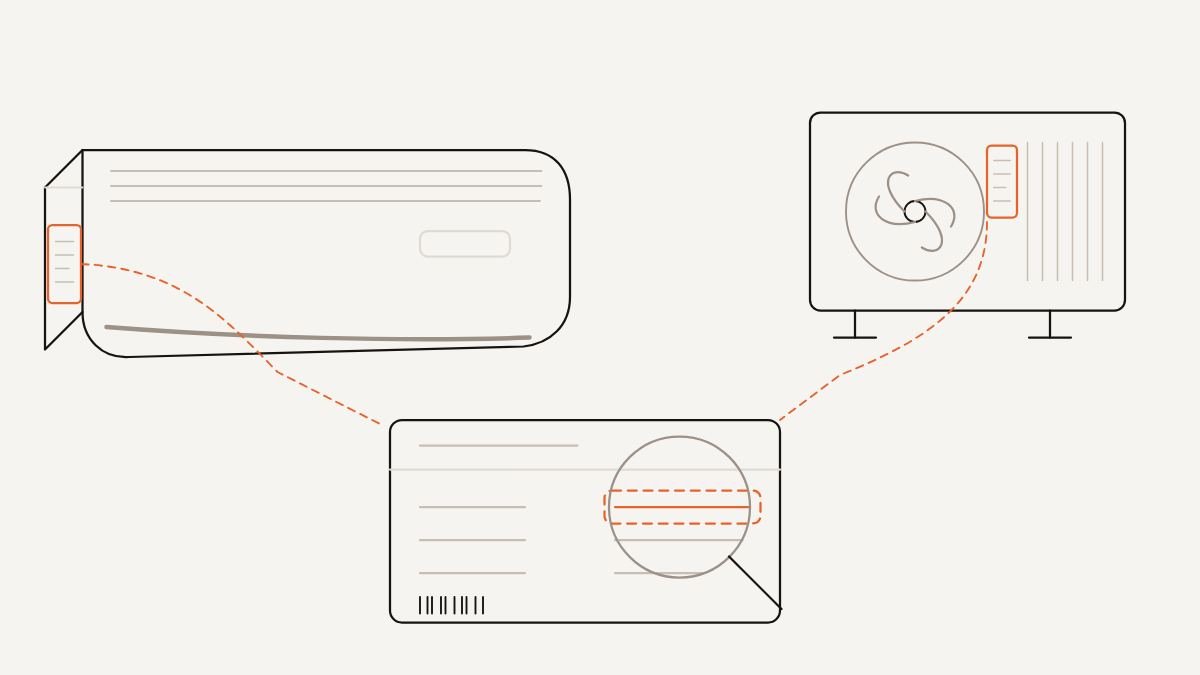
The rating plate sits on the side or back of the outdoor unit, usually a silver label. It carries the model number, the serial number and the electrical data.
Photograph the whole plate rather than copying it out by hand. Because model strings run long and mix letters with digits, a photo removes transcription errors.
The indoor unit carries a plate of its own, often behind the front flap or on the side casing. Send both, since indoor and outdoor pairings matter when a technician looks up a code.
If weather has faded the label, the original paperwork or the installation invoice usually repeats the model. Failing that, our technicians identify the series on site from the cabinet and the board.
What a technician would advise
Ask any experienced technician about a flashing outdoor LED and the first two questions come back the same. They want the count, and they want the model number.
The second piece of advice concerns power cycling. Turning the isolator off hides many codes from view, and it also destroys the evidence before anyone reads it.
So record the pattern first, then decide whether to reset. A code that returns immediately after a reset tells us far more than a code that vanished unrecorded.
Finally, resist the urge to buy a part based on a forum post. A Kelvinator outdoor unit fault light narrows the search, yet it rarely names one component on its own.
What we do with the count when we arrive
Our technicians start with your recording, then confirm the pattern at the unit themselves. Confirmation matters, because a code can change once the system runs again.
Next they match the count against the service documentation for your model family. That step turns a bare number into a short list of suspect parts.
Then the testing begins. Sensor resistance, supply voltage, capacitor condition, fan rotation and refrigerant pressures all go through checks against expected values.
Most visits for a flashing outdoor LED end with a clear answer in a single trip. Where a part needs ordering, an accurate count from you shortens that wait considerably.
Safety, and what to leave alone
The outdoor unit holds mains wiring, a stored charge in the capacitor and an unguarded fan blade. So keep the covers on and keep children well away from it.
You can safely clear leaves from the coil face and check that nothing blocks the air discharge. Confirm the isolator switch sits in the on position as well. Beyond that, stop.
Nobody should open the electrical cover without the right training and the right test equipment. Therefore leave that work to a qualified technician, even when the fix looks obvious.
Do not hose the cabinet down while it flashes. Water forced into the electrical compartment turns a small fault into a much larger and more expensive one.
Where we work and how to reach us
Our technicians work across metropolitan and suburban areas, in houses, apartments and small commercial sites. Wherever the unit sits, the same reading process applies.
Calls about a Kelvinator outdoor unit flashing and not working tend to arrive in clusters during heat waves. Therefore an early call, with the count already recorded, usually earns an earlier slot.
Cost depends on the fault behind the count, the parts involved and the access around the unit. Our pricing page explains the factors that shape a repair quote without guessing at your figure.
When you feel ready, you can book a service and include your flash count in the notes. That single detail often saves a return visit for parts.
Frequently asked questions
What does a flashing outdoor light actually mean?
It means the control board has stored a fault and now reports it as a repeating count of blinks. The count identifies a category of problem rather than a single part. Because the mapping differs by model family, that count needs pairing with your model number.
What is the Kelvinator outdoor light flashing meaning if the indoor unit still works?
The indoor fan can keep running while the outdoor unit sits in a protection state. So you get air movement without cooling or heating. Record the count anyway, since the outdoor board holds the useful information.
Why does my outdoor unit show a yellow light instead of a red one?
Many boards use yellow or amber for status and fault reporting, then reserve red for alarms or power. Therefore a yellow pattern carries the same weight as a red one on those units. Record the colour and the count together.
Does a green light mean everything works normally?
Usually it does, since green commonly reports power or successful communication between the two units. However, a green LED that blinks in a fixed pattern may still carry a code. Count it the same way you would count any other colour.
How do I count the flashes when the pattern runs fast?
Film the light with a phone and play the video back slowly. Most phone cameras capture enough frames to separate blinks that look continuous in real time. Otherwise count only the group that follows the longest pause.
Should I turn the power off and on to clear the code?
Record the pattern before you touch the isolator, because a reset hides the fault from view. One reset does no harm once you hold the count. Repeated resets, though, can damage the compressor over time.
Are Kelvinator air conditioner led fault codes the same across every model?
No, and that limit stands as the single most important point on this page. The same count can mean different things on different series. So the service documentation for your model decides the answer.
What should I tell you when I book a repair?
Give the count, the colour, the model number and what the indoor unit does at the same moment. Add whether the fault appears from cold or only after a long run. Those details shape the parts our technician brings.
The Core of It
A steady light reports a resting system, while a flashing light reports a fault with a number attached. Knowing which one you have decides your next move.
So count the blinks between the long pauses, film the pattern, note the colour and photograph the rating plate. That small pile of evidence does most of the diagnostic work for you.
We will not guess at a count to fault table, because an honest answer beats a confident wrong one. Instead we read your pattern against the right documentation for your unit.
When you have the count written down, get in touch and we will take it from there. Bring the model number too, and the visit gets shorter for everyone involved.
Browse the site
Book a technician
Speak to a qualified technician who works on Kelvinator systems
Call 1300 495 033 and tell us the model and the fault, or book online and we will come back to you.