Error codes
Kelvinator F2 Error Code, Sensor Fault Explained for Owners
Two characters on the display can cost you a whole summer weekend. F2 halts the cooling cycle, the room climbs back to outdoor temperature, and nothing you press on the remote changes it.
Left alone, that halt becomes a habit. The unit restarts, runs briefly, then locks out again. Every one of those false starts adds wear the original fault never called for.
The Kelvinator F2 error code reports a sensor fault. In plain terms, part of the temperature sensing chain has stopped feeding the control board a reading it can trust.
So the earlier you deal with it, the smaller the job usually stays. This guide follows the fault forward, from the first appearance through to the repair sequence a technician follows.
Our work is independent of the manufacturer, and so is our advice.
On this page
- What the Kelvinator F2 Error Code Reports
- How the Sensing Chain Works When Nothing Has Gone Wrong
- What Breaks the Chain and Raises a Kelvinator F2 Fault Code
- When a Kelvinator F2 Error Appears and Why That Timing Counts
- The Chain of Effects When F2 Gets Ignored
- What to Record Before You Call About a Kelvinator F2 Error
- Safe Checks You Can Make Yourself
- How to Reset a Kelvinator Air Conditioner F2 Error Properly
- Repair Options Ordered by Severity
- The Order a Technician Works Through on a Kelvinator F2 Error
- How F2 Differs From the Codes Beside It
- Model Families and Where the Code Shows Up
- What Drives the Cost of a Kelvinator F2 Error Repair
- Maintenance That Keeps the Fault From Returning
- Where We Work and How to Arrange a Visit
- Common Questions About the Kelvinator F2 Error Code
- Tying the Threads Together
What the Kelvinator F2 Error Code Reports
Kelvinator error code F2 flags a sensor fault. A sensor here means a temperature probe, a small component that measures warmth and passes that value to the control board.
The board does not measure anything by itself. Instead, it acts on numbers the probes supply, so a probe it cannot believe leaves the board with no safe option but to stop.
That single idea carries the whole Kelvinator F2 code meaning. The Kelvinator F2 error meaning does not shift with the weather, although the conditions that expose the fault certainly do.
A Kelvinator air conditioner error code F2 therefore names a symptom rather than a part. Testing decides which link in the chain has let go.
Here is the honest part that many guides skip. A Kelvinator air conditioner carries more than one probe, and the exact probe behind F2 varies between model families.
One system may tie F2 to the indoor coil probe. Another may tie the same two characters to the room air probe or to a probe out at the outdoor unit.
Because of that variation, only the label on the unit and the manual written for your specific model confirm which probe applies. Treat any blanket claim about a single part with caution.
How the Sensing Chain Works When Nothing Has Gone Wrong
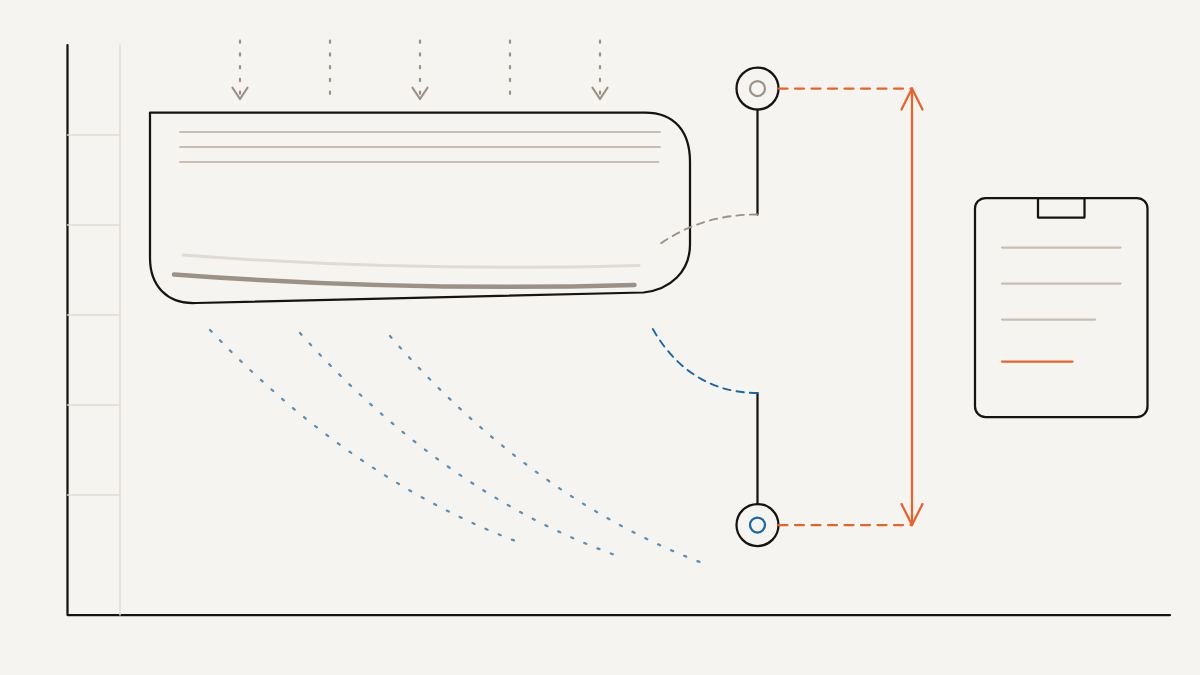
Think of the sensing chain as four links working in order. The probe measures, the lead carries the signal, the plug joins the lead to the board, and the board reads the result.
All four links must hold for a normal run. When they do, the board compares the reading against the target you set and adjusts output to match.
On a Kelvinator inverter model, that adjustment happens constantly. Compressor speed rises and falls in small steps, so the room holds steady rather than swinging between cold and warm.
Because that tuning depends on live readings, a Kelvinator inverter F2 error code stops the whole cycle. Without a trustworthy number, the board has nothing to tune against.
Reverse cycle systems lean on the same chain during heating. The board watches coil temperature to decide when to run a defrost cycle and when to hold off.
Accurate readings therefore drive comfort, running cost and component life at the same time. Once one reading turns unreliable, the board loses its main source of truth about the system.
What Breaks the Chain and Raises a Kelvinator F2 Fault Code
A break can happen at any of the four links. Some causes are mechanical, some come from moisture, and a few follow an electrical event on the supply.
Here are the situations our technicians meet most often behind a Kelvinator fault code F2.
Notice that most of these sit in the wiring rather than in the probe itself. That is why a careful technician tests the whole chain before replacing any component.
- A plug that has worked loose through years of vibration, so the signal drops out intermittently.
- Moisture or corrosion at a terminal, which changes the signal before it reaches the board.
- Cable chafing where a lead passes an edge, caused by movement rather than by any single event.
- A probe whose reading has drifted with age, so it now reports values the board rejects.
- Insects or dust inside a terminal housing, common on units near gardens or in roof spaces.
- Damage to the board input that reads the probe, which is less common but still possible.
When a Kelvinator F2 Error Appears and Why That Timing Counts
The moment the code lands narrows the search sharply. Three patterns come up again and again, and each one points somewhere different.
A Kelvinator split system F2 error rarely arrives at random. Watch the clock from the moment you press start, because that number does real diagnostic work.
A Kelvinator air conditioner showing F2 within seconds of startup usually points to a connection that has failed outright. The board looks for a reading, finds nothing believable, and stops immediately.
By contrast, a code that arrives well into a run suggests drift under heat. The chain holds while everything sits cool, then fails once temperatures inside the unit climb.
A Kelvinator F2 error after power outage forms the third pattern. Supply interruptions and voltage dips can unsettle the board, and some units simply hold the last fault until you clear it.
Heating brings its own version. A Kelvinator reverse cycle F2 error that appears only in winter often relates to the probes the defrost logic depends on.
So note the clock, not just the code. Timing turns a vague complaint into a short list of likely causes.
The Chain of Effects When F2 Gets Ignored
Ignoring the code does not keep the system still. It sets off a sequence of effects that each cost a little more than the last.
First comes the comfort loss. A Kelvinator F2 error not cooling means the compressor stays off while the indoor fan keeps pushing untreated air around the room.
Then comes the cycling. Owners naturally switch the unit off and on again, and each restart draws heavy current for a moment before the lockout returns.
Humidity follows next. Without a working cooling cycle the indoor coil never strips moisture from the air, so rooms feel sticky even when the fan runs hard.
Running cost rises alongside all of it. The fan draws power continuously, the room never reaches target, and the system spends hours achieving nothing useful.
Finally, the fault itself can spread. A corroded terminal that damages one board input today can take a second input tomorrow, which turns a small repair into a large one.
Talk it through with a technician
Tell us the model and what the unit is doing, and we will bring the right parts to the first visit.
What to Record Before You Call About a Kelvinator F2 Error
This step saves more time than any other. A technician who arrives with your notes in hand starts testing rather than starts guessing.
Work through the following list and write the answers down somewhere you can read them out.
Six of those eight answers cost you nothing but attention. Together they often halve the time a diagnosis takes.
- The exact characters on the display, since some models show F2 alone and others pair it with a flashing indicator light.
- Model number and serial number from the label on the indoor unit, because the sensor layout differs between families.
- How long the unit ran before the code appeared, measured in minutes rather than described loosely.
- Which mode you had selected, cooling or heating, and the temperature you had set at the time.
- Whether the indoor fan kept turning after the code arrived, and whether the outdoor unit made any sound at all.
- Any storm, blackout or electrical work in the days before the fault first appeared.
- How many times the code has returned, and whether the gap between returns is shrinking.
- Anything that changed in the space recently, such as new insulation, a new heat source or building work nearby.
Safe Checks You Can Make Yourself
A few checks carry no risk and occasionally clear the problem outright. Stay outside the casing and leave every electrical component alone.
Start with the power. Owners regularly ask how to clear F2 error Kelvinator systems display. A full power down at the isolator or the breaker is the standard first move.
Leave the supply off for several minutes, then restore it and run the unit again. That pause lets the board drop any stored fault rather than resume where it stopped.
Next, look at the filters. Blocked filters starve the coil of airflow, which pushes temperatures away from normal and can expose a marginal sensing chain.
Then check the outdoor unit for leaves, rubbish or a fence built too close. Restricted airflow out there changes coil temperatures indoors as well.
If the code returns after all of that, stop. A Kelvinator F2 error keeps coming back for a physical reason, and further resets simply delay the repair.
How to Reset a Kelvinator Air Conditioner F2 Error Properly
Plenty of owners want to know how to reset Kelvinator air conditioner F2 error displays. A reset is worth one attempt, so long as you read the result honestly.
The remote alone rarely does it. A Kelvinator F2 error reset needs the board to lose power, which means the isolating switch or the circuit breaker rather than the standby button.
Watch what happens on the run that follows. If the unit cools normally for a full cycle, the fault may have been a one off disturbance on the supply.
Should the code return within the same day, treat the reset as a test that has given you information. It has told you the chain has a real break in it.
Repeating the reset over and over does harm rather than good. Each restart loads the compressor, and none of them repairs a corroded plug or a drifted probe.
Repair Options Ordered by Severity
Not every Kelvinator F2 error fix means new parts. Repairs sit on a ladder, and a good technician starts at the bottom rung rather than the top.
The lightest repair is a connection. Cleaning and reseating a plug, or making good a corroded terminal, resolves a fair share of cases on older units.
One step up sits the lead. Where a cable has chafed through, a technician repairs or replaces that section rather than the probe hanging off it.
Next comes the probe itself. When testing shows the component reading outside its expected range, replacement of that single part restores normal control.
Above that sits board work. Damage to the input circuit calls for a control board replacement, which is the point where repair cost and unit age start to matter.
At the top sits the replacement conversation. On a system that is already tired, a technician should tell you plainly when further spending stops making sense.
The Order a Technician Works Through on a Kelvinator F2 Error
Good Kelvinator F2 error troubleshooting follows a sequence. Skipping ahead to parts replacement is how people end up paying twice for the same fault.
Our technicians work through the chain in this order.
That last step matters more than it sounds. A fault that hides while everything sits cool will show itself again during a full run.
- First, confirm the code and read any stored fault history the model keeps.
- Second, check the model documentation, since the probe tied to F2 differs between families.
- Third, inspect every plug and terminal in the sensing chain for corrosion, moisture and looseness.
- Fourth, test the leads for continuity along their full length, including the sections that pass through tight bends.
- Fifth, measure the probe itself against the range the manufacturer documentation gives for that model.
- Sixth, examine the board input only once the wiring and the probe both test sound.
- Lastly, run the system through a complete cycle to confirm the code stays away under load.
How F2 Differs From the Codes Beside It
Kelvinator systems use several codes in the same family, and owners often mix them up. Reading the neighbouring codes helps you confirm you are on the right page.
Our guide to the F1 error code covers the fault that sits immediately before this one in the sequence. Symptoms can look similar from across the room, so the display is the deciding evidence.
The F3 error code guide covers the next code up. If your display alternates between two codes, note both, because that pattern changes the diagnosis.
Further along, our F4 error code page handles a separate fault again. Read whichever page matches the characters you actually see, rather than the one that sounds closest.
Never assume the codes share a cause because they share a letter. Each one directs the technician to a different part of the system.
Model Families and Where the Code Shows Up
The characters look the same across the range, yet the layout behind them does not. That is why model information belongs at the front of any service call.
A Kelvinator KSV F2 error on a wall mounted split system usually involves probes inside the indoor head or out at the condenser. Access is straightforward for a technician with the right documentation.
A Kelvinator KSD F2 error code brings the same logic in a different package. The probe positions and the wiring routes vary, so the model number remains the starting point.
Owners with a Kelvinator HWJ series F2 error should expect the same testing sequence, applied to that series layout. The method holds even when the hardware differs.
A Kelvinator window air conditioner F2 error sits in a more compact chassis. Everything crowds together, which makes careful access and correct reassembly more important than usual.
A Kelvinator wall air conditioner F2 code follows the same pattern as the window style unit. Both types put the electrics close to the airflow path, so dust and moisture matter more.
What Drives the Cost of a Kelvinator F2 Error Repair
Cost depends on where the break sits in the chain. A cleaned terminal and a new control board sit at opposite ends of the range.
Access is the second factor. A high wall unit above a stairwell takes longer to reach safely than one at standing height in a bedroom.
Parts availability matters as well. Components for current model families arrive quickly, while an older series may take longer and narrow the options.
Finally, the state of the rest of the system counts. Where testing uncovers other worn components, an honest technician tells you before the work goes ahead rather than afterwards.
Our pricing guide explains how we structure charges and what shapes a Kelvinator F2 error repair cost. Ask any Kelvinator F2 error technician to confirm the scope of work before starting.
Maintenance That Keeps the Fault From Returning
Sensing faults respond well to prevention, because most of their causes build slowly. Regular attention interrupts that build up before the board ever raises a code.
Wash the filters often through the cooling season. Clean airflow keeps coil temperatures in their normal band, which keeps the probes working inside the range they suit.
Keep the outdoor unit clear all year. Plants, stacked boxes and fence panels close to the coil all push operating temperatures up and stress the sensing chain.
Book a professional service once a year. During that visit a technician inspects terminals, checks for corrosion and tightens connections that vibration has loosened.
Ask about surge protection if your supply is unstable. Homes that lose power frequently see more board and sensor trouble than homes on a steady supply.
In short, the maintenance that prevents F2 is the same maintenance that prevents most other faults. It simply needs doing before the failure rather than after it.
Where We Work and How to Arrange a Visit
We service and repair Kelvinator systems as qualified technicians. We hold no manufacturer relationship, so our advice on repair against replacement stays free of brand pressure.
Our team covers homes and small businesses across the metropolitan area. A Kelvinator F2 error Sydney households report gets the same testing sequence whatever the suburb.
Any Kelvinator air conditioner F2 error Australia wide follows the same underlying logic, although parts supply and access vary by location. Local knowledge helps with both.
If the fault has knocked out cooling in a bedroom or a nursery, tell us when you make contact. Urgency changes how we schedule the visit.
You can book a service online with the notes you recorded earlier. Those details let us arrive prepared rather than exploring from scratch.
Common Questions About the Kelvinator F2 Error Code
What does F2 mean on Kelvinator air conditioner displays?
F2 reports a sensor fault, which means the control board has lost a temperature reading it can rely on. The board stops the cooling cycle instead of running without that information. Because the exact probe varies by model, the manual for your unit confirms which one applies.
What is F2 error on Kelvinator systems in simple terms?
Think of it as the system refusing to guess. A probe, a lead, a plug or a board input has failed, so the reading no longer makes sense. Rather than risk damage, the board holds everything still and shows the code.
How to fix F2 error on Kelvinator air conditioner units?
Start with a full power down at the isolator, then check filters and outdoor clearance. If the code returns, the repair moves to testing the sensing chain, which needs a qualified technician. Repairs range from cleaning a terminal through to replacing a probe or a board.
How to fix Kelvinator F2 code faults without replacing parts?
Sometimes you can, because a fair number of cases trace back to a loose or corroded connection. Cleaning and reseating that connection restores the signal without any new component. Testing decides whether your unit falls into that group.
Why does my Kelvinator F2 error keep coming back after a reset?
A returning code means the underlying break is still there. The reset only clears the stored fault, so the board raises it again as soon as it reads the same bad value. Shrinking gaps between returns usually point to a connection that is failing progressively.
Can a Kelvinator F2 error after power outage clear by itself?
Occasionally it does, because some units simply hold the last fault until the board loses power. One controlled power down and restart tells you which situation you have. If the code survives that test, the fault is physical rather than stored.
Is a Kelvinator aircon F2 error safe to leave until the weekend?
The system will not create a hazard by sitting idle, so a short wait is reasonable. However, repeated restart attempts do add wear, and heat stress in a bedroom matters for young children and older people. Turn the unit off at the wall and arrange a visit.
Does a Kelvinator split system error code F2 affect the refrigerant?
No, F2 concerns the sensing chain rather than the refrigerant circuit. That said, a technician may still check pressures during the visit, because unusual temperatures can have more than one cause. Sensor testing comes first in the sequence.
Tying the Threads Together
The Kelvinator F2 error code marks a sensor fault, and the system stops because it no longer trusts a reading. The break may sit in a plug, a lead, a probe or a board input.
Note when the code appears, record the model details and the run time, then try one clean power down. Those three actions cover everything an owner can safely do.
After that, testing takes over, and it works best in order rather than by guesswork. A Kelvinator aircon error code F2 solved properly should not return within weeks.
Perhaps your Kelvinator AC error F2 has outlasted a reset. Or a Kelvinator air conditioner displaying F2 code has become a weekly event in your home.
Either way, get in touch. Our team can work through the Kelvinator AC F2 error code methodically and tell you honestly what the unit needs.
Browse the site
Book a technician
Speak to a qualified technician who works on Kelvinator systems
Call 1300 495 033 and tell us the model and the fault, or book online and we will come back to you.