Product types
Kelvinator Inverter Air Conditioner Repairs and Servicing
Kelvinator inverter air conditioner reliability shows itself slowly rather than in one dramatic moment. Instead the system slides, cooling a little less each week until the room never reaches the temperature you set.
That slow slide costs money twice. It lifts the power bill first, then it shortens the life of the compressor, which is the single most expensive part in the system.
Because an inverter compressor changes speed rather than switching on and off, it responds to a fault by working harder. So a blocked filter today can become a dead compressor next summer.
This page walks through the cause and the effect. You will see how these systems work, what breaks them, how one small fault spreads and what a repair actually involves.
On this page
- How an inverter split system is meant to work
- Sizes, capacity and the faults a mismatch creates
- What breaks the cycle
- The chain of effects when one fault gets ignored
- How our technicians diagnose an inverter fault
- Repair options ordered by severity
- Maintenance that stops the chain from starting again
- Reliability, lifespan and what a review really tells you
- Choosing a specialist rather than any available trade
- Noise, position and living with the outdoor unit
- The regions we travel to
- Common questions about inverter split systems
- The short version and your next step
How an inverter split system is meant to work
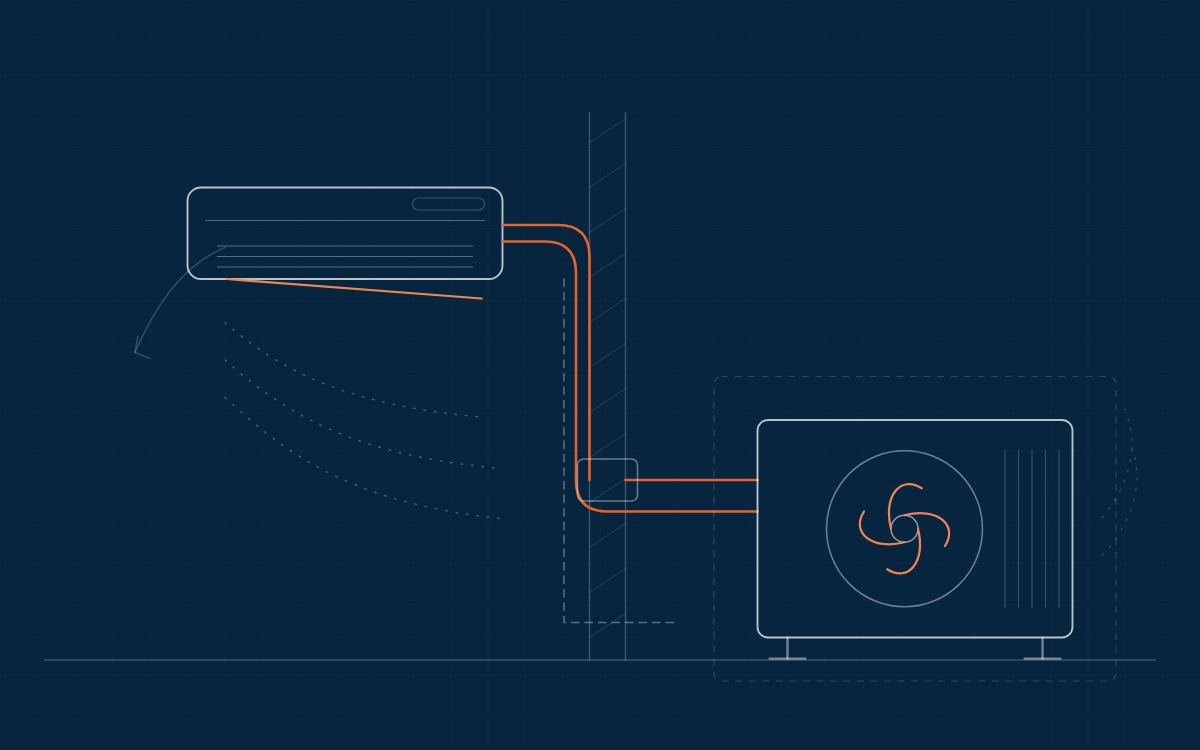
A split system moves heat rather than creating it. The indoor unit pulls heat out of your room, and the outdoor unit releases that heat into the open air.
In heating mode the same loop runs the other way. So one machine covers both seasons, which is why the industry calls it reverse cycle.
Refrigerant carries the heat between the two boxes through a pair of insulated copper pipes. Meanwhile a drain line carries away the water that condenses on the cold indoor coil.
The variable speed compressor
The compressor pumps that refrigerant around the loop. An older fixed speed unit runs the compressor flat out, then stops it dead once the room feels right.
By contrast an inverter model varies the speed of that motor. Therefore it eases back to a gentle hum once the room sits near your chosen temperature.
That steady low speed running uses less energy and holds a far more even temperature. However it also asks much more of the electronics than a basic on and off system.
The trade off matters when something goes wrong. A fixed speed unit simply stops, while an inverter model often keeps struggling and hides the fault for months.
The control board and the sensors
A circuit board reads several small sensors and decides what speed to run. Because those readings drive every decision, one drifting sensor upsets the entire cycle.
Sensors sit on the indoor coil, in the return air path and on the outdoor pipework. When one of them drifts, the board reads a temperature that does not match the real room.
The board then makes a sensible decision from bad information. As a result the system may run flat out in a cool room or barely run in a hot one.
The remote and the manual
Your Kelvinator inverter air conditioner remote does far more than set a number. It also chooses the mode, the fan speed, the louvre position and any timer or sleep function.
Plenty of callouts turn out to be a settings problem rather than a mechanical fault. Economy mode, a timer left on or a fan only setting all mimic a broken system.
So read the Kelvinator inverter air conditioner manual before you assume the worst. Five minutes with the mode button can save you an entire service call.
Settings that quietly undo good hardware
A well fitted system still disappoints when the settings fight it. Most of those settings sit on the remote, and most owners never touch more than two of them.
Start with the set point. Every degree lower in cooling asks the compressor for more work, so a sensible temperature does more for the bill than any gadget.
Leave the fan on automatic rather than on low. Low fan speed feels gentle, although it starves the coil and makes the room take far longer to settle.
Point the louvres high in cooling and low in heating. Cold air falls while warm air rises, so working with that habit spreads the temperature evenly.
Use the timer instead of leaving the unit running for an empty house. A short pre cool before you get home costs far less than eight hours of holding an empty room.
Finally, resist the urge to switch the system off and on through the day. An inverter works best once it settles into a long steady run at low speed.
Sizes, capacity and the faults a mismatch creates
Capacity decides how hard the system must work every single day. A unit that is too small never catches up, while an oversized one short cycles and leaves the air damp.
Installers match capacity to the room rather than to a rule of thumb. Kelvinator inverter air conditioner sizes vary between models, so treat the following as rough guidance only.
Insulation, ceiling height, glazing and the direction the windows face all change the answer. For example a west facing room with large windows needs more capacity than the floor area suggests.
Getting this wrong creates symptoms that look exactly like a breakdown. An undersized unit runs at full speed all afternoon and still leaves the room warm and sticky.
By contrast an oversized unit fails in the opposite way. It reaches the set point quickly, then drops to minimum speed and never runs long enough to strip moisture from the air.
- Small bedrooms and studies sit at the bottom of the range, where the smallest capacity is usually plenty.
- A larger bedroom or a modest lounge tends to need the next step up from that.
- Open lounge and combined living areas call for something well above bedroom capacity.
- Large open plan spaces with high ceilings need the top of the domestic range, or more than one head.
One head or several from the same outdoor unit
Some homes run several indoor heads from a single outdoor box. That saves wall space outside, though it changes how the system behaves when only one room is in use.
Running one small head off a large outdoor unit pushes the compressor to its slowest setting. Then the system spends its life at minimum output, which suits neither comfort nor the machine.
Faults spread further on that layout as well. A leak or a board failure outside takes every room offline at once, while separate systems fail one at a time.
So ask about both options before committing. The right answer depends on how many rooms you actually condition at the same time.
What breaks the cycle
Most Kelvinator inverter air conditioner problems trace back to a short list of causes. Some you can prevent with a cloth and ten minutes, while others need gauges and a licence.
Blocked filters and dirty coils
Dust settles on the indoor filters first, then works its way onto the fins behind them. As airflow falls, the indoor coil runs colder than the designers intended.
Routine Kelvinator inverter air conditioner cleaning prevents almost all of this. Wash the filters yourself, and let our technicians deal with the coil, the barrel fan and the drain tray.
Coil cleaning matters more than most owners expect. A thin grey film across the fins cuts heat transfer badly, even though the coil still looks reasonably clean.
Low refrigerant and leaks
Refrigerant does not burn away during normal running. So if the charge falls, a leak exists somewhere in the pipework, a flare joint, a coil or a service valve.
A Kelvinator inverter air conditioner regas without a leak repair simply wastes your money. Our technicians locate the leak first, repair it, then weigh in a fresh charge.
Low charge starves the compressor of cooling and lubrication. Therefore a system that loses gas twice in two seasons usually ends up needing a much larger repair.
Electrical and control board faults
Surges, moisture, vermin and insects all damage outdoor control boards. Once the board misreads its sensors, the compressor either sits idle or runs at the wrong speed for hours.
These faults usually announce themselves as Kelvinator inverter air conditioner error codes. The indoor display shows a code, or the operation lights flash a repeating pattern.
Capacitors, contactors and terminal blocks also fail with age and heat. A loose terminal can arc quietly for months before it finally burns out a connection.
Outdoor unit and airflow restrictions
The outdoor unit needs clear air on every side to shed heat. Shrubs, fences, bins and stored boxes trap hot air around the coil and drive the pressure up.
When pressure climbs too far, the system protects itself and shuts down. Then it restarts, struggles again and finally locks out with a fault rather than risking damage.
Drainage and water marks
The indoor coil produces water whenever the system cools. That water runs into a tray, then out through a drain line to the garden or a downpipe.
Slime, dust and insect nests block that line easily. Once the tray overflows, water stains the wall below the unit and can reach flooring and skirting boards.
The chain of effects when one fault gets ignored
A neglected filter rarely stays a filter problem. Instead it triggers a chain of consequences that ends at the most costly component in the entire system.
Here is how that chain usually unfolds over a season or two.
Every step in that list costs more than the step before it. Therefore simple Kelvinator inverter air conditioner troubleshooting in the first month avoids the largest bill at the end.
The same chain explains an inverter system that stops cooling during a hot spell. A weakened system copes in mild weather and gives up completely once the load rises.
Winter exposes a different link in the chain. A unit that will not heat usually points at the reversing valve, the defrost cycle or an outdoor sensor.
Because heating uses the same loop in reverse, one stuck component removes the whole mode. Cooling may still work perfectly, which confuses owners into thinking the unit is fine.
Sound gives you early warning long before a shutdown. Rattles, a rising whine or a knock from the outdoor unit all deserve attention within days rather than months.
- Airflow across the indoor coil drops because dust coats the filter and the fins.
- The coil runs colder than its design temperature and starts to collect frost.
- Frost turns to ice, blocks the fins and cuts airflow even further.
- Liquid refrigerant returns to the compressor instead of gas and washes away the oil film.
- The board reads odd pressures and throws a fault code at the display.
- Bearings and windings wear, current draw climbs, and finally the compressor fails outright.
Why the power bill moves before the fault shows
An inverter system hides its own decline for a while. Because the compressor can simply run longer and faster, the room still feels right while the meter ticks over harder.
That is why a rising bill often arrives before any complaint about comfort. A summer that costs noticeably more than the last one, in a home that has not changed, is worth a look.
Compare like with like before you worry. Weather, a new occupant, a home office or a swimming pool pump all move the same number.
If nothing else has changed, suspect airflow first. Dust on the filters and the coil forces longer run times, and longer run times show up as energy long before they show up as warm rooms.
Talk it through with a technician
Tell us the model and what the unit is doing, and we will bring the right parts to the first visit.
How our technicians diagnose an inverter fault
Diagnosis follows that chain backwards. Our technicians start at the symptom, then trace towards the cause rather than swapping parts and hoping for the best.
Reading the codes and the flashing lights
The indoor display and the outdoor board both hold useful clues. A code narrows the search to one subsystem, although it rarely names the exact failed component.
For example, a code pointing at the indoor coil sensor has several possible causes. A failed sensor, a loose plug or a damp connector all produce the same reading.
Measuring what the board cannot see
Gauges, clamp meters and temperature probes tell the real story. They reveal operating pressures, compressor current draw and the temperature split across the indoor coil.
That split matters most of all. When air leaving the unit sits close to room temperature, the system moves very little heat regardless of what the display claims.
Checking the installation before blaming the unit
Many stubborn faults trace straight back to the original fitting. Pipe run length, bracket vibration, drain fall, cable size and charge weight all deserve a proper look.
A machine cannot correct a poor install. So our technicians check those basics early, especially on a system that has never performed well since the first day.
Repair options ordered by severity
Not every fault deserves the same response. Our technicians sort the work by how far along the chain the problem has already travelled.
Minor work you can manage yourself
Filter washing, clearing space around the outdoor unit and checking remote settings all sit here. None of it requires tools, refrigerant handling or an electrical licence.
Still, stop at the cabinet. Anything behind a cover involves mains voltage and sealed refrigerant, so hand that work to a qualified technician instead.
Moderate repairs finished in one visit
Sensor replacement, capacitor faults, drain clearing and fan motor work belong in this group. Most jobs of that size finish inside a single visit.
Common Kelvinator inverter air conditioner parts remain available for popular models. However, Kelvinator inverter air conditioner spare parts for discontinued lines sometimes take a fortnight to arrive.
So ask about availability while the technician is still on site. Knowing that a board is a special order changes whether you wait, hire a portable unit or plan a replacement.
Ask any technician whether they carry sensors and capacitors on the van. A stocked vehicle turns a two visit job into one, which lowers the total labour charge.
Major repairs and the replacement decision
Compressor failure, a burnt control board or a leaking indoor coil all count as major. At that point the repair cost starts to approach the cost of a whole new system.
Our technicians lay out the facts and leave the choice with you. If the system still has good years ahead, repair makes sense, otherwise replacement usually wins.
Our air conditioner repairs page explains how a callout runs from first phone call to final test. Read it if you want to know what to expect on the day.
Maintenance that stops the chain from starting again
Sound Kelvinator inverter air conditioner maintenance costs a fraction of a compressor. Once a year suits most homes, and twice a year suits dusty, coastal or heavily used systems.
A full Kelvinator inverter air conditioner service covers far more than a filter wash. Our technicians measure pressures and current draw, then check drainage, electrical connections and both coils.
Regular care also protects the Kelvinator inverter air conditioner warranty. The manufacturer handles that warranty directly, and it generally expects evidence of proper upkeep.
Our workmanship guarantee sits entirely separate from the Kelvinator warranty. So keep the paperwork from every visit together in one folder or one email thread.
- Wash the indoor filters every few weeks through heavy cooling or heating use.
- Keep at least an arm span of clear space around the outdoor unit.
- Run the system briefly in the opposite mode each season so parts keep moving.
- Book the visit before the season starts rather than during the first heatwave.
- Report new noises, smells or water marks early instead of waiting for a shutdown.
The off season and what to do with the system
Most homes leave the system idle for part of the year. So a little care at the changeover keeps the next season from starting with a fault.
Run the system in the opposite mode for a while before you park it. That circulates oil, exercises the reversing valve and dries moisture out of the indoor unit.
Wash the filters before storage rather than after. Dust left sitting on a damp coil for months is exactly how a musty smell starts.
Leaving power on at the isolator is usually fine, since the crankcase heater and the controls draw very little. However, switch off at the isolator before any cleaning around the outdoor unit.
Installation quality shapes everything that follows
A rushed Kelvinator inverter air conditioner installation creates faults for the next decade. Overlong pipe runs, weak brackets, poor drain fall and an incorrect charge all surface eventually.
Ask exactly what the work includes before you accept any quote. Pressure testing, vacuum time, charge adjustment and a written commissioning check all matter.
Ask about the outdoor position too. A unit baking against a west wall works harder every afternoon than one tucked into shade with clear airflow.
Reliability, lifespan and what a review really tells you
Owners ask about reliability more than almost anything else. Much of it depends on install quality, servicing habits and how hard the system works.
The Kelvinator inverter air conditioner lifespan depends far more on care than on the badge. Neglect can halve it, while yearly attention stretches it well beyond expectations.
Owners often line up Kelvinator against Daikin or another premium badge. Yet that comparison misses the more useful question, because fitting and servicing outweigh the brand.
A well fitted budget unit routinely outlasts a neglected premium one. So the trade doing the work deserves at least as much research as the box on the wall.
When you read a Kelvinator inverter air conditioner review, look past the star rating. Check whether the writer mentions the installer, the room size and how many summers they have owned it.
One bad review after a poor install says little about the machine. Meanwhile a pattern of the same fault across many owners does tell you something real.
People also hunt for the best Kelvinator inverter air conditioner. Best model lists rarely survive contact with a real house, because the right choice follows your room, your climate and your budget.
Kelvinator inverter air conditioner prices move with capacity, features and the retailer of the day. So compare the installed figure rather than the sticker on the carton, since fitting can swing the total either way.
If you rent or move often, weigh a fixed system against portable units before you commit. Likewise consider cooling only models in a home that already has good heating.
Reading a comparison table without being misled
Published figures come from laboratory conditions rather than from your lounge room. They still help, although only when you compare like with like.
Check the star rating for both cooling and heating, since a unit can score well in one mode and poorly in the other. Also check the rating at the capacity you actually need.
Noise figures deserve the same care. Manufacturers quote the quietest fan speed, whereas your unit spends hot afternoons nowhere near that setting.
Warranty length looks like a quality signal, though the conditions attached matter far more. Read what the terms expect of you in maintenance before you treat a long period as reassurance.
Choosing a specialist rather than any available trade
Any licensed refrigeration technician can legally work on these systems. Even so, a specialist meets the same boards, sensors and fault patterns every week.
That familiarity shows up as speed. A technician who recognises a code on sight skips an hour of elimination that a newcomer has to work through.
It also shows up in the parts on the van. Somebody who services these units regularly stocks the sensors and capacitors that fail most often on them.
Ask three questions before you book. Find out how often they see this brand, whether they test before quoting, and who actually attends on the day.
Ask about the licence as well, because refrigerant handling requires a current one. A trade that hesitates over that question has answered it already.
Noise, position and living with the outdoor unit
Inverter systems run quieter than older units, yet they run for far longer. So a low hum at two in the morning matters more than a loud burst at midday.
Position decides most of that. A unit bolted to a bedroom wall transmits vibration through the brickwork, while one on a well isolated bracket barely registers.
Anti vibration mounts and a rigid base cost very little at installation. Retrofitting them later costs far more, because the pipework usually has to come off first.
Think about your neighbours too. A unit facing a boundary window can turn into a dispute, whereas the same unit turned ninety degrees causes nobody any trouble.
Airflow still comes first though. Never box the outdoor unit in for the sake of appearance, since a starved coil raises pressure and shortens the life of the compressor.
The regions we travel to
We service homes and small businesses across much of Australia. So if you want someone nearby, start with who genuinely attends your street.
Interest in Kelvinator inverter air conditioner Australia wide keeps climbing as split systems replace older wall boxes. Yet coverage varies suburb by suburb, and travel distance affects both timing and cost.
Searches from across Sydney rise sharply during every heatwave. Coastal salt drives many of those jobs, because it corrodes outdoor fins and shortens coil life near the water.
Calls from across Melbourne peak in the cold months instead. Heating faults, defrost problems and reversing valve failures dominate once the temperature drops.
Wherever you live, ask whether the Kelvinator inverter air conditioner technician holds a refrigerant handling licence and insurance. Also ask whether they test before quoting rather than after.
A technician who meets these systems every week has an advantage. As a result they diagnose faster, guess less and finish more jobs on the first visit.
Common questions about inverter split systems
Why is my Kelvinator inverter air conditioner not working at all?
Start with power, because a tripped breaker or an isolator switch causes many dead systems. Next check the remote batteries and the mode setting on the display.
If power reaches the unit and nothing happens, the fault usually sits in the board, the capacitor or the compressor. At that stage a technician needs to test the circuit safely.
What do the error codes on the display mean?
A code points to a subsystem rather than a single component. For example a sensor code tells you which sensor circuit misbehaves, though not whether the sensor, the plug or the wiring failed.
Write the code down before you switch the power off. Then a technician arrives already knowing where to look, which shortens the visit.
How often should an inverter split system have a service?
Once a year suits most households, ideally just before the season of heaviest use. Homes near the coast, near busy roads or with pets often benefit from twice yearly attention.
Regular servicing catches airflow and refrigerant issues while they remain cheap. In short, it interrupts the chain long before the compressor pays the price.
Does an inverter system need a regas every year?
No, and any technician who suggests otherwise deserves a second opinion. A sealed system holds its charge indefinitely unless a leak develops.
So if the charge keeps falling, the correct answer involves finding and fixing the leak. Topping up alone treats the symptom and leaves the cause in place.
Why does my unit cool well but refuse to heat?
Heating uses the same refrigerant loop running in reverse. Therefore a stuck reversing valve, a failed outdoor sensor or a defrost fault stops heating while cooling continues normally.
Frost on the outdoor coil during heating is normal in short bursts. However thick ice that never clears signals a defrost problem worth investigating.
What does a repair cost?
Cost follows the part, the labour time and the access to the unit. A sensor on a ground floor wall costs far less to change than a board on a roof mounted outdoor unit.
Refrigerant work adds time because of testing and recovery requirements. Our pricing guide explains the drivers without pretending every job looks the same.
Is it cheaper to leave an inverter running all day?
Not usually, although the answer depends on how long the house sits empty. A short absence of an hour or two suits leaving the system running at a steady set point.
For a full working day, a timer that starts an hour before you return costs less. So match the habit to the gap rather than following one rule all year.
Why does the outdoor unit keep changing speed?
That is the inverter doing exactly what it should. The compressor lifts its speed when the room drifts from the set point, then eases back once the temperature settles again.
A unit that instead surges to full speed and stops dead is worth a look. That pattern suggests the drive has dropped back to simple on and off behaviour.
Can I fix an inverter split system myself?
You can wash filters, clear the outdoor unit, check the remote and reset the breaker. Beyond that, both the electrical side and the refrigerant side require a licence.
Opening a sealed system without training risks injury and an expensive mistake. In addition it can void the manufacturer warranty on the appliance.
Will a repair affect the manufacturer warranty?
The manufacturer sets the terms of the Kelvinator warranty, and the manufacturer administers any claim under it. We are not the manufacturer, so we always tell you when a claim looks like the better route.
Keep receipts and service records together, because warranty assessors ask for maintenance history. Our own guarantee then covers the workmanship we provide.
The short version and your next step
An inverter system fails gradually, which means early action always costs less. Because the chain starts with airflow and refrigerant, cleaning and yearly servicing prevent most serious repairs.
Learn the sound of your system when it runs well. Then any change in noise, airflow or run time becomes an early warning rather than a surprise breakdown.
What a repair comes to varies with the fault, the parts and the access. Ask any quote to separate labour from parts, because a single figure with no detail explains nothing.
If your system struggles today, book a service and describe exactly what you notice. Tell us the code, the noise and the timing, and our technicians arrive prepared.
Browse the site
Book a technician
Speak to a qualified technician who works on Kelvinator systems
Call 1300 495 033 and tell us the model and the fault, or book online and we will come back to you.