Product types
Kelvinator Reverse Cycle Air Conditioner Repairs, Service and Replacement
You are standing in front of a wall unit that blows air with no real warmth in it. Now you face a choice. Do you pull the filters out, book a technician, chase a part or price a new system?
That single fork sits behind almost every search about Kelvinator reverse cycle air conditioner problems. The right answer depends on what the unit does, how long it has run and what a technician finds once the covers come off.
Guessing costs money, because a filter clean and a full changeover sit a very long way apart. So this guide walks the choice down a ladder, one rung at a time.
Each rung tells you what to look at, what the symptom usually means and when to stop and hand the work over.
On this page
- What Reverse Cycle Actually Means on These Systems
- The Decision Ladder in Order
- Rung One, Cleaning and the Simple Resets
- Owner Jobs and Licensed Work, Where the Line Sits
- Settings People Blame on the Machine
- Controlling the System From an App
- How Heating Mode Behaves in Cold Weather
- Heating a Room That Never Feels Warm
- Rung Two, When a Service Visit Is the Right Answer
- Getting Ready for Each Season
- Coastal Air, Dust and What They Do to a Coil
- Storm Damage and What Your Insurer Wants
- Systems Left Unused for a Season
- Rung Three, When the Job Becomes a Repair
- What the Reversing Valve Does When It Fails
- When Nobody Can Find the Fault
- When the Original Installation Is the Real Fault
- Buying, Moving or Inheriting a Used System
- Rung Four, Replacement and New Installation
- Energy Labels and What the Stars Mean
- Refrigerants and Why They Keep Changing
- Multi Head and Ducted Versions of the Same Idea
- What It Costs to Run in Heating Mode
- What Drives the Cost of Each Path
- Myths That Cost Owners Money
- What a Good Outcome Looks Like
- Where You Can Book Us
- Questions Owners Ask Us Most
- Bringing the Ladder Together
What Reverse Cycle Actually Means on These Systems
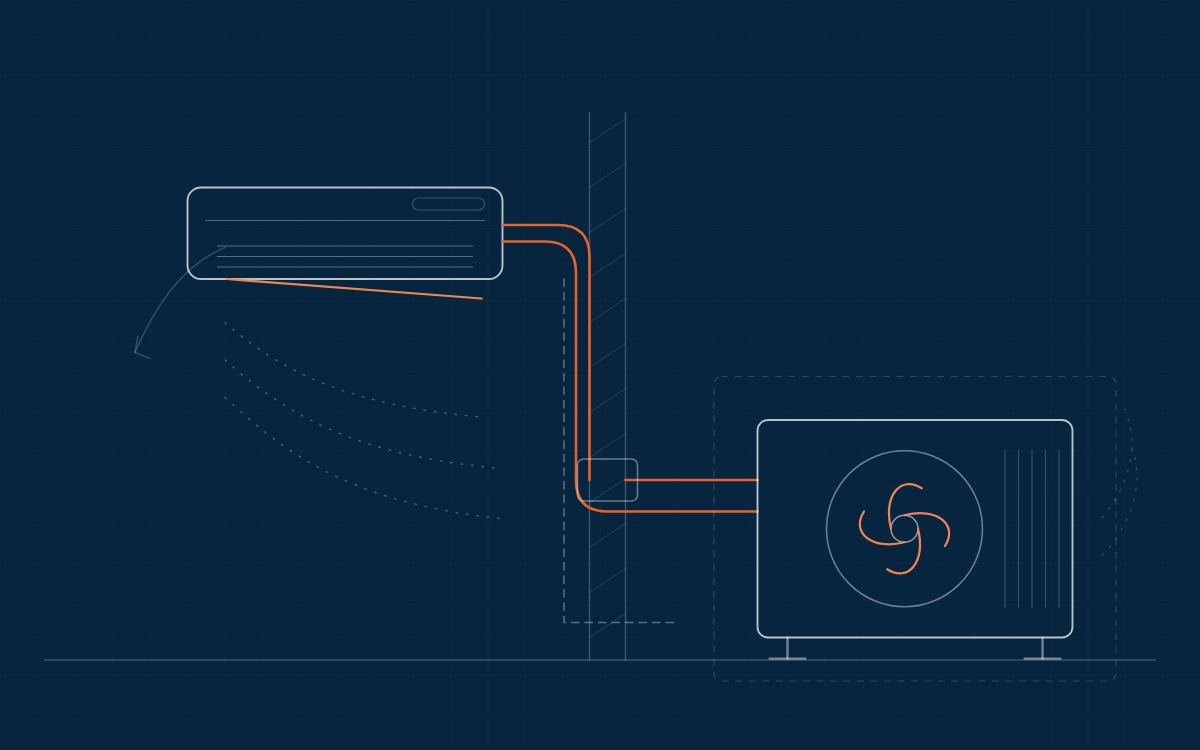
A reverse cycle system moves heat rather than creating it. In summer it carries heat out of your room and dumps it outside through the outdoor coil.
Come winter the same machine runs backwards. A reversing valve flips the direction of the refrigerant, so the outdoor coil gathers heat from cold air and the indoor coil releases it.
That valve is the reason one box handles both seasons. It also explains why a unit can cool beautifully and still heat poorly, or the other way around.
If yours only ever cools, you have a different machine, and our guide to cooling only systems covers that path instead.
The Parts You Will Hear a Technician Mention
Because every one of those parts can fail on its own, symptoms overlap. Weak heating, for example, can come from a blocked filter, a lazy valve or low refrigerant.
- The compressor, which pumps refrigerant around the circuit and does the heavy work.
- Two coils, which swap heat between refrigerant and air at each end.
- A reversing valve, which decides whether the system heats or cools.
- Indoor and outdoor fans, which move air across those coils.
- The control board and sensors, which read temperatures and drive everything else.
The Decision Ladder in Order
Work through these steps in sequence and stop at the first one that solves the problem. Most owners find their answer in the first three.
This order matters because each step rules out the cheaper causes first. Skipping ahead often means paying for a diagnosis that a wash cloth would have handled.
Check power, the remote and the mode setting, then reset the unit at the isolator.
Pull the filters, wash them and look at the indoor coil behind them.
Watch the outdoor unit for a minute and listen for the fan and the compressor.
Write down any code that flashes on the indoor display or the remote screen.
Book a service if the unit runs but performs badly with clean filters.
Call for a repair if the unit stops, trips power or shows a fault code.
Ask about replacement only after a technician has priced the repair.
Rung One, Cleaning and the Simple Resets
Most of the faults owners solve alone come down to airflow. When the indoor unit cannot breathe, it cannot move heat in either direction.
Start with the filters. Lift the front panel, slide them out, rinse them under a tap and let them dry fully before they go back in.
Filters, Coils and Drains
Behind the filters sits a fine aluminium coil. If it looks grey and furred, a proper Kelvinator reverse cycle air conditioner cleaning by a technician will do far more than another filter wash.
Water dripping from the indoor unit usually points at the drain rather than a leak of refrigerant. Dust and slime build up in that pipe and back the water up into the tray.
Outside, clear leaves and grass clippings away from the fan grille. Because the outdoor coil breathes hot air out in summer and pulls heat in during winter, anything blocking it hurts both modes.
Checks you can safely make
Stay outside the electrical side of the unit and you cannot do much harm. Filters, vents, the drain outlet and the space around the outdoor box are all fair game.
Feel the air at the indoor grille and compare it with room air. Then walk outside and feel the air leaving the outdoor fan while the system runs.
In heating mode the outdoor air should feel cold and the indoor air warm. If both feel much the same, the system is moving very little heat.
The Remote and the Manual
A surprising share of calls end at the handset. A Kelvinator remote can sit in fan mode, in a low fan speed or on a timer that nobody remembers setting.
Change the batteries, select heat or cool clearly and set a temperature well past the room reading. Then wait several minutes, since many systems delay the compressor after a mode change.
If the buttons make no sense, find the manual for your model on the manufacturer website. The model number sits on a sticker along the bottom edge or side of the indoor unit.
Owner Jobs and Licensed Work, Where the Line Sits
Owners can safely do more than they think, and less than the internet suggests. The boundary follows the refrigerant and the wiring.
Filters, vents, drain outlets and the space around the outdoor unit all belong to you. None of that work needs a licence or a tool you do not already own.
Anything inside the sealed circuit belongs to a licensed technician. Australian law restricts refrigerant handling, so a top up at home is neither legal nor safe.
Electrical work sits behind the same line. A cover held on with screws is a warning rather than an invitation.
Insurance follows the licence as well. Damage that traces back to unqualified work rarely ends well once a claim reaches an assessor.
Settings People Blame on the Machine
Plenty of complaints turn out to be instructions rather than faults. Auto mode is the classic example, because it chases a target and switches between heating and cooling on its own.
Fan speed matters more than owners expect. A unit left on the quietest setting moves very little air, so the room warms slowly and the vent feels weak.
Louvre position changes the result again. Warm air rises, therefore heating works best with the blades pointed down and cooling works best with them level.
Sleep and economy settings quietly drift the target temperature over several hours. If the room feels wrong late at night, check whether one of those settings is running.
Timers cause the rest. A timer set months ago will still switch the system off at the same hour, long after anyone remembers programming it.
So work through the handset before you book anything. Our remote control guide explains what each symbol on the display means.
Talk it through with a technician
Tell us the model and what the unit is doing, and we will bring the right parts to the first visit.
Controlling the System From an App
Many owners now run the system from a phone. That convenience brings a handful of faults which never existed on a handset.
A dropped connection is the usual complaint. The unit keeps working on its last instruction, so the room feels wrong while the app shows nothing at all.
Check the router before you blame the machine. A new modem, a changed password or a busy band all break the link in the same way.
Firmware updates arrive quietly in the background. If the app behaves oddly after one, restarting both the app and the unit usually settles it.
Then keep the handset somewhere safe. When the network fails, that piece of plastic is still the fastest way to run the system.
How Heating Mode Behaves in Cold Weather
Heating asks more of the system than cooling does. On a cold morning the outdoor coil has very little heat to gather, so the unit works harder for a smaller result.
Warm up delays are normal. After you select heat, the indoor fan often waits a minute or two until the coil has something worth blowing into the room.
Frost on the outdoor coil is also normal in winter. The system runs a defrost cycle to clear it, and during that cycle the indoor air turns cool for a few minutes.
Steam rising off the outdoor unit belongs to the same process. Although it looks alarming, it simply means the ice has melted and the water is evaporating.
What is not normal is ice that never clears, or defrost cycles every few minutes. Both patterns point at a sensor, a valve or a low charge.
Cold snaps also expose undersizing. A system that copes in autumn can fall behind once the outside temperature drops near freezing.
Heating a Room That Never Feels Warm
Plenty of complaints turn out to be comfort rather than fault. The system makes heat, yet the room still feels cool down at floor level.
Warm air rises and gathers near the ceiling. So a head blowing horizontally can leave a cold layer exactly where people sit.
Point the louvres down in heating mode and lift the fan speed. Moving more air mixes the room instead of stacking heat above your head.
A ceiling fan on a slow reverse setting helps for the same reason. It nudges the warm layer back down without creating a draught.
Close the doors on rooms you are not heating. One head cannot warm a whole house through an open hallway.
If the room still lags, feel the air at the grille. Warm air at the vent with a cold room points at airflow rather than at the machine.
Rung Two, When a Service Visit Is the Right Answer
Sometimes nothing has broken. The unit runs, the fan spins and air comes out, yet the room never quite gets there.
That pattern usually calls for a reverse cycle service rather than a repair. A service restores capacity that dirt and drift have quietly taken away.
What Our Technicians Do on a Service
Annual servicing suits most homes, while dusty sites or heavy year round use justify two visits. A service also catches small faults before they strand you in a heatwave.
In short, a service is planned spending. A repair is unplanned spending, and the first tends to reduce the second.
- Deep clean the indoor coil, the fan barrel and the drain line.
- Wash the outdoor coil and clear the space around the outdoor unit.
- Measure supply and return air temperatures in both heating and cooling.
- Check operating pressures and confirm the refrigerant charge looks correct.
- Tighten electrical connections and read the current the compressor draws.
- Test the reversing valve by running the system in both modes.
Getting Ready for Each Season
Two short jobs a year prevent most of the misery. Before summer, wash the filters, clear the outdoor unit and run cooling for half an hour while nothing depends on it.
Ahead of winter, repeat the same checks in heating mode. A fault found in April is a booking, whereas the same fault found in July is an emergency.
Listen while the system runs through that test. New rattles, a longer start delay or a weaker vent all deserve attention before the season loads the machine up.
Planned maintenance also protects the compressor, which is the one part nobody wants to replace. Clean coils and correct airflow keep its working pressures where they belong.
Keep a note of what you did and when. That short record tells a technician more than a description of the noise ever will.
Coastal Air, Dust and What They Do to a Coil
Where a system lives decides how long it lasts. Salt, dust and smoke each attack the outdoor unit in their own way.
Salt air corrodes aluminium fins and the joints behind them. Within a few streets of the surf, that process runs fast enough to notice.
A fresh water rinse every few months slows it down. Use a gentle spray rather than a pressure washer, which folds fins flat in seconds.
Inland the enemy is fine dust. It packs between the fins, and the coil then rejects less heat with every hot week that passes.
Bushfire smoke leaves a sticky film across both coils. After a smoky season a proper coil clean does more for output than any setting change.
So match the service interval to the site. A coastal or dusty home earns two visits a year, while a sheltered suburb usually does not.
Storm Damage and What Your Insurer Wants
Hail, flood and falling branches all reach the outdoor unit. Because it lives outside, it takes weather that the rest of the system never sees.
Photograph any damage before anybody touches it. Insurers ask for images of the unit in place, along with the model and serial numbers.
Bent fins and a dented cabinet matter more than they look. Air has to pass through those fins, so a flattened section costs capacity every day.
Flood water is the harder case. A unit that has stood in water needs a proper inspection rather than a hopeful restart.
Ask your insurer whether the policy covers the appliance or only the building. That answer often decides how the claim proceeds.
Systems Left Unused for a Season
Holiday houses and spare rooms bring their own faults. A unit that sits idle for months rarely starts as cleanly as one in daily use.
Insects and geckos treat a quiet outdoor unit as shelter. They nest around terminals, and a short circuit follows in the first week of the season.
Seals and drain lines dry out as well. The first run of summer then pushes water along a path that has partly closed up.
So run the system for half an hour every few weeks. That habit keeps the compressor lubricated and clears the drain before it matters.
Then book a service ahead of the season rather than during it. A fault found in a quiet week is an appointment, while the same fault in January is a wait.
Rung Three, When the Job Becomes a Repair
Move to this rung when the unit stops, trips power or shows a code. At that point the job needs a licensed technician rather than more cleaning.
A good repair starts with measurement, not part swapping. Our technicians read pressures, temperatures, voltages and control signals before naming a cause.
Error Codes and Fault Codes
Codes appear as flashing lights or as letters on the display. Write down exactly what you see, including how many times each light blinks.
Those codes narrow the search enormously. A sensor code sends the technician to a thermistor, while a communication code points at wiring between the indoor and outdoor units.
However, a code names a symptom, not a culprit. Careful troubleshooting on a reverse cycle system still has to prove which component actually failed.
When It Cools but Will Not Heat
A unit that cools well and heats badly often has a reversing valve that sticks or leaks internally. Low refrigerant produces the same complaint, because heating asks more of the charge than cooling does.
Ice on the outdoor coil during winter can be normal for short periods. If the defrost cycle never clears it, though, a system that is not heating properly has a real fault behind it.
The mirror image also happens. A unit that is not cooling in summer may have a dirty outdoor coil. A tired fan or a leak in the pipework produces the same complaint.
Noises That Point Somewhere Useful
Sound tells a technician a great deal before any gauge goes on. A steady hum with no airflow suggests a fan motor or capacitor rather than a refrigerant problem.
Rattles usually mean loose panels, a fan blade catching debris or brackets that have worked loose. Gurgling from the indoor unit points at the drain line instead.
A loud click followed by silence often means the compressor tried to start and gave up. Because repeated attempts damage the compressor, switch the system off and book help.
Refrigerant and Regas Work
Refrigerant does not get used up. So a regas on a Kelvinator system only makes sense once someone finds and fixes the leak that let the gas escape.
Our technicians pressure test the circuit, trace the leak, repair the joint or component and then weigh in a fresh charge. Simply topping the system up wastes your money and vents gas into the air.
What Happens During a Repair Visit
A visit opens with questions rather than tools. What changed, when did it change and does the fault appear in both modes.
Then the system runs while readings come in at both ends. Because many faults only appear under load, that running time earns its place.
Once the cause is plain, you hear the options and the reasoning behind them. Some repairs finish inside the hour, while others wait on a part.
Finally the technician repeats the opening readings. Numbers before and after are the only honest proof that the fault has gone.
Parts, Boards and Availability
Common Kelvinator parts include fan motors, capacitors, sensors, control boards and the reversing valve itself. Availability varies with the age of the model.
Spare parts for older models can take time to source, or may no longer exist at all. When a board becomes unobtainable, replacement moves up the ladder whether you like it or not.
An experienced technician for Kelvinator systems will tell you that early, rather than ordering parts on hope. Ask for the part name and the reason it failed.
What the Reversing Valve Does When It Fails
The reversing valve is the part that makes this system different. So a fault there produces symptoms that nothing else creates.
A valve stuck halfway sends refrigerant both ways at once. The unit then runs, draws current and delivers almost nothing at either end.
Listen for a heavy clunk when the mode changes. That sound is the valve shifting, and its absence points straight at the valve or its coil.
The coil that drives it fails more often than the valve body does. Because it is simply an electrical part, testing it takes minutes rather than hours.
Replacing the body means opening the sealed circuit. That work runs long, therefore on an older system it often tips the decision toward replacement.
When Nobody Can Find the Fault
Intermittent faults are the hardest work in this trade. A unit that misbehaves once a fortnight rarely misbehaves during a visit.
So collect evidence between visits. Note the time, the outdoor conditions, the mode and whatever the display showed.
A short video of the unit misbehaving beats any description. Sound and timing both survive the recording.
Ask the technician about a monitored run. Leaving gauges and probes on the system for a longer stretch catches faults that a quick test misses.
Then accept that some faults need two visits. A careful second look beats a guessed part that solves nothing.
When the Original Installation Is the Real Fault
Some systems never worked properly from the first day. In those cases no repair will fix the complaint, because the machine is fighting its own position.
Look at where the indoor head sits. Air needs a clear run down the length of the room, so a head above a doorway or behind a curtain rail struggles from the start.
The outdoor unit needs breathing room as well. Boxed into a narrow side passage, it swallows its own hot air and loses capacity on the days you need it most.
Pipe runs matter too. Long or badly insulated pipework wastes capacity between the two units, and a poor flare joint leaks slowly for years.
Drainage is the last of the four. A drain line that runs uphill or sags in the middle will keep dripping no matter how often someone clears it.
Buying, Moving or Inheriting a Used System
Not every system arrives with a receipt. People buy houses with units already on the wall, or take a machine with them when they move.
Start with the model sticker on both boxes. Those two numbers tell a technician the age, the refrigerant and the parts family in one go.
Ask the previous owner for any service history. Even a rough date for the last clean tells us where to begin.
Moving a split system is real work rather than a weekend job. The refrigerant has to come out lawfully, the pipework needs care and a technician should remake the flare joints.
Plan on a service straight after any move. Long pipe runs, old flares and a fresh position all deserve a check under load.
Second hand units carry no warranty from anybody. So weigh the saving against the first repair, which tends to arrive sooner on an older machine.
Rung Four, Replacement and New Installation
Replacement earns its place when repair costs approach the value of the unit. Vanished parts or plain wear push you the same way. An installation done well then pays you back for years.
Good work starts with position. Indoor placement controls how evenly air reaches the room, and outdoor placement controls noise, airflow and future access for servicing.
Sizing and Capacity Choices
Reverse cycle capacity sizes appear right in the model names. A small bedroom might suit a Kelvinator 2.5kw, while a bigger bedroom usually wants 3.5kw. Those numbers describe output, not room area on their own.
Larger rooms and open plan living push owners toward a 5kw model or above. Ceiling height, insulation, glazing and orientation all shift the answer again.
Because of that, sizing deserves a proper load calculation rather than a rule of thumb. An oversized unit short cycles and controls humidity poorly, while an undersized one never catches up.
If a wall split will not suit the room, consider window and wall units. Meanwhile portable options help in spaces where fixed pipework is not possible.
Choosing Between Models
Plenty of people hunt for the best Kelvinator model, hoping for a single name. In truth the right choice changes with the room, the budget and the way you use the space.
Look at the energy label, the noise rating and the heating output at low outdoor temperatures. Quiet operation matters most in bedrooms, while heating output matters most in cold climates.
Ask your installer which models they see least often for faults. That practical answer beats any feature list on a box.
Comparing Brands Without the Marketing Noise
Owners often ask how Kelvinator compares with Daikin or another familiar name. Compare warranty terms, parts availability, noise ratings and energy labels instead of badges.
Ask about Kelvinator reliability in the field rather than in a brochure. Independent technicians see which models keep coming back and which ones quietly work for years.
Kelvinator lifespan depends far more on installation quality and servicing than on the sticker. A careful install and steady maintenance outlast a neglected premium system.
Energy Labels and What the Stars Mean
Every new system carries a label with stars for heating and for cooling. More stars mean more output for the same input, measured under set test conditions.
Those conditions rarely match a February afternoon. So treat the label as a fair comparison between machines rather than a promise about your room.
Some labels show a cold climate rating as well. That figure matters in an alpine or inland town where winter nights fall well below zero.
Capacity and efficiency pull in different directions. A larger machine reaches the target sooner, although it may sit outside its efficient range for most of the day.
So read the label beside the sizing calculation rather than instead of it. The right size at three stars beats the wrong size at five.
Refrigerants and Why They Keep Changing
Systems built in different decades carry different refrigerants. That single fact shapes what a repair looks like years later.
International agreements have phased the older gases down over time. As supply tightens, charging an old circuit becomes harder to justify.
Newer systems mostly use a different refrigerant again. It works at different pressures, so gauges, tools and parts do not simply swap between generations.
None of that changes what you should do. Fix the leak first, then charge by weight, whichever gas the plate on the unit names.
That plate matters more than any assumption. A technician reads it before touching a gauge, since guessing at a charge ruins compressors.
Multi Head and Ducted Versions of the Same Idea
The heat pump inside a wall split also powers larger systems. One outdoor unit can feed several indoor heads, or a single fan coil hidden in the roof.
Multi head systems share a refrigerant circuit, so a fault in one room can affect the others. Because of that, diagnosis takes longer than it does on a single head.
Head sizes vary across the same system. One bedroom might carry a Kelvinator 3.5kw head while a smaller room next door runs something lighter.
They also share one mode at a time on many models. If somebody selects heating in the study, the bedroom head cannot cool while that setting stands.
Open plan living pushes the sums the other way. A large room can call for a Kelvinator reverse cycle air conditioner 7kw, or for a ducted system instead of one big head.
Ducted systems hide almost everything above the ceiling. Filters, drains and the fan coil all sit out of sight, which is exactly why they get forgotten.
So tell us which arrangement you have when you book. A roof space job needs different access, different tools and an earlier start on a hot day.
What It Costs to Run in Heating Mode
These systems are the cheapest common way to heat a room, because they move heat rather than burning anything. That advantage falls away as the outside air gets colder.
Set the target sensibly and leave it there. Every extra degree asks the compressor to work longer, and the difference shows up on the bill rather than in the room.
Heat the space you actually use. Closing doors on unused rooms lets the system reach its target sooner and hold it with less effort.
Dirty filters raise running cost quietly. When airflow drops, the machine runs longer for the same warmth, and the compressor pays for it.
Our page on running costs goes further into the sums. In practice, clean coils and a sensible set point beat every other trick.
What Drives the Cost of Each Path
We never quote a figure before someone looks at the system. The same symptom can have very different causes behind it. Instead, understand the factors that move the number.
The Main Cost Factors
Anyone quoting a cost for a Kelvinator over the phone without questions is guessing. Our page on how our pricing works explains what shapes a fair quote in more detail.
A fair price for a Kelvinator repair covers the diagnosis as well as the fix. So ask which parts of the visit a figure includes before anybody starts work.
When you compare figures between providers, compare inclusions as well. Diagnostic fees, parts warranty and return visits all belong in the comparison.
Ask what happens if the first repair does not hold. A clear answer to that question separates a careful business from a cheap one.
- Whether the visit is a clean, a diagnosis or a full component replacement.
- The part itself, its availability and whether the model still has support.
- Access, since a high wall unit or an awkward roof space adds labour.
- Refrigerant volume, if the circuit needs a repair and a fresh charge.
- Pipe runs and electrical work on a new installation.
What a Written Quote Should List
A quote is a scope before it is a number. The scope decides whether the figure means anything at all.
Look for the fault named in plain words. A line that simply says repair air conditioner tells you nothing about what will happen.
Check that parts appear by name and by role. A capacitor, a fan motor and a control board sit at very different points on any scale.
Look for what happens if the fault returns. A stated position on return visits protects you better than a discount does.
Ask whether refrigerant, access equipment and travel sit inside the figure or outside it. Those three items cause most of the arguments we hear about.
Where the Manufacturer Warranty Fits
The Kelvinator warranty belongs to the manufacturer, not to us. If your unit still sits inside that period, contact the manufacturer or the retailer before any independent work begins.
We are not the manufacturer, so we cannot administer that cover. Our own guarantee applies to the workmanship and the parts we supply.
Checking your Kelvinator warranty status first can save you the price of a call out. Keep the purchase receipt and the installation paperwork together somewhere safe.
Myths That Cost Owners Money
Setting the target higher does not heat a room faster. The system works at its own pace, so a target of thirty simply overshoots and wastes energy.
Refrigerant is not a consumable either. A circuit that has lost gas has a leak, therefore topping it up every season only pays for the same gas twice.
Cool air during a winter cycle is rarely a fault. Most of the time the machine is defrosting the outdoor coil and will return to heating within minutes.
Closing every vent in a ducted system does not push more air where you want it. Instead it raises pressure, strains the fan and can freeze the coil.
Lastly, a noisy outdoor unit is not always a dying one. Loose panels and a rattling fan guard sound far worse than they are.
What a Good Outcome Looks Like
After the right work, the room reaches the set temperature in a reasonable time and holds it. Air from the indoor unit feels clearly warm in heat mode and clearly cold in cool mode.
The unit should run quietly, drain cleanly and stop cycling on and off every few minutes. Any code that prompted the visit should stay away for weeks, not hours.
Power use should settle down as well. A system that has regained its capacity spends more time idling and less time running flat out.
Ask for the closing measurements in writing where you can. Those figures give the next technician a baseline to compare against.
The First Week After a Repair
The days after a repair matter more than the visit itself. A fault that returns quickly tells you something a single test cannot.
Run the system in both modes during that first week. Heating and cooling stress different parts, so testing only one leaves half the machine unchecked.
Watch the drain outlet and the pipework for the first few days. Water and ice both appear early when something remains out of balance.
Keep the closing readings somewhere you can find them. If the same complaint returns, those numbers turn a debate into a comparison.
Then call promptly rather than waiting for the next season. Most workmanship guarantees expect a prompt report rather than a late one.
Why Two Identical Units Behave Differently
Two houses in one street can run the same model and report opposite experiences. The machine itself is rarely the reason.
Position accounts for most of it. A head above a doorway and a head on a long wall deliver very different results in the same room.
Glass changes the load more than owners expect. A western window keeps adding heat all afternoon, long after a shaded room has settled.
Then there is use. One household runs with the door open and another keeps it closed, and the closed room wins every time.
So compare like with like before blaming a badge. The install and the building explain most differences between two identical systems.
Judging a Technician Before You Book
Read reviews with an eye for detail rather than star counts. A Kelvinator review that names the fault and the fix beats ten vague ones.
Ask whether the person holds a refrigerant handling licence and electrical qualifications. A genuine specialist explains the diagnosis plainly and shows you the failed part.
Be wary of anyone who recommends a regas without a leak test, or a new system before diagnosing the old one. Those two shortcuts appear again and again in complaints.
Where You Can Book Us
Owners want someone local who can attend quickly when a system fails. That instinct is sound, because travel distance affects both availability and callout arrangements.
Climate changes the job across the country. Coastal salt air, inland dust and alpine cold each place their own load on the same machine.
A Sydney owner with a reverse cycle Kelvinator often battles humidity, so drainage and coil hygiene matter more there. A Melbourne owner leans on heating mode for months instead, and notices reversing valve faults sooner.
We book jobs Australia wide, although travel time still shapes what we can promise in remote areas. So we tell you honestly when a job sits outside our reach.
Our technicians cover metropolitan and suburban areas across the mainland and Tasmania. Where we cannot attend, we point you toward the right kind of trade rather than leaving you stuck.
Questions Owners Ask Us Most
Why is my Kelvinator not working at all?
Start at the power supply, the isolator switch and the circuit breaker. If power is present and the unit still shows nothing, a control board or transformer fault becomes likely. Because that work sits behind live terminals, call a licensed technician rather than opening panels.
What do the error codes actually mean?
Each code maps to a sensor, a circuit or a communication path inside the system. The code narrows the fault down, yet it does not name the failed part on its own. Record the pattern of flashes, then let a technician confirm the cause with meter readings.
How often should this system have a service?
Once a year suits most households, ideally before the season you rely on most. Dusty homes, pets, coastal sites and constant use all justify a second visit. Regular attention keeps capacity up and reduces the chance of a breakdown mid summer.
Can I download a manual for my model?
Yes, the manufacturer publishes user manuals for current and many older models. Find the model number on the sticker under the front flap of the indoor unit. Manuals explain remote functions and basic indicators, although they rarely cover internal diagnosis.
Does a regas fix weak heating?
Only when a genuine leak has lowered the charge, and only after that leak gets repaired. Adding gas to a sealed system that has not leaked achieves nothing. If someone offers a regas without a leak test, ask a lot more questions first.
What lifespan should I expect from one of these systems?
Expected life varies with installation quality, climate and how often the unit gets serviced. Coastal salt and constant heavy load shorten it, while annual servicing extends it. Rather than counting years, watch for rising repair frequency and falling performance.
How do I find a good technician nearby?
Look for licensed refrigeration technicians who work on this brand regularly and carry the right insurance. Check reviews that describe real diagnoses instead of vague praise. Then ask directly how they charge for the diagnostic stage before you book.
Should I compare brands before I replace the system?
Comparing brands is sensible, so long as you compare the things that matter. Weigh warranty terms, parts support, noise levels, energy ratings and installer availability. In practice, a careful installation and honest servicing influence your result more than the badge does.
Bringing the Ladder Together
Work down the rungs in order and the right decision usually becomes obvious. Clean first, then service, then repair, and treat replacement as the last rung rather than the first.
Along the way, insist on measurement before diagnosis and diagnosis before parts. That habit alone protects you from most of the poor outcomes owners describe.
If you are stuck on a rung, our technicians are happy to talk it through and explain what a visit would involve. You can book a service with our team whenever you want a proper look at the system.
And if you would rather keep reading first, the guides linked above cover sizing, cost factors and the other system types in more depth.
Browse the site
Book a technician
Speak to a qualified technician who works on Kelvinator systems
Call 1300 495 033 and tell us the model and the fault, or book online and we will come back to you.