Model series
Kelvinator KSD25HWJ Service Checklist for the KSD HWJ Series
You lifted the front panel on the indoor unit and found a rating label reading Kelvinator ksd25hwj. Now you want a clear list of what to check.
This page is that list. It covers the KSD HWJ wall mounted inverter range, from small bedroom units up to larger models such as Kelvinator ksd90hwj.
Because every unit in the series shares the same control logic, the checks run in the same order. So the sequence works for a Kelvinator ksd35hwj as well as a Kelvinator ksd71hwj.
Work down the list and stop at the first item that fails. That single habit prevents more wasted callouts than any other.
This site belongs to an independent repair business, not to the manufacturer.
On this page
- Why a written checklist beats guesswork on this series
- How to read the model number on your rating label
- The twelve point checklist for a Kelvinator ksd25hwj and its siblings
- Working through the first five items
- Resetting the unit and what a reset really does
- Airflow and drainage checks
- Outdoor unit checks
- Reading error codes on the KSD HWJ display
- When the unit will not start at all
- When it runs but the room stays warm
- Checklist items that need a licensed technician
- Wifi setup and app control
- Finding the manual for your model
- What a series review can and cannot tell you
- What drives the cost of a repair
- Keeping a service record for the unit
- Where You Can Reach Us
- Frequently asked questions
- What This Adds Up To
Why a written checklist beats guesswork on this series
Inverter units hide their faults well. The compressor changes speed instead of switching on and off, so a struggling machine still hums and still moves air.
As a result, owners swap the remote batteries, then the remote, then book a repair, while the real fault sits in a filter or a drain.
A checklist forces the cheap checks first. In addition, it leaves you with a record of what you already ruled out, which shortens any visit that follows.
Kelvinator ksd hwj series problems fill long forum threads with no order to them. Instead of reading those, follow a sequence that matches how a technician works.
Our technicians move through the same broad order on site. First the settings, then airflow, then drainage, then electrical, then refrigerant.
How to read the model number on your rating label
Every check below depends on knowing exactly which unit you own. So find the label before you touch anything else.
Do not rely on the carton, the invoice or the outdoor sticker alone. The indoor label is the one that matches the parts a technician will order.
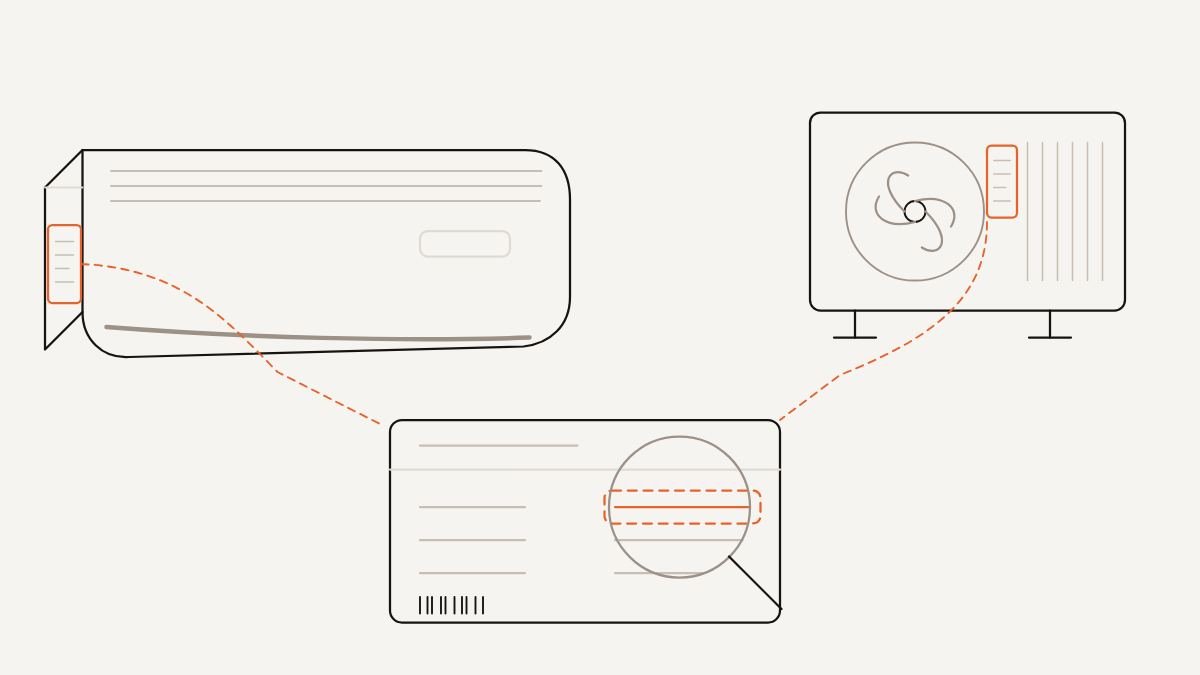
Where the label sits on a wall mounted unit
Lift the hinged front panel until it holds open on its own. The label usually sits on the right hand side of the chassis, near the filter runners.
The outdoor unit carries a second label on the side casing. That one lists electrical and refrigerant data, which a licensed technician reads during a service.
What the letters KSD and HWJ indicate
Kelvinator model codes follow a pattern rather than a random string. The opening letters mark the product family, and the closing letters mark the generation.
Here the trailing HWJ marks the series. Neighbouring ranges end in HWH or HRH instead, which is why the paperwork can look confusing at first glance.
If your label ends in HWH, the KSV and KSD HWH series guide suits your unit better. Likewise, an HRH ending points to the KSV and KSD HRH series guide.
What the digits in the middle mean
The number between the letter groups describes the nominal size of the machine. A larger number means a larger unit, so a Kelvinator ksd50hwj serves a bigger room than a 25 model.
Do not convert that number into a kilowatt rating from memory. Read the capacity straight off your own label, because cooling and heating figures differ on the same machine.
People searching Kelvinator ksd25hwj specs usually want that one figure. Therefore the honest answer stays the same, read it from the label in front of you.
KSD or KSV, the difference owners ask about
Some labels in this generation open with KSV instead of KSD. The two share much of the same platform, yet parts lists and documentation differ.
If your code starts with KSV, the KSV HWJ wall mounted inverter guide covers your unit. Otherwise stay on this page.
Write the full code down before you go further. Then photograph the label, since the print fades in sunlight and rubs off during cleaning.
The twelve point checklist for a Kelvinator ksd25hwj and its siblings
Run these in order. Each item takes only a few minutes, and the early ones settle most complaints without any tools.
Stop at the first item that fails and deal with it before moving on. Otherwise you risk chasing two faults at once.
Confirm the full model code on the indoor rating label.
Check the power point, the isolator and the circuit breaker.
Read any code on the indoor display, or count the flashing lights.
Check the mode, the set temperature and the fan speed on the remote.
Fit fresh batteries in the remote and test the signal.
Remove and wash both indoor filters.
Inspect the indoor coil behind the filters for dust or ice.
Watch the drain outlet outside for a steady drip during cooling.
Listen to the indoor fan for rattle, scrape or wobble.
Clear leaves, mulch and clutter from around the outdoor unit.
Confirm that the outdoor fan turns and the compressor runs.
Compare room temperature against set temperature after twenty minutes.
Working through the first five items
Power, isolators and breakers
Start at the switchboard rather than the wall unit. A tripped breaker explains a dead system faster than any code on a display.
Reset a tripped breaker once. If it trips again straight away, stop there and call a licensed technician, because a repeat trip signals a real electrical fault.
Many installations also have an isolator switch beside the outdoor unit. Check that nobody turned it off during painting, gardening or a previous repair.
The remote, the mode and the set temperature
Plenty of calls that begin with Kelvinator ksd25hwj not working end at the remote. Modes get changed by accident, especially in a household with children.
Check the mode symbol first. A unit sitting in fan only will move air all day without cooling anything, which reads exactly like a failed compressor.
Then check the set temperature and the timer. A timer left on from winter will shut the unit down halfway through a hot afternoon.
Testing the Kelvinator ksd25hwj remote
Point a phone camera at the front of the handset and press a button. Most cameras show the infrared emitter flashing, which confirms the handset still transmits.
If nothing flashes, fit fresh batteries and try again. Corrosion on the battery springs also stops a handset, so look for white powder in the compartment.
A working handset that the unit ignores points at the indoor receiver instead. That check belongs to a technician, since it means opening the front casing.
Filters and the wash routine
Filter work sits at the centre of every service visit. Dust blocks airflow, lost airflow drops capacity, and lost capacity looks exactly like a refrigerant problem.
Lift the panel, slide each filter upward slightly, then draw it out and down. Wash both in lukewarm water with a soft brush and mild detergent.
Dry them fully in shade before refitting. Sunlight warps the mesh, and a damp filter breeds the smell that owners often blame on the drain.
Do this monthly through heavy use. Anyone searching Kelvinator ksd25hwj filter cleaning for a one off fix usually finds the fault returns within weeks.
Resetting the unit and what a reset really does
The correct way to reset
A reset clears a latched fault so the board can try again. It does not repair anything, so treat it as a test rather than a cure.
Turn the unit off at the remote first. Then switch off the wall isolator or the breaker, wait a few minutes, and switch it back on.
That sequence is what people mean by a Kelvinator ksd25hwj reset. The same steps apply to a Kelvinator ksd35hwj reset and to every other size in the series.
When a reset is the wrong move
If the same code returns within a day, stop resetting. Repeated resets on a protection fault push a compressor through cycles that shorten its life.
Write down the code, the time and what the unit did before it stopped. Then book a diagnosis, because the board protects something for a reason.
Talk it through with a technician
Tell us the model and what the unit is doing, and we will bring the right parts to the first visit.
Airflow and drainage checks
The indoor coil
Shine a torch through the filter opening at the aluminium fins. Grey felt across the face means the coil needs a proper clean, not a wipe.
Ice on the fins points somewhere else entirely. Frost forms when airflow drops or when refrigerant charge falls, and both need measurement rather than guesswork.
The drain and water marks
In cooling mode the coil sheds water, and that water leaves through a hose. Walk outside and confirm a steady drip while the unit runs hard.
No water outside plus damp walls inside means a blocked drain. Sludge builds in the hose, backs up into the tray, then spills over the edge.
A gentle flush sometimes clears it. However, a drain that blocks twice in one season usually has a fall problem in the pipe run.
The indoor fan
Listen with the unit on low fan in a quiet room. A rhythmic tick often means a loose flap, while a scrape suggests the barrel fan touches its housing.
Wobble and vibration point at the bearing at the far end of the barrel. That part fails slowly, so owners tolerate the noise for months.
Outdoor unit checks
Clearance and airflow
The outdoor unit dumps heat, so it needs open air on every side. Fences, shrubs, bin storage and stacked garden pots all trap that heat.
Clear a working gap around the casing and above it. In addition, sweep leaves out of the base, since rotting debris holds moisture against the metal.
Hot air blowing back into the coil raises pressure inside the system. Then the board reduces output or shuts down, which owners read as a cooling fault.
Fan, compressor and noise
With the unit calling for cooling, the outdoor fan should turn steadily. A fan that starts, stops and starts again suggests a capacitor or a control problem.
Listen for the compressor as a low hum under the fan noise. Silence from the compressor with a spinning fan sits behind many Kelvinator ksd50hwj problems.
Rattles usually come from loose panels or from pipework touching the casing. Grinding is different, and grinding means stop and call for help.
Pipework and insulation
Look at the two copper lines running into the outdoor unit. Both should carry foam insulation right up to the service valves.
Ice on a valve or a pipe is never normal. If you see frost outside, turn the unit off and book a technician rather than running it on.
Reading error codes on the KSD HWJ display
How the unit reports a fault
The indoor display shows a short letter and number combination when the board detects a problem. On some builds the run, timer and defrost lights blink in a pattern instead.
Count the blinks carefully before you touch anything. Because a reset wipes the display, that pattern is often the only evidence you get.
Codes across the range fall into the same broad families. So Kelvinator ksd hwj series error codes generally split into sensor faults, communication faults, protection faults and fan faults.
Code tables still differ slightly between sizes. So Kelvinator ksd35hwj error codes and Kelvinator ksd71hwj error codes may use similar letters for different sensors.
Sensor and board codes
Sensor codes appear when a thermistor reads outside its expected range. A thermistor is a small temperature probe that clips to a coil or sits in the airstream.
These probes fail cheaply and often. Therefore many Kelvinator ksd25hwj error codes end in a straightforward sensor replacement rather than a major repair.
Protection and pressure codes
Protection codes deserve respect. The board has measured something outside safe limits, then shut the system down to prevent damage.
High pressure faults often trace back to the outdoor checks above. Low pressure faults usually mean refrigerant loss, which calls for a leak search rather than a top up.
Owners reporting Kelvinator ksd35hwj fault codes that clear overnight and return each afternoon usually have a heat rejection problem. Meanwhile the underlying leak or blockage keeps growing.
What to record before you call
Write the exact code, not an approximation from memory. Note whether it appears in cooling, in heating, or in both.
Add the outdoor conditions and how long the unit ran before it stopped. That detail turns Kelvinator ksd50hwj error codes from a mystery into a short diagnosis.
Photograph the display if you can. Then send the photo when you book a service visit, so the right parts travel with the technician.
When the unit will not start at all
A completely dead indoor unit usually points at power, not refrigeration. Check the breaker, the isolator and any power point behind the unit.
A Kelvinator ksd35hwj not working, or a Kelvinator ksd50hwj not working, often describes this exact situation. The display stays blank and the remote gets no response.
Where power reaches the unit and the display stays dark, the fault sits in the indoor board or its transformer. That work needs a licensed technician and correct parts.
Larger machines behave the same way. So Kelvinator ksd71hwj not working and Kelvinator ksd90hwj not working follow the same first three checks as the smallest model.
When it runs but the room stays warm
Air moving without cooling is the most reported complaint on this range. It also carries the widest list of causes, which is why order matters.
Start with mode and setpoint, then filters, then coil, then outdoor clearance. Only after those four does refrigerant become a sensible suspicion.
Complaints logged as Kelvinator ksd25hwj not cooling frequently resolve at the filter stage. By contrast, a Kelvinator ksd35hwj not cooling after a filter wash usually needs gauges on the system.
Undersizing also masquerades as a fault. A small unit fighting a west facing room with thin curtains will never hold a low setpoint.
Checklist items that need a licensed technician
Some items on the list stop at looking. Anything involving refrigerant, electrical testing or the sealed system requires a licensed technician by law.
That includes pressure testing, leak detection, recovery and recharging. It also covers capacitor replacement, board swaps and any work inside the outdoor casing.
A Kelvinator ksd50hwj repair on a compressor circuit is not a weekend job. The same applies to a Kelvinator ksd71hwj repair where the fault sits behind the electrical cover.
Booking a Kelvinator ksd50hwj service once a year keeps most of these off the list. Our technicians clean coils, test electrical values and watch how the charge behaves.
Wifi setup and app control
Some units in this generation accept a wireless module for app control. Others do not, and no app will change that.
Check your own documentation before buying anything. A Kelvinator ksd25hwj wifi setup only works where the indoor unit carries the matching connector and module.
Where the feature exists, the module joins your home network on a lower frequency band. Therefore a modern router running one combined band often refuses the connection.
Wifi trouble almost never causes cooling trouble. So if the app fails while the unit still runs from the remote, treat them as separate issues.
Finding the manual for your model
Manuals for this range split into two documents. The user guide covers remote functions and cleaning, while the installation manual covers wiring, pipe sizes and code tables.
Search using the full code from your label. A search for Kelvinator ksd25hwj manual or Kelvinator ksd35hwj manual returns the right document far more often than a search by room size.
Owners of larger units do the same thing. So Kelvinator ksd50hwj manual, Kelvinator ksd71hwj manual and Kelvinator ksd90hwj manual each point at their own paperwork.
A Kelvinator ksd hwj series manual is not one universal book. Sizes share a family, yet electrical data and code tables vary between them.
What a series review can and cannot tell you
Owners often look for a Kelvinator ksd hwj series review before choosing between repair and replacement. Reviews describe first impressions, and few of them follow a unit through several summers.
Read them for patterns rather than verdicts. Repeated mentions of one symptom carry more weight than a single strong opinion.
A Kelvinator ksd25hwj review written after one week says little about durability. Likewise a Kelvinator ksd35hwj review from a mild season tells you nothing about real heat.
Installation quality shapes long term reliability more than model choice does. Poor pipe runs, weak brackets and bad drainage cause faults that no review would predict.
What drives the cost of a repair
Owners often expect one number for a Kelvinator ksd25hwj price. In practice the figure depends on the fault, the part, the access and the time on site.
A sensor is a small part with a short labour time. A compressor sits at the other extreme, since it involves recovery, replacement and a full recharge.
Our pricing information page explains how we build a quote. Ask any technician to confirm the scope before work starts.
Keeping a service record for the unit
Write the checklist results somewhere you will find them again. A note inside the meter box or an album on your phone both work.
Record the date, the code, what you checked and what changed. Over two or three seasons that record shows whether a fault drifts worse.
Keep receipts for parts and services as well. While the unit remains inside the Kelvinator warranty period, the manufacturer handles that claim, and maintenance evidence helps.
Where You Can Reach Us
We service and repair Kelvinator wall mounted inverter systems across Australian homes and small workplaces. Our team handles every size in this series.
We work as specialists, and we are not part of the manufacturer. So we attend any KSD HWJ unit, whether you bought it new or inherited it with the house.
If you need a Kelvinator service agent in your area, look for a licensed refrigeration technician with current electrical permissions. Ask what test equipment they carry before booking.
Frequently asked questions
What do Kelvinator ksd25hwj error codes actually mean?
Each code maps to a family of faults, such as sensors, communication, protection or fans. The letter and number combination narrows the search, though it does not name the failed part. Therefore a technician still measures values before replacing anything.
How do I perform a Kelvinator ksd25hwj reset?
Turn the unit off at the remote, then isolate power at the breaker or the wall isolator. Wait a few minutes, restore power and start the unit again. If the same fault returns quickly, stop resetting and book a diagnosis.
Why is my Kelvinator ksd35hwj not cooling on hot days?
Hot days expose weaknesses that mild weather hides, such as dirty filters or a crowded outdoor unit. Check airflow first, then clearance, then look for ice on the pipework. A unit that only fails above a certain temperature usually has a heat rejection or charge issue.
Where do I find the Kelvinator ksd50hwj manual?
Search the full model code exactly as it appears on the indoor rating label. Manufacturer support pages and appliance document libraries both host these files. Remember that the installation manual and the user guide remain separate documents.
Is a Kelvinator ksd71hwj repair worth doing on an older unit?
It depends on the failed part and the condition of the rest of the system. Sensors, capacitors, fan motors and boards usually justify a repair. A failed compressor on a well used unit deserves a replacement discussion instead.
Why do Kelvinator ksd90hwj error codes keep coming back after a reset?
A returning code means the protection circuit keeps measuring the same unsafe condition. Resets clear the display without touching the cause, so the fault reappears. Book a diagnosis rather than resetting repeatedly, because repeat cycling harms the compressor.
How often should a Kelvinator ksd50hwj service happen?
Once a year suits most homes, ideally before the season you rely on most. Dusty sites, pets and coastal air justify a shorter interval. Between visits, wash the filters monthly during heavy use.
Can I complete a Kelvinator ksd25hwj wifi setup without a technician?
Yes, where the unit already carries a compatible module. Follow the pairing steps in the module documentation and use the correct network band. Fitting a module for the first time means opening the indoor unit, which stays technician work.
What This Adds Up To
Find the label, write down the full code, then work the twelve items in order. Most faults on this series reveal themselves in the first six.
Stop when a check needs refrigerant, electrical testing or the sealed system. Those belong to a licensed technician, and attempting them costs more than it saves.
If the checklist runs out before the fault does, get in touch and describe what you found. Our technicians will pick up where your list stopped.
Browse the site
Book a technician
Speak to a qualified technician who works on Kelvinator systems
Call 1300 495 033 and tell us the model and the fault, or book online and we will come back to you.