Model series
Kelvinator KWH27HRF and the KWH HRF Window and Wall Box Series
Your Kelvinator KWH27HRF sits in the wall of the room it cools. So when it drips onto the sill, rattles at night or blows warm air, you notice within minutes. There is no outdoor unit tucked quietly down the side of the house.
This page covers the KWH HRF window and wall box range. Alongside the Kelvinator KWH27HRF you will find the Kelvinator KWH39HRF, the Kelvinator KWH52HRF and the Kelvinator KWH60HRF. Because the whole machine lives in one chassis, the servicing works differently from a split system.
We are qualified technicians and we service and repair Kelvinator air conditioners. Since we do not make them, we work from the rating label on your unit and the manual that came with it.
We work on this brand as specialists, and the manufacturer is a separate company.
On this page
- What the symptom in front of you usually means
- How to read the model number on your rating label
- The most common Kelvinator KWH HRF series problems
- Error codes across the KWH HRF window range
- Window mounted units compared with wall box units
- Where to find the manual for your model
- Safe checks you can make before you call
- When to stop and call for help
- How a technician diagnoses a Kelvinator KWH27HRF fault
- Why this servicing differs from a split system
- Pulling the chassis for a proper clean
- Keeping a KWH HRF unit healthy through the year
- What reviews and forum threads are actually worth
- Costs, quotes and getting a technician out
- Where we work and what we cover
- Frequently asked questions
- Where That Leaves You
What the symptom in front of you usually means
A window and wall box unit gives away more than a split system does. You stand right beside the compressor, the fan and the drain, so small faults become obvious early. That closeness is an advantage when you act on it.
Warm air with a running fan points at airflow or at the sealed refrigeration side. Water on the floor points at the drainage path or at the fall of the sleeve. Grinding or ticking points at the fan, the blower wheel or a loose panel.
A dead display with no response points at power, the control board or the remote. Meanwhile a unit that starts and stops after a few minutes usually has a protection trip behind it. Each of those patterns has a short list of likely causes.
Timing matters as well. For example a Kelvinator KWH39HRF not cooling in the afternoon but coping overnight suggests a condenser struggling with heat. That is a very different job from one that never cools at all.
How to read the model number on your rating label
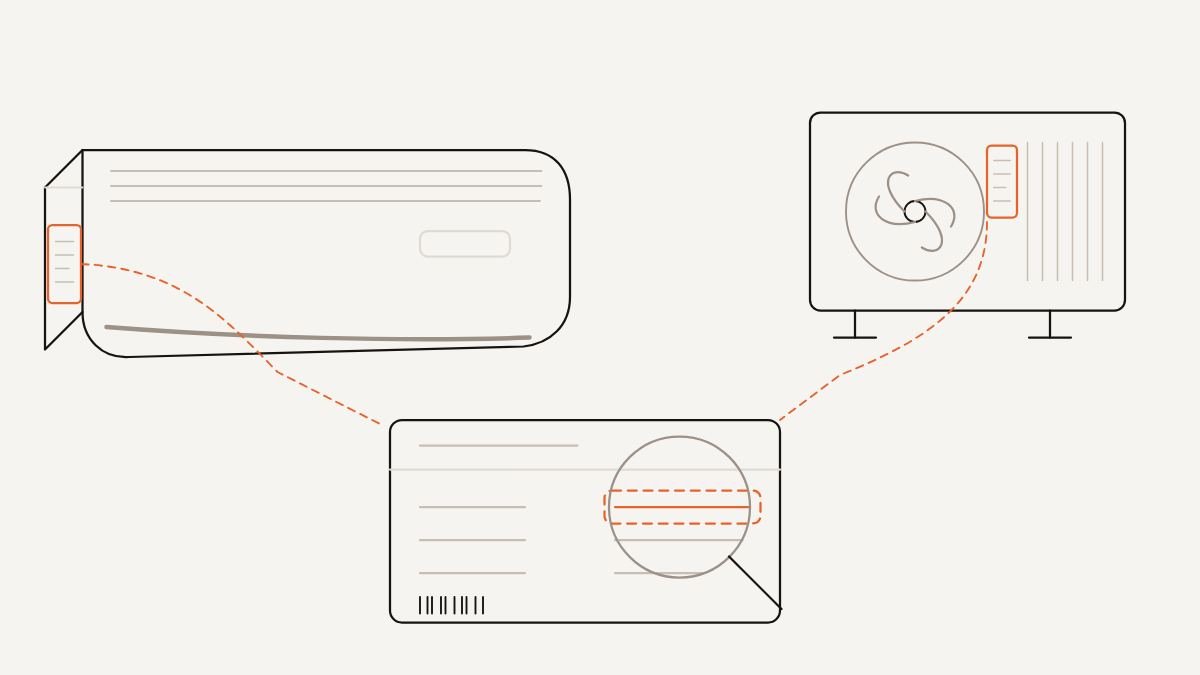
The rating label carries the full model number and the electrical data. On a window and wall box unit that label often sits behind the front grille. Sometimes it sits on the side of the cabinet, where the sleeve does not hide it.
KWH marks the window and wall family and HRF marks the series. The digits between them separate one model from another, so a Kelvinator KWH27HRF and a Kelvinator KWH60HRF are different machines. Do not assume those digits equal a rating in kilowatts.
If you are chasing Kelvinator kwh27hrf specs, the label beats any forum thread. Read the capacity, the voltage and the current draw straight from it. Then write the whole string down before you call anybody.
That short record turns a vague phone call into a useful one. It also helps when you weigh a Kelvinator KWH27HRF review against your own unit. Reviews often lump several models together, so the model number keeps you honest.
- The complete model number, letters and digits together.
- Serial number, which the manufacturer uses to date the unit.
- Electrical data printed on the label, including voltage and current.
- Refrigerant type exactly as the label prints it.
- A photograph of the label, because sleeves are awkward to reach twice.
The most common Kelvinator KWH HRF series problems
Faults in this range fall into a fairly short list. We have ordered them from the ones we attend most often to the ones we attend least. Work down that order rather than jumping straight to the compressor.
Blocked filters and a choked front grille
Dust builds on the filter behind the front grille and airflow drops away. Then the coil runs colder than it should and ice creeps across the face. As a result the unit blows almost nothing while the fan still hums.
Regular Kelvinator kwh27hrf filter cleaning prevents most of this. Slide the filter out, wash it in warm water and let it dry fully. Never refit a damp filter, because damp dust turns into a smell within days.
Drainage, the sleeve and water where you do not want it
These units handle condensate very differently from a split system. Many of them fling water onto the condenser coil deliberately, which helps cooling. However the sleeve still needs a slight fall towards the outside.
When a sleeve sits level or falls inwards, water tracks back into the room. Silt, insects and leaf litter block the drain holes just as often. So a proper service always clears the tray and checks that fall.
Fan motors, blower wheels and bearings
One motor usually drives the indoor blower and the outdoor fan on a shared shaft. When the bearings dry out, you hear a whine that rises with fan speed. Left alone, that motor draws more current and eventually trips the supply.
A loose blower wheel or a cracked blade makes a different sound entirely. Instead of a whine you get a knock that changes as the unit starts and stops. Either way the chassis has to come out for a proper look.
Compressor and sealed system faults
Most Kelvinator KWH52HRF problems turn out to be airflow or drainage rather than refrigerant. Still, sealed system faults do appear as a unit ages. A slow leak, a blocked capillary or a tired compressor all show up as weak cooling.
Only a licensed technician may open the refrigeration circuit in Australia. So this is the point where owner checking stops and diagnosis begins. We measure pressures, temperatures and current draw before we recommend anything.
Controls, sensors and the handset
Thermistors tell the control board what the air and the coil are doing. When one drifts, the unit short cycles or refuses to start at all. A faulty Kelvinator kwh27hrf remote can look exactly the same from the sofa.
Try fresh batteries and a clear line of sight to the receiver first. If the onboard buttons work while the handset does nothing, blame the handset. Then a replacement often clears the whole complaint in one go.
Error codes across the KWH HRF window range
Not every unit in this family shows a coded display. Some flash an indicator light in a pattern instead of showing letters. So the first job is working out which language your unit speaks.
Owners look up Kelvinator kwh27hrf error codes, Kelvinator kwh39hrf error codes and Kelvinator kwh52hrf error codes in similar numbers. Kelvinator kwh60hrf error codes come up just as often. The characters usually group the fault rather than name the exact part.
Some owners find very little on Kelvinator kwh39hrf fault codes. That happens because code sets differ between production runs of the same series. A published Kelvinator kwh hrf series error codes list is a starting point, never gospel.
That handful of notes shortens a visit considerably. A code that returns instantly points at a sensor or a wiring fault. One that takes an hour to return usually points at heat, airflow or drainage.
- Write down the exact characters and the flash pattern before you cut power.
- Note what the unit was doing at the moment the code appeared.
- Record whether the code clears on a restart or returns straight away.
- Check the manual for your exact model rather than a neighbouring one.
- Photograph the display, since codes sometimes scroll or alternate.
Window mounted units compared with wall box units
Some units in this family sit in a window opening and others sit in a wall sleeve. The chassis is much the same, so a Kelvinator kwh27hrf window error codes search returns the same lists. Support, sealing and drainage are where they really differ.
A window installation relies on side panels, a top seal and the sash holding everything down. Over the years those seals shrink and gaps open up. So a Kelvinator KWH27HRF window not working after a storm often has water behind the fault.
A wall sleeve is more permanent and usually seals better. However it also hides rust and sagging until the day water appears inside. Both styles need the same annual attention, just for slightly different reasons.
Talk it through with a technician
Tell us the model and what the unit is doing, and we will bring the right parts to the first visit.
Where to find the manual for your model
The manual that shipped with the unit is the one that matches it. Kelvinator publishes documentation for its products, and a search for Kelvinator kwh27hrf manual will usually reach the maker rather than a reseller. Check that the document names your exact model.
The same applies if you need the Kelvinator kwh39hrf manual, the Kelvinator kwh52hrf manual or the Kelvinator kwh60hrf manual. Owners of boxed in units often want the Kelvinator kwh27hrf window manual specifically. All of them cover clearances, filter access and indicator lights.
A Kelvinator kwh hrf series manual will not tell you why your unit failed. However it does show the clearances, the filter route and the safe way to isolate power. Read that much before you open anything.
Safe checks you can make before you call
These checks need nothing beyond a torch and, on some models, a screwdriver for the filter grille alone. Work through them in order and stop at the first one that needs the chassis out.
The filter grille is the only cover an owner should ever remove. Never unscrew the chassis, the top panel or any cover over the electrical compartment, because mains voltage and charged capacitors sit behind them.
A Kelvinator KWH27HRF reset belongs at the end of that list rather than the start. Pull power at the isolator, wait a few minutes and restore it. If the fault returns immediately, the reset has told you something useful.
The same logic covers a Kelvinator KWH39HRF reset or any other model in this family. Resets clear latched protection, though they repair nothing at all. So a code that keeps coming back still needs a real diagnosis.
Switch the unit off at the wall or the isolator before you open a panel.
Remove the front grille and pull the filter out. Hold it up to a light.
Wash the filter in warm water, then dry it fully before refitting it.
Look at the coil face behind the filter for ice, matted lint or bent fins.
Check the outside face for leaves, cobwebs and nests blocking the condenser.
Restore power and run the unit on high fan only for several minutes.
Set cooling well below room temperature and listen for the compressor starting.
Note any code, flash pattern or beep and write it down straight away.
When to stop and call for help
Some symptoms mean the checking phase is over. Water inside the electrical compartment is one of them. A burning smell, a tripping breaker or a scorched connector is another.
Stop as well if the unit runs but never reaches temperature after a full clean. That pattern points at the sealed system, and only a licensed technician may work there. Refrigerant handling in Australia carries legal requirements for good reason.
Weight and height matter on this style of unit too. A wall box chassis is heavier than it looks and it often sits above head height. So pulling one out alone is a genuine risk rather than a formality.
A Kelvinator KWH27HRF not working at all usually points at the supply. Check the isolator and the circuit breaker before anything else. Beyond that, a dead board or a failed capacitor needs testing under power.
The approach does not change with size. A Kelvinator KWH39HRF not working, a Kelvinator KWH52HRF not working or a Kelvinator KWH60HRF not working all start at the supply. Then we move to the board, the capacitor and the motor.
How a technician diagnoses a Kelvinator KWH27HRF fault
Diagnosis on a window and wall box unit starts before the chassis moves. We measure supply voltage, then current draw while the unit tries to start. Those two numbers separate a supply problem from a motor problem quickly.
Next we compare the air going into the unit against the air coming out. A healthy temperature split across the coil shows the refrigeration side working. When the split is poor and the filters are clean, we move to pressures instead.
Then the chassis comes forward out of the sleeve, or the cabinet comes off it. Once we can reach the back, the drain tray, the blower wheel and the capacitor all become accessible. Most of those parts are simply unreachable while the unit sits in the wall.
Finally we test the controls. We warm and cool the sensors deliberately and watch how the board responds. That shows whether a code reflects a real condition or a failed thermistor.
Why this servicing differs from a split system
On a split system the noisy half lives outside and the quiet half lives inside. Here both halves share one frame, one motor shaft and one drainage path. So a fault on the outdoor side is audible from the sofa.
Access is the second difference. A split system indoor head unclips from a wall bracket in seconds. By contrast a wall box unit comes forward out of its sleeve, which often needs two people and a platform.
Drainage is the third. Split systems run a dedicated drain line to a safe point outside. Window and wall units rely on the fall of the sleeve, the tray and a slinger ring that throws water at the condenser.
If you also own newer equipment, our notes on the legacy KSV HRE inverter series describe a very different routine. Reading both is worth the few minutes before you compare quotes.
Pulling the chassis for a proper clean
A deep clean is the most valuable single job on this style of unit. Dust, salt and garden debris pack into the condenser fins from the outside face. You cannot see that build up from inside the room at all.
With the chassis out we wash both coils, flush the tray and clear the drain holes. Then we check the slinger ring, the blower wheel and the foam seals around the sleeve. Perished foam lets hot outside air leak straight back in.
We inspect the sleeve itself for rust, packing and fall. A sleeve that has sagged over the years pulls water inwards instead of outwards. Correcting that fall often fixes a drip which no amount of drain clearing would.
Coastal homes need this attention more often than inland ones. Salt attacks aluminium fins and steel sleeves alike. So we look hard at fin condition whenever a unit faces the water.
Keeping a KWH HRF unit healthy through the year
Most failures we attend begin as neglected airflow. A short routine prevents nearly all of them. It also keeps running costs sensible, because a choked coil makes the compressor work harder.
Annual attention suits most homes running this equipment. A Kelvinator KWH52HRF service in a coastal or dusty spot may suit twice a year instead. Our technicians will tell you honestly which pattern fits your unit.
- Wash the filter monthly during heavy use and at least each season otherwise.
- Clear leaves, cobwebs and nests from the outside face twice a year.
- Check the sill below the unit for staining, which shows an early drainage problem.
- Listen for new noises and act while they are still quiet.
- Book a professional service once a year, ideally before the hot months.
What reviews and forum threads are actually worth
A Kelvinator KWH HRF series review tells you how a unit sounds and feels in a room. It cannot tell you how your installer fitted yours or how well it has run since. Those two things drive most of the complaints we attend.
Read a Kelvinator KWH39HRF review with the same caution. Noise depends heavily on the sleeve, the packing and the wall itself. So two identical units in two homes can behave very differently.
Where reviews do help is expectation. If several owners mention drainage or fan noise, raise those points at service time. Then you are steering the visit rather than following it.
Costs, quotes and getting a technician out
Owners often expect a single number for a Kelvinator kwh27hrf price. In reality the figure moves with the fault, the parts and the access. A unit at head height in a brick wall takes longer than one at waist height.
Consider a Kelvinator KWH52HRF repair needing only a clean and a drain clear, which sits at one end of that scale. Meanwhile a Kelvinator KWH60HRF repair needing a motor or a board sits at the other. Our notes on what shapes the cost of a repair set out the factors plainly.
Ask any technician for the diagnosis before the quote. A good one names the part, the reason and the alternative. When you are ready, you can book a service and we will carry the common parts with us.
Where we work and what we cover
Our technicians service and repair Kelvinator air conditioners across Australian homes and small businesses. We work on window and wall box units, split systems and ducted equipment. So a mixed household does not need two separate trades.
Kelvinator handles its own manufacturer warranty, and that sits separate from our workmanship guarantee. If your unit is still inside the warranty period, tell us before we begin. Then we can point you the right way rather than complicate a claim.
Owners of older equipment often ask us to look at several machines at once. Our notes on the KSV and KSD HRH series and the older KSV HRA series cover those visits. Booking them together saves a second trip.
Frequently asked questions
Why is my Kelvinator KWH27HRF not cooling?
A Kelvinator KWH27HRF not cooling almost always starts with airflow. Check the filter, the indoor coil face and the outdoor face for blockage. If all three look clean and the air still feels warm, the sealed system needs testing.
What do Kelvinator KWH27HRF error codes mean?
Kelvinator KWH27HRF error codes group a fault rather than name a part. A sensor code, for example, may mean the sensor, the plug or the board behind it. Write the code down and note whether it returns after a restart.
How do I do a Kelvinator KWH27HRF reset?
A Kelvinator KWH27HRF reset simply means removing power at the isolator or the wall. Leave it off for a few minutes, then restore it and try again. Because a reset only clears latched protection, a returning fault still needs a technician.
Where do I find the Kelvinator KWH27HRF manual?
Search for the Kelvinator kwh27hrf manual on the manufacturer website and match your exact model. The document covers clearances, filter access and indicator lights. It will not diagnose a fault, although it does show where everything lives.
Does my unit have a Kelvinator KWH27HRF wifi setup?
Do not assume that it does. Some Kelvinator products offer app control and others do not, so check your label and manual for the exact model. A Kelvinator KWH27HRF wifi setup guide written for a different series will only confuse things.
What should I do about a Kelvinator KWH39HRF not working?
Start at the supply, because a tripped breaker or safety switch explains most dead units. Then try the onboard button rather than the handset to rule out a remote fault. If neither brings it back, the board or the capacitor needs testing.
How often does a Kelvinator KWH52HRF need servicing?
Once a year suits most homes, ideally before the hot months arrive. Coastal, dusty or heavily used units benefit from twice yearly attention instead. Filter washing between services matters more than the exact interval.
What does a Kelvinator KWH60HRF repair involve?
Most visits start with the chassis coming forward out of the sleeve for access. Then we clean, test electrically and measure the temperature split across the coil. Parts follow the diagnosis, so we confirm the cause before we order anything.
Where That Leaves You
Window and wall box units in the KWH HRF family reward simple attention. Filters, drain paths and the fall of the sleeve explain most of the faults we attend. Everything past that point needs a licensed technician and proper test gear.
Read your own rating label before you trust any specification you find online. Then match the manual to that exact model number rather than a similar one. Those two habits save more time than any troubleshooting list.
If your unit is dripping, noisy or blowing warm air, talk to our team about it. We are happy to explain what we would check and why before you commit to anything.
Browse the site
Book a technician
Speak to a qualified technician who works on Kelvinator systems
Call 1300 495 033 and tell us the model and the fault, or book online and we will come back to you.