Model series
Kelvinator KSV26HRE and the Legacy KSV HRE Inverter Series
You lifted the flap on the indoor unit, found a small silver label, and read something like KSV26HRE. Very little of what is written about the Kelvinator ksv26hre then turned out to help.
That is normal for this family. It belongs to an earlier generation of Kelvinator inverter split systems, so the product pages that once described it have mostly disappeared.
The reassuring part is that the hardware inside stays familiar to any experienced technician. Because the layout follows a common design, most faults on these units still have a clear diagnosis and a clear repair path.
This guide explains the model number, the parts that fail most often, and the honest question every owner of a legacy machine eventually reaches. Repair it again, or replace it.
We service Kelvinator air conditioners as an independent business with no manufacturer appointment.
On this page
- What the model number Kelvinator ksv26hre actually tells you
- How the KSV HRE inverter series works
- Common misunderstandings about the KSV HRE series
- Living with a Kelvinator ksv26hre day to day
- Kelvinator KSV HRE series problems our technicians see most
- Error codes and fault codes across the KSV HRE models
- Finding a Kelvinator ksv26hre manual for your model
- How to check a Kelvinator ksv26hre before you book
- Parts availability on a legacy series
- Deciding between repair and replacement
- Knowing when to stop checking and call a technician
- Where we service the KSV HRE family
- Frequently asked questions about the KSV HRE series
- Putting the Pieces in Place
What the model number Kelvinator ksv26hre actually tells you
Kelvinator model numbers follow a pattern rather than a random code. Once you learn that pattern, the label on your own unit tells you far more than any search result will.
Every part of the code carries meaning. However, we will not guess the values for your machine, because only the rating label on your equipment holds the correct figures.
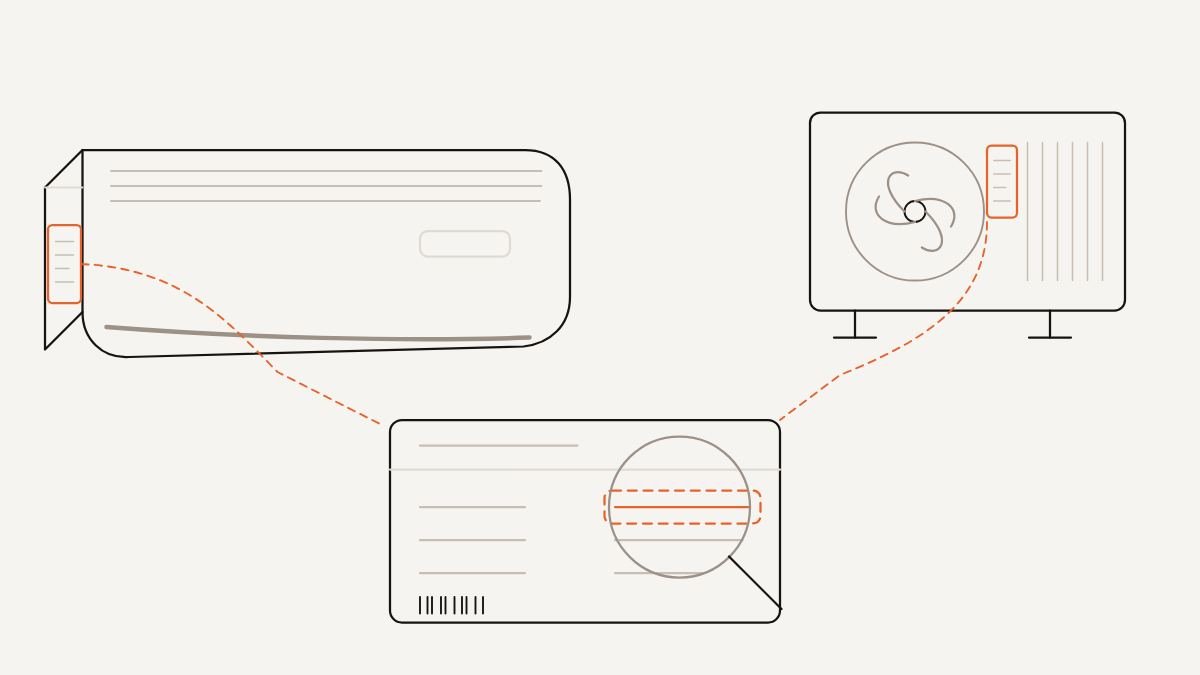
Where to find the rating label
On a wall mounted indoor unit, lift the front panel until it clicks and hold it open. A printed label sits on the right hand side of the chassis, close to the filter runners.
The outdoor unit carries its own label on the side casing or the rear. That second label matters more, because it lists the refrigerant type and the charge weight for your exact machine.
Photograph both labels with your phone before you call anyone. As a result, a technician can order the right part on the first attempt instead of the second.
How to read the letters and the digits
The first group of letters describes the product family, such as a wall mounted inverter split system. The digits that follow point to the nominal capacity of that particular model.
The final letters mark the series or generation. In this case HRE identifies the generation, which is why Kelvinator ksv35hre and Kelvinator ksv53hre share so much of their internal design.
So a code like KSV26HRE, KSV70HRE or KSV80HRE reads as one family offered at several sizes. Read the exact digits from your own label rather than trusting a number quoted on a forum.
If your label does not read HRE
Not every Kelvinator wall unit belongs to this family. Where the code ends in HRA, the guide to the legacy KSV HRA series covers the right generation instead.
Window and through the wall units use a different code again. Those owners want the KWH HRF window and wall series, while older box style units appear under legacy KWH CRE box units.
Why we will not quote your specifications
Owners often ask us for Kelvinator ksv26hre specs before we arrive. We do not publish them, because a figure copied from the wrong generation leads straight to the wrong part.
Instead, we read the plate on your unit. That plate carries the model number, the serial number, the electrical ratings and the refrigerant details that any real repair depends on.
How the KSV HRE inverter series works
An inverter system varies the speed of the compressor instead of switching it fully on and fully off. Therefore the room holds a steadier temperature, and the power draw settles once the room reaches your setting.
What the outdoor unit does
The outdoor unit holds the compressor, the outdoor coil, the fan and the control board that drives them. It moves heat out of the home in cooling, and into the home in heating.
Refrigerant carries that heat between the two units through a pair of copper lines. When those lines lose charge, everything downstream of the loss starts to suffer.
What the indoor unit does
The indoor unit holds the fan barrel, the indoor coil, the filters and the display board. It also holds the room sensor that tells the system how far the air sits from your setting.
Because the indoor unit meets every gram of dust in the room, it needs the most routine attention. Filters and the coil behind them drive most of the performance complaints we attend.
What the boards and sensors do
Thin wire sensors clip into the coils and into the airstream. They report temperature back to the board, which then decides fan speed, compressor speed and defrost timing.
Common misunderstandings about the KSV HRE series
A legacy label does not mean beyond repair
Older does not mean unfixable. Many Kelvinator ksv53hre problems come down to a capacitor, a fan motor, a sensor or a contactor, and all of those remain straightforward jobs.
What changes with a legacy series is the sourcing of specific boards and moulded assemblies. So the repair question becomes a parts question long before it becomes a labour question.
The fault list is not identical across every model
People assume Kelvinator ksv26hre error codes and Kelvinator ksv80hre error codes must match exactly. In practice the larger models carry extra protections, so a code can exist on one and not the other.
Kelvinator ksv35hre fault codes and Kelvinator ksv70hre error codes overlap heavily, yet the detail still differs. Always read a code against documentation for your own model rather than a neighbouring one.
Topping up refrigerant is not a repair
A system that cools poorly after a top up will cool poorly again before long. Refrigerant does not wear out, so a low charge always means a leak somewhere in the circuit.
Our technicians look for the leak first, then build the repair around that finding. Adding gas without finding the loss simply postpones the very same call.
Living with a Kelvinator ksv26hre day to day
Filter cleaning
Kelvinator ksv26hre filter cleaning takes about ten minutes and pays back immediately. Lift the panel, slide each filter up and out, then wash them in cool water with a little detergent.
Let the filters dry fully in shade before they go back in. A damp filter breeds odour, and direct sun warps the plastic mesh out of shape.
Do this monthly through heavy use and quarterly for the rest of the year. Because airflow drives everything else, clean filters prevent more faults than any other habit.
The remote control
A Kelvinator ksv26hre remote that stops responding usually wants batteries rather than replacement. Fit a fresh pair, check the polarity, then aim straight at the display window from a couple of metres.
If the display stays blank, test the emitter with a phone camera. Point the remote at the lens and press a button, and you should see a faint flash on screen.
Wifi and app control
Kelvinator ksv26hre wifi setup depends on whether your unit ever carried a wireless module. Many units in this family shipped without one, and some gained an accessory module later at installation.
Where a module exists, your phone must sit on a two point four gigahertz network rather than a five gigahertz one. Otherwise the pairing step fails without any useful message.
Resetting the system
A Kelvinator ksv26hre reset clears a latched fault so the board can try again. It does not repair anything, yet it does tell you whether the fault was momentary or permanent.
Switch the isolator off at the wall or beside the outdoor unit, wait several minutes, then switch it back on. A Kelvinator ksv35hre reset follows exactly the same sequence.
When the same code returns within a day, stop resetting. Repeated resets on a protection fault can turn a modest repair into a compressor failure.
Talk it through with a technician
Tell us the model and what the unit is doing, and we will bring the right parts to the first visit.
Kelvinator KSV HRE series problems our technicians see most
The unit runs but the room stays warm
Kelvinator ksv26hre not cooling is the single most common call on this family. The usual chain starts with restricted airflow, then moves to a dirty outdoor coil, then to a refrigerant loss.
Kelvinator ksv35hre not cooling follows the same order. Because the diagnosis works by elimination, a technician measures pressures and temperatures rather than guessing at the cause.
The unit will not start at all
Kelvinator ksv26hre not working covers everything from a tripped breaker to a failed indoor board. First check the isolator, then the switchboard breaker, then the batteries in the remote.
If those all look right, listen at the outdoor unit while someone starts the system. Silence outside with a running indoor fan often points at a capacitor or a contactor.
Kelvinator ksv35hre not working, Kelvinator ksv53hre not working and Kelvinator ksv70hre not working share those same starting checks. Larger units simply draw more current, so their protection devices trip a little sooner.
Noise that was not there before
A rattle usually means a loose panel or a fan blade catching a leaf. A grinding or humming noise from outside points instead at bearings or at a compressor under strain.
Switch the system off if the noise sounds metallic and repetitive. Running through that kind of noise turns a bearing job into a full outdoor unit job.
Water where it should not be
Water dripping inside almost always means a blocked drain. Dust and slime build up in the drain pan, then the pan overflows towards the room instead of towards the outside.
Odd behaviour after a power interruption
Blackouts and brownouts upset control boards more than any other single event. After an outage a unit can sit with its display lit yet refuse every command from the remote.
Isolate it fully, leave it a few minutes, then restore power. Kelvinator ksv80hre not working in this way often traces back to the board or to its small onboard fuse.
Error codes and fault codes across the KSV HRE models
The display on the indoor unit shows a short code when the board halts the system deliberately. That code names the protection that tripped, not the broken component itself.
So a code is a starting point rather than an answer. Kelvinator ksv hre series error codes tell a technician which circuit to measure first, which saves real time on the visit.
Reading the display correctly
Some codes appear as characters on the small screen. Others appear as a pattern of flashes across the operation, timer and defrost lights, which owners often miss entirely.
Count the flashes and the pauses before you switch anything off. Because a reset clears the code, that count is sometimes the only evidence a technician has to work from.
Codes that deserve attention quickly
Codes covering high pressure, low pressure, compressor overload and outdoor communication all point at faults that worsen with use. Therefore switch the system off and book a diagnosis rather than persevering.
Cross checking between models
Kelvinator ksv53hre error codes and Kelvinator ksv35hre error codes read alike on paper. However, the fault behind an identical code can differ, since the sizes use different compressors and different protections.
Finding a Kelvinator ksv26hre manual for your model
A Kelvinator ksv26hre manual is worth keeping, even though it will not diagnose a fault for you. It confirms button functions, filter removal, drain positions and the meaning of each indicator light.
Search the manufacturer support site using your full model number rather than a shortened version. Kelvinator hosts documentation for discontinued models alongside current ones.
Where the exact document has vanished, the nearest sibling usually serves well. A Kelvinator ksv35hre manual, a Kelvinator ksv53hre manual or a Kelvinator ksv70hre manual covers the same controls and layout.
The Kelvinator ksv80hre manual and the broader Kelvinator ksv hre series manual follow that same structure. Print the pages you use most, then keep them in the drawer nearest the unit.
How to check a Kelvinator ksv26hre before you book
Work through these steps in order before you call anyone. Many callers solve the problem by step four, and the rest reach a much faster diagnosis on the day.
Every one of these steps stays safe with the covers and panels in place. Do not open electrical covers, and do not touch the copper lines while the system runs.
Read the model number and the serial number from the rating label, then photograph both.
Check the wall isolator and the switchboard breaker, and reset that breaker once only.
Fit fresh batteries in the remote, then confirm the display responds to a mode change.
Remove and wash both indoor filters, then dry them fully in shade before refitting them.
Set cooling to the lowest temperature and the fan to high, then wait ten minutes.
Feel the air at the outlet, and note whether it feels cold, cool or simply neutral.
Walk outside and confirm the outdoor fan spins and the compressor hums steadily.
Clear leaves, cobwebs and garden growth away from the outdoor coil and the fan guard.
Note any code on the display, or count the flashes on the indicator lights.
Write down what you saw at each step, then book the visit with those notes ready.
Parts availability on a legacy series
This is the part of the conversation that matters most on an older machine. Mechanical parts stay easy, while model specific electronics grow harder as a series moves further from production.
Parts that remain easy to source
Capacitors, contactors, fan motors, thermistors, drain pans and filters cross over between many models. Therefore a technician can usually match them by specification rather than by a single part number.
Parts that get harder
Indoor display boards, outdoor inverter boards and moulded fan scrolls are the difficult ones. Each belongs to a specific generation, so a direct substitute rarely exists on a shelf.
Sometimes a reconditioned board or a superseded equivalent solves it neatly. Even so, we tell you honestly when a search looks uncertain rather than promising a part we cannot confirm.
How we check availability before you commit
We diagnose first, then confirm the part before we quote the repair itself. Nobody wants to pay for a diagnosis and then hear that the component no longer exists anywhere.
You can read how our pricing works before you book anything at all. That page explains the factors behind a repair rather than quoting any figure.
Deciding between repair and replacement
Every owner of a legacy unit eventually reaches this fork. The honest answer depends on the failed part, the condition of the rest of the system, and how the unit runs when it does run.
Signs that repair still makes sense
A single failed component on an otherwise sound system points firmly towards repair. If the coils look clean, the fan runs true and the cabinet shows no corrosion, a repair buys plenty of service.
Signs that replacement makes more sense
A compressor failure alongside a corroded outdoor coil changes the maths completely. So does a leak inside the wall cavity, because opening that wall adds work well beyond the machine.
Repeated unrelated failures across the same unit tell their own story. When two major parts fail in close succession, the third rarely stays far behind.
What a series review really tells you
Searching Kelvinator ksv26hre review or Kelvinator ksv35hre review brings up opinions written when the units were brand new. Those opinions say little about a machine that has already worked through many summers.
A Kelvinator ksv hre series review is most useful for the layout it describes. Instead of chasing scores, judge your own unit by how it runs and by what a technician measures.
Why the cost question comes second
Owners often search Kelvinator ksv26hre price before they know what has actually failed. That order rarely helps, because the failed part decides the work, and the work decides the cost.
Find the fault first, then weigh a repair against a replacement with real information. Our technicians will tell you plainly when we think further spending on a unit makes no sense.
Knowing when to stop checking and call a technician
Some checks belong to the owner, and some belong to a licensed technician. The line sits at the electrical covers and at the refrigerant circuit.
Call straight away for a burning smell, a breaker that trips repeatedly, or ice forming on the copper lines. Also call when a protection code returns after a single reset.
Kelvinator ksv53hre service, Kelvinator ksv53hre repair and Kelvinator ksv70hre repair all begin with the same measured diagnosis. We test before we replace, so you never pay for a component that still worked.
Australian law restricts refrigerant handling to licensed people. Therefore any work involving the gas, the copper lines or the compressor needs a technician who holds that licence.
Where we service the KSV HRE family
Our technicians work on Kelvinator systems in houses, apartments and small offices across the areas we cover. Because this family appeared in so many homes, we carry its common parts on the van.
We work on Kelvinator equipment without any manufacturer relationship. If your unit still sits within the Kelvinator warranty, contact the manufacturer first, since that warranty stays entirely theirs to administer.
Frequently asked questions about the KSV HRE series
What does the model number Kelvinator ksv26hre actually mean?
The letters identify the product family and the generation, while the digits point to the nominal capacity. HRE marks the generation, which is why Kelvinator ksv53hre and Kelvinator ksv80hre look so similar inside. Read your own label rather than trusting figures quoted elsewhere.
Where do I find Kelvinator ksv26hre error codes on the display?
Most codes appear as two characters on the indoor display when the unit halts. Others show as a repeating flash pattern on the operation, timer or defrost lights. Count the flashes before you reset anything, because a reset erases the evidence.
Can I still get a Kelvinator ksv35hre manual?
Usually yes, through the manufacturer support pages, which keep documentation for discontinued models. If the exact file has gone, a Kelvinator ksv53hre manual or a Kelvinator ksv70hre manual covers the same controls. The Kelvinator ksv hre series manual for any sibling model will guide you through the buttons.
Why is my Kelvinator ksv26hre not cooling on a hot day?
Start with airflow, since blocked filters and a dirty indoor coil cause most of these calls. Next look at the outdoor unit for leaves, dust or a fan that will not spin. If those look fine, the system probably needs a pressure test for a refrigerant leak.
How do I carry out a Kelvinator ksv26hre reset safely?
Switch the unit off at the remote, then isolate the power at the wall switch or outdoor isolator. Wait several minutes so the board fully discharges, then restore power and try again. Never reset more than once for the same code, because repeated resets can damage the compressor.
Are parts still available for Kelvinator ksv70hre repair?
Mechanical and electrical parts such as capacitors, motors and sensors remain widely available through trade suppliers. Model specific boards and moulded plastics are harder, and sometimes a reconditioned board becomes the practical route. We confirm the part before we quote, so you know where you stand early.
Why is a Kelvinator ksv80hre not working after a blackout?
Power interruptions often trip a protection circuit or blow a small fuse on the control board. Isolate the unit fully for several minutes, then restore power and test the remote again. If nothing responds, a technician should test the board and its supply properly.
Should I repair or replace a legacy KSV HRE unit?
Repair usually wins where one component has failed and the rest of the system stays sound. Replacement makes more sense after a compressor failure combined with corrosion, or after repeated unrelated faults. Get a proper diagnosis first, because the failed part drives that decision more than anything else.
Putting the Pieces in Place
The KSV HRE family rewards owners who read their own label and act on what they see. Model number, error code and a short list of checks turn a vague fault into a targeted repair.
Kelvinator ksv26hre error codes, filter cleaning and a careful reset solve a surprising share of complaints. Beyond that, the deciding factor on a legacy unit is nearly always parts availability rather than labour.
If your unit shows a code, refuses to cool, or simply sounds wrong, you can book a service visit whenever it suits you. Bring your label photos to the call and we will get moving faster.
Browse the site
Book a technician
Speak to a qualified technician who works on Kelvinator systems
Call 1300 495 033 and tell us the model and the fault, or book online and we will come back to you.