Model series
Kelvinator KSV70HRA Servicing and Repair for Older Systems
A Kelvinator KSV70HRA that has spent many summers on one wall behaves differently to a new one. It still cools, yet it takes longer, and the outdoor unit works harder to get there.
Owners of the KSV HRA series usually arrive at one question. Is an older split system worth servicing, or is the money better saved towards a replacement?
That question gets answered badly online, because most advice about this series repeats the same handful of myths. So this guide works through them one at a time.
Along the way you will learn how to read your own rating label, what a reset achieves, and where maintenance earns its keep.
We are an independent specialist, and the brand runs its own warranty separately.
On this page
- Myth One, an Older Kelvinator KSV70HRA Cannot Be Improved
- What Actually Wears Out on a Long Serving Split System
- Myth Two, the P1 in Kelvinator KSV70HRA P1 Is a Fault Code
- Myth Three, an E1 Suffix Means the Unit Already Failed
- How to Read Kelvinator KSV70HRA Specs From Your Own Label
- Myth Four, Kelvinator KSV70HRA Error Codes Mean Major Repair
- Myth Five, a Kelvinator KSV70HRA Reset Fixes the Fault
- Myth Six, Filter Cleaning Only Affects the Air You Breathe
- Myth Seven, Weak Cooling Always Means the Gas Leaked Out
- Myth Eight, the Remote and the App Are Cosmetic Extras
- Myth Nine, the Kelvinator KSV70HRA Manual Answers Everything
- Myth Ten, Reviews Tell You Whether Yours Is Worth Keeping
- What an Evidence Based Service Visit Actually Measures
- Practical Steps That Extend the Life of the KSV HRA Series
- What Shapes the Cost of a Kelvinator KSV70HRA P1 Repair
- When Replacement Starts to Make More Sense
- Where We Work and How This Series Compares
- Common Questions About the Kelvinator KSV HRA Series
- Keeping an Ageing Kelvinator KSV70HRA Worth Running
Myth One, an Older Kelvinator KSV70HRA Cannot Be Improved
The most common belief about this series runs like this. Once a unit passes a certain age, servicing only delays the inevitable, so owners quietly stop booking it.
In practice the opposite holds. Maintenance on an ageing Kelvinator KSV70HRA stops small faults from cascading into compressor damage, and that changes the economics of the whole system.
A young split system tolerates neglect. Airflow drops a little, pressures drift a little, and the electronics compensate without anyone noticing a difference in the room.
An older one has no spare capacity to give. So the same neglect shows up straight away as weak cooling, longer run times and a warmer room by mid afternoon.
That is why maintenance on this series aims at a different target. Rather than chasing peak performance, our technicians work to keep the surviving components inside their safe operating range.
What Actually Wears Out on a Long Serving Split System
Age does not attack every part equally. Some components fail gradually and cheaply, while others fail suddenly and end the useful life of the unit.
Capacitors sit at the cheap end. They lose capacitance slowly, so the compressor or the fan motor struggles to start long before it refuses altogether.
Coils suffer differently. Fine dust builds a felt layer that no filter catches, and corrosion thins the fins, so heat transfer falls year after year.
Electronics wear in their own way. Solder joints fatigue with thermal cycling, and relay contacts pit, which produces intermittent faults that come and go with the weather.
Compressors usually die from something else. Poor airflow, low charge or repeated protection trips damage them, and that is exactly what a service visit exists to prevent.
Myth Two, the P1 in Kelvinator KSV70HRA P1 Is a Fault Code
Two very different things get blurred here. Owners raise Kelvinator ksv70hra p1 for two reasons, and only one of them involves a fault at all.
The first reason sits on the rating label. Some Kelvinator model numbers carry a short suffix after the base code, and owners include that suffix when they look the model up.
The second reason sits on the display. P codes appear on many split system indoor units as protection messages, and they have nothing to do with a model suffix.
So a Kelvinator ksv80hra p1 question may come from either place. Before troubleshooting anything, check whether P1 sits on your label or flashes on your indoor unit.
Where the suffix appears on the label, treat it as part of the model identity. It matters for parts matching, and our technicians ask for the full string when quoting.
Where it flashes on the display, treat it as a live protection message instead. A Kelvinator KSV70HRA P1 not working complaint then becomes a diagnostic job rather than a labelling question.
The same logic covers a Kelvinator KSV80HRA P1 not working report. First identify where the characters came from, then decide what the system is trying to tell you.
Getting this wrong wastes time. Owners chase Kelvinator KSV70HRA P1 problems in the wrong manual, so the real fault stays untouched.
Myth Three, an E1 Suffix Means the Unit Already Failed
The same confusion repeats with E codes. Owners spot a Kelvinator KSV70HRA E1 listing on a parts page and assume the unit shipped with a permanent fault.
It does not work that way. A suffix on a listing usually marks a production variant, while an E code on a display marks a live communication or sensor problem.
Because the characters look identical, the two meanings collide. So a Kelvinator KSV70HRA E1 not working can mean either a dead machine or a labelling question.
Our advice stays the same in both cases. Photograph the rating label, note whatever appears on the indoor display, and describe both when you call for help.
How to Read Kelvinator KSV70HRA Specs From Your Own Label
We do not publish figures for this series, because numbers vary by variant. Instead we teach owners to read their own label, which is always accurate for their unit.
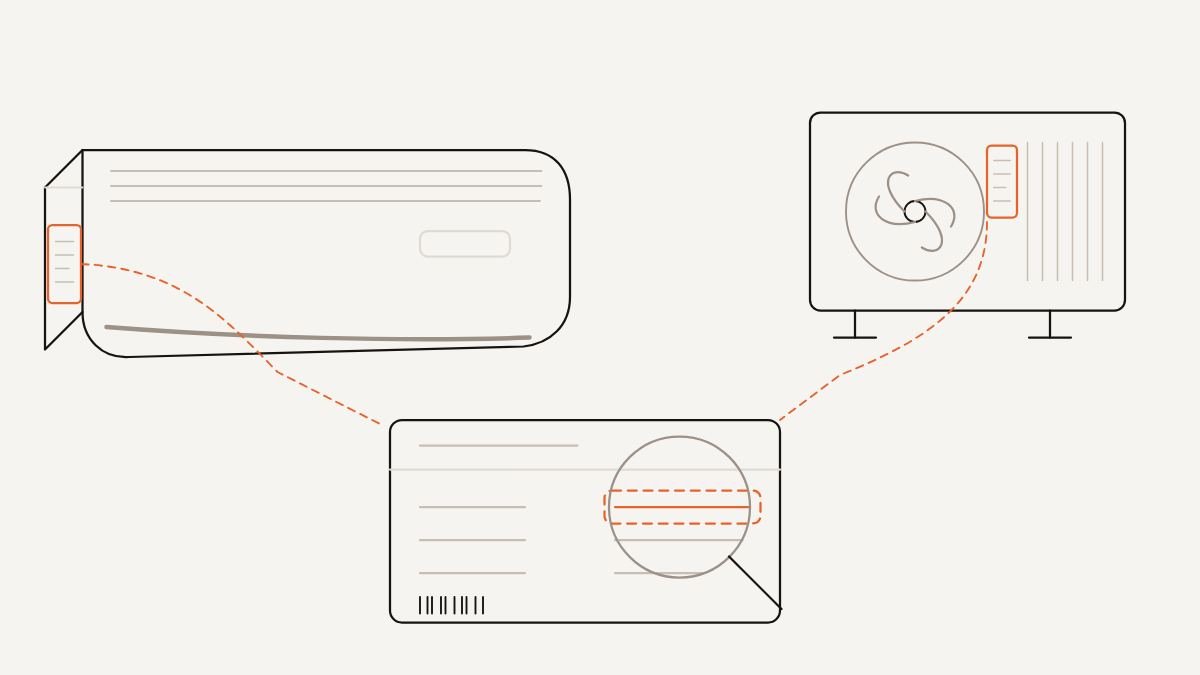
The indoor label usually sits behind the front panel or along one side of the case. Outdoors, that label sits on the casing of the condenser, near the pipe connections.
Anyone searching Kelvinator ksv70hra specs should start there rather than with a generic listing. The label carries the model, the serial, the refrigerant type and the electrical data.
Record the details below and keep them somewhere you can find them quickly.
Photograph both labels once and keep the images on your phone. Then every future call about a Kelvinator KSV80HRA or its indoor partner starts with facts rather than guesses.
If the label has faded beyond reading, do not guess. Our technicians can often recover the model from control board markings or from stamping on the outdoor chassis.
- Full model number, including any suffix such as P1 or E1.
- Serial number, which pins down your individual unit for parts lookup.
- Refrigerant type, printed near the pipe connections on the outdoor unit.
- Charge weight, stated on that same outdoor label alongside the refrigerant type.
- Supply voltage and the maximum current the unit draws.
- Indoor model paired with the outdoor model, since the two must match.
Talk it through with a technician
Tell us the model and what the unit is doing, and we will bring the right parts to the first visit.
Myth Four, Kelvinator KSV70HRA Error Codes Mean Major Repair
A flashing display frightens the owner of older equipment. Many assume the worst, and some replace a serviceable system because of a code that pointed at a cheap sensor.
Kelvinator KSV70HRA error codes describe a symptom the control board noticed, not a verdict on the whole machine. They narrow the search, and that is all they do.
Some codes report a protection event. The board saw a pressure, a current or a temperature outside its limits, so it stopped the compressor to protect it.
Other codes report a broken signal. A sensor has drifted out of range, or the indoor and outdoor boards have lost the conversation that keeps them in step.
Kelvinator KSV80HRA error codes behave the same way, since the series shares a control philosophy across capacities. Reader intent behind Kelvinator ksv80hra fault codes is identical.
What matters is the condition that triggered the message. A Kelvinator KSV70HRA P1 error codes search often ends at a blocked outdoor coil rather than a failed board.
The same applies to Kelvinator KSV80HRA P1 error codes and to any Kelvinator KSV70HRA E1 error codes lookup. Each one names a symptom, and the cause usually sits upstream.
Owners searching Kelvinator KSV HRA series error codes should therefore treat the code as a starting point. Then let a technician measure the conditions that produced it.
Myth Five, a Kelvinator KSV70HRA Reset Fixes the Fault
A reset clears the stored code and lets the system try again. On an older unit that can feel like a repair, because cooling returns for an hour or a day.
It is not a repair. A Kelvinator KSV70HRA reset removes the message, while the condition that produced the message usually remains exactly where it sat before.
Resets still have a place. They confirm whether a code came from a one off event, and they restore comfort while you wait for a booked visit.
Use them sparingly though. Repeated resetting on a protection fault forces the compressor to restart into the same bad conditions, and that shortens its remaining life.
A Kelvinator KSV80HRA reset follows the same rule. If the code returns within a day, stop resetting and let someone measure the system properly.
Myth Six, Filter Cleaning Only Affects the Air You Breathe
Owners think of filters as dust catchers for the lungs. That is true, yet on ageing equipment the filter matters far more for the machinery than for the air.
Airflow across the indoor coil sets the pressure the compressor sees. Choke that airflow and the coil runs colder, refrigerant returns cold and liquid, and the compressor suffers for it.
Kelvinator KSV70HRA filter cleaning therefore protects the most expensive part in the system. On a unit with many years behind it, that protection matters more than on a new one.
Clean the filters every few weeks through the cooling season. Rinse them in cool water, shake them out and let them dry fully before you refit them.
Filters are only half the job though. The coil behind them collects a felt of fine dust that no household rinse reaches, and only a proper service clears it.
Myth Seven, Weak Cooling Always Means the Gas Leaked Out
Refrigerant does not get used up. A sealed system holds its charge for the life of the unit unless a joint, a coil or a valve develops a leak.
So a Kelvinator KSV70HRA not cooling well is not automatically low on refrigerant. Airflow faults, dirty coils and tired capacitors produce that same complaint far more often.
A genuine leak leaves evidence behind. Oil traces at a flare joint, ice along the thin pipe and a low suction pressure all point in the same direction.
Topping up without finding the leak wastes the gas. The charge escapes again, the compressor runs hot in the meantime, and the underlying fault stays exactly where it started.
That same reasoning applies to a Kelvinator KSV80HRA not cooling on a hot afternoon. Our technicians measure the system before they add anything to it.
On older equipment we check the outdoor coil first. A coil packed with lawn clippings and road dust lifts head pressure, and that alone can flatten cooling capacity.
Myth Eight, the Remote and the App Are Cosmetic Extras
A tired remote causes genuine faults. Weak batteries send partial commands, and the indoor unit then behaves as though its settings changed on their own.
Before blaming the machine, test the Kelvinator KSV70HRA remote with fresh batteries. Point it close to the receiver window, then listen for the confirmation beep from the indoor unit.
Wifi raises a different question entirely. Owners approach the Kelvinator ksv70hra wifi setup expecting app control, yet not every unit of this generation carries a wireless module.
Check your own label and any documentation that came with the system. Where no module exists, no app will ever connect, however many times you repeat the pairing steps.
If a module does exist, pairing usually needs the slower home network band rather than the faster one. Our technicians can confirm what your particular variant supports.
Myth Nine, the Kelvinator KSV70HRA Manual Answers Everything
Manuals matter, and we tell every owner to keep one safe. Still, a Kelvinator KSV70HRA manual describes the unit as it left the factory, not as it stands today.
Older systems drift away from the document. Someone swapped a capacitor, added a drain pump, or fitted the nearest available outdoor fan motor during an earlier repair.
A Kelvinator KSV80HRA manual also stops short of real diagnosis. It lists codes and basic checks, yet it cannot say which of four possible causes applies in your home.
Variant suffixes complicate the hunt further. A Kelvinator KSV70HRA P1 manual and a Kelvinator KSV80HRA P1 manual may differ in wiring detail even where the casing looks identical.
The same caution applies to any Kelvinator KSV70HRA E1 manual found on a third party site. Check that the model on the cover matches the model on your label exactly.
If you cannot find a Kelvinator KSV HRA series manual anywhere, the rating label still carries what a technician needs. Documentation helps, although it is never the only route.
Myth Ten, Reviews Tell You Whether Yours Is Worth Keeping
Owners read a Kelvinator ksv hra series review hoping for a verdict. Reviews describe how a model behaved in other households, under other conditions, with other maintenance histories.
Your unit carries its own history. Installation quality, pipe run length, sun exposure and servicing habits shape its condition far more than any general reputation does.
So a Kelvinator KSV70HRA review cannot tell you whether your compressor is healthy. Only measurement can, and that takes about an hour with the right instruments.
Read reviews for patterns rather than verdicts. If a Kelvinator KSV80HRA review repeatedly mentions the same component, ask your technician to inspect that component specifically.
Reports of Kelvinator KSV HRA series problems work the same way. Treat recurring themes as a checklist, not as a prediction about your own installation.
What an Evidence Based Service Visit Actually Measures
Guesswork gets expensive on older equipment. So our technicians work from readings rather than impressions, and they record those readings for comparison at the next visit.
A visit starts on the electrical side. We check supply voltage under load, the running current of the compressor and the health of the start and run capacitors.
Then comes airflow. We measure the temperature difference across the indoor coil, which shows whether the air side or the refrigerant side limits performance today.
After that we look at pressures and superheat. Those figures separate a charge problem from a restriction, and they explain why a Kelvinator KSV70HRA not working case behaves as it does.
Drains and hygiene close the visit. We flush the condensate path, clean the blower wheel where access allows, and inspect the insulation along the pipe run.
A Kelvinator KSV80HRA not working at all gets one extra step. We confirm power at the isolator and at the terminal block before opening anything further inside the cabinet.
Practical Steps That Extend the Life of the KSV HRA Series
Small habits matter more than heroic repairs at this stage. The order below suits an older system, because it deals with the cheap causes before the expensive ones.
None of those steps needs tools or training. Together though they remove most of the conditions that produce protection codes on an ageing split system.
- Clean the indoor filters every few weeks during heavy use, rinsing them in cool water only.
- Clear at least half a metre of open space around the outdoor unit on every side.
- Switch the power off at the isolator before any water goes near the outdoor cabinet.
- Hose loose debris off the outdoor fins gently, always working along the direction of the fins.
- Watch the drain outlet after a long cooling run, because a steady drip means the path stays clear.
- Listen for new sounds at startup, since a change in noise often arrives before a fault code does.
- Replace the remote batteries once a year so that partial commands never mimic a control fault.
- Book a full service annually, ideally before the first hot spell rather than during it.
- Record the model, the serial and the date of every visit together in one place.
What Shapes the Cost of a Kelvinator KSV70HRA P1 Repair
We never quote before seeing the unit, because one symptom carries many causes. Instead we explain what moves the number up or down.
Parts availability leads that list. A legacy series sometimes needs a sourced board or a substitute fan motor, and that changes both the wait and the labour involved.
Access matters next. A high wall head above a stairwell, or an outdoor unit on a roof, adds time to every task on the job sheet.
Then comes the depth of the fault. A capacitor swap sits at one end of the range, while a sealed system repair with recovery and recharge sits at the other.
Anyone weighing a Kelvinator KSV70HRA price against replacement should count the remaining life too. Our guide to what shapes a repair price sets out these factors in more detail.
Owners often fear the worst about a Kelvinator KSV70HRA P1 service call. In practice a Kelvinator KSV70HRA P1 repair only turns major once the sealed system fails.
The same holds for a Kelvinator KSV80HRA P1 repair. Diagnosis comes first, then a clear recommendation, and only then a decision about repair or replacement.
When Replacement Starts to Make More Sense
Sometimes the honest answer is a new system. We say so plainly, because stringing out a failing unit rarely serves the household well.
Three signals usually appear together. A sealed system failure, a scarce control board and rising power bills each carry weight on their own.
Corrosion adds a fourth signal. Coastal installations lose fin material steadily, and once the fins crumble under a fingernail, capacity will not return with cleaning.
Where We Work and How This Series Compares
Our technicians service Kelvinator split systems in homes right across Australian suburbs. We work on legacy equipment as readily as on current models, since the diagnostic method carries over.
Owners often ask how this series sits beside its neighbours. The later KSV HRE inverter range uses different control behaviour, so its fault patterns and service notes differ noticeably.
Further back again, the older KWH CRE box units follow simpler wiring and simpler failures. Their repairs turn on mechanical wear rather than board communication.
Through wall equipment differs again. The KWH HRF window and wall range lives in a single cabinet, so its access and drainage habits share little with a split system.
If your unit belongs to one of those families, read the matching guide first. Then book a service whenever you want a technician to measure rather than guess.
Common Questions About the Kelvinator KSV HRA Series
What do Kelvinator KSV70HRA error codes actually tell a technician?
They name the symptom the control board noticed, such as a protection event or a lost sensor signal. However they never name the cause. So the technician uses the code to choose which measurements to take first.
Why is my Kelvinator KSV70HRA not cooling on hot afternoons?
Heat load peaks exactly when the outdoor coil rejects heat least well. Blocked fins, a tired capacitor or restricted indoor airflow all show up first in the afternoon. Therefore start with cleaning and airflow before you consider refrigerant.
How do I perform a Kelvinator KSV70HRA reset safely?
Switch the unit off at the remote, then turn off the circuit breaker or isolator that feeds it. Wait a few minutes, restore power and start it again. If the same code returns quickly, stop resetting and book a diagnosis.
Where do I find a Kelvinator KSV80HRA manual for my exact unit?
Match the full model string on your rating label, suffix included, before downloading anything. A Kelvinator KSV80HRA manual written for another variant can list wiring that does not match yours. When in doubt, send us a photograph of the label instead.
Is a Kelvinator KSV70HRA P1 repair worth doing on an old system?
It depends on what the code turned out to mean. A blocked coil or a failed capacitor is usually well worth fixing. By contrast, a sealed system failure on a long serving unit deserves a replacement comparison first.
What should I check first when a Kelvinator KSV80HRA is not working?
Check power at the switchboard, then confirm the isolator near the outdoor unit sits in the on position. Next fit fresh remote batteries and try one simple command. If nothing responds at all, the fault sits inside the unit.
How often does the KSV HRA series need filter cleaning?
Every few weeks in heavy cooling weather, and at least at the start and end of each season. Homes with pets or nearby roadworks need it more often. In addition the indoor coil needs a professional clean roughly once a year.
Can I add wifi control to a Kelvinator KSV70HRA?
Only where your particular variant supports a module, which the label and the documentation will confirm. Questions about Kelvinator ksv70hra wifi setup often assume a feature the unit never carried. Where no module exists, a smart infrared controller gives you the simpler path.
Keeping an Ageing Kelvinator KSV70HRA Worth Running
Most of what owners believe about this series comes from what they have read rather than from measurement. Once you separate label suffixes from display codes, the picture gets a great deal clearer.
Maintenance on older equipment does something quite specific. It keeps airflow, pressures and electrical loads inside the range the surviving parts can tolerate, and that buys years.
So the honest answer to the opening question is conditional. A well maintained unit of this age often deserves repair, while a badly neglected one often does not.
If you want that answer for your own system, our team can measure it rather than guess. Get in touch when you are ready, and have a photograph of your rating label handy.
Browse the site
Book a technician
Speak to a qualified technician who works on Kelvinator systems
Call 1300 495 033 and tell us the model and the fault, or book online and we will come back to you.